AsiaTechDaily – Asia's Leading Tech and Startup Media Platform

When AI Knows More About Products, Brands Will Have to Prove More
 by
Byungho Lim
by
Byungho Lim

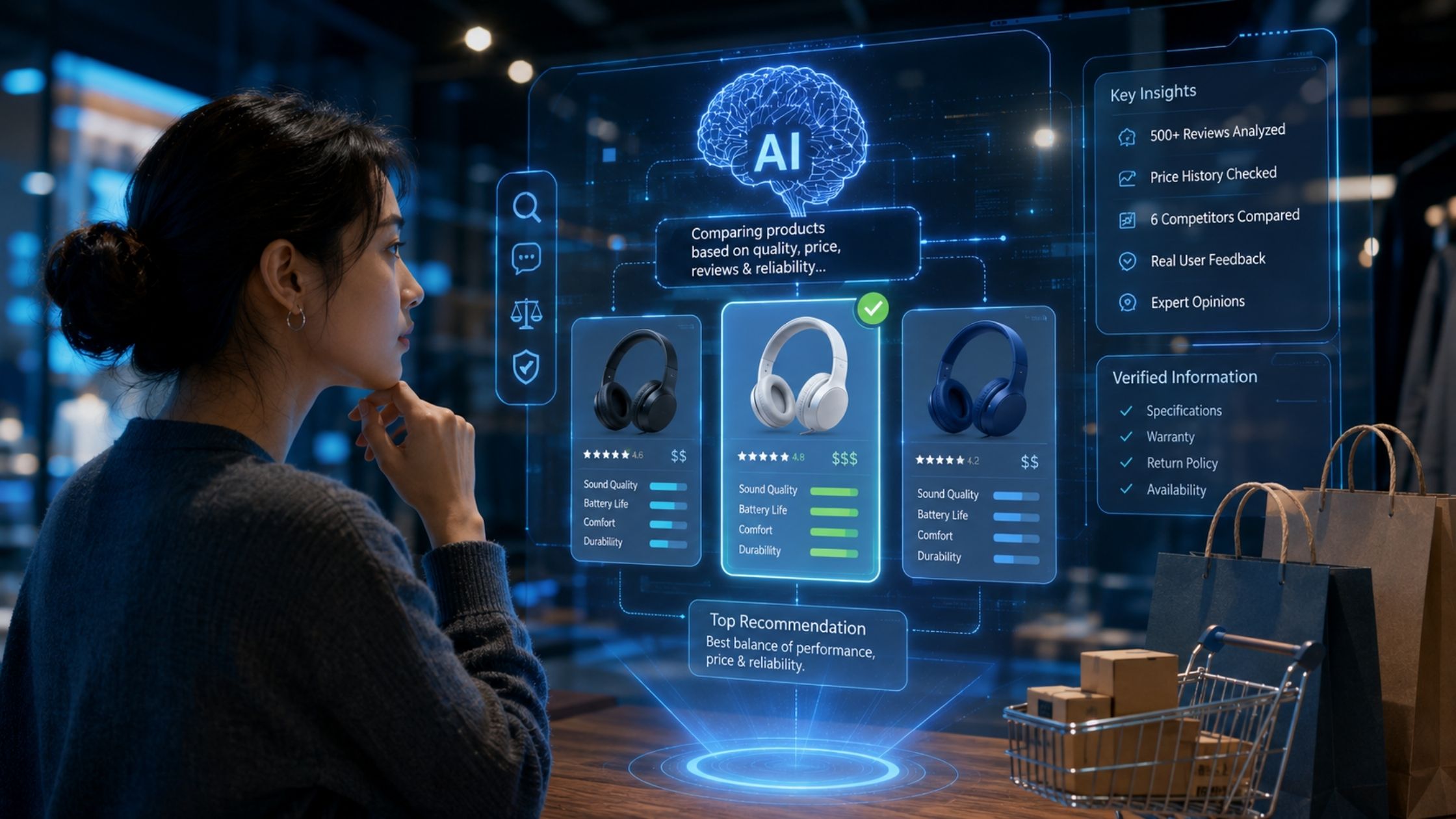
As AI moves from search and discovery into product comparison, brands face a new challenge: making their products understandable, comparable and credible to both consumers and the systems increasingly influencing their purchase decisions.
The way consumers discover products is changing faster than the way many brands present them. Nearly three-quarters of shoppers now use AI for product discovery, according to a global study released by NIQ and World Data Lab in August 2026. In Asia Pacific, the shift is particularly pronounced. Deloitte estimates that almost three-quarters of consumers in the region already use AI to discover, compare or learn about products, while 29% of consumer businesses have adopted agentic AI, a figure expected to reach 76% within two years.
The significance is not that consumers are suddenly handing all purchasing decisions to AI. Fully autonomous shopping remains limited. NIQ found that only 5% of consumers surveyed had used fully autonomous AI agents to place orders, while 17% had used AI for product recommendations. The more consequential change is happening earlier in the journey. AI is increasingly helping consumers decide what products are worth considering in the first place.
That puts pressure on a familiar source of competitive advantage: the ability of brands to control how their products are presented. When an AI system can compare specifications, prices, reviews, use cases and alternatives before making a recommendation, marketing claims increasingly have to withstand external scrutiny. For brands, the challenge may therefore shift from simply being visible to being verifiable.
AI is becoming a new layer of product comparison
Traditional digital commerce gave consumers access to far more information than physical retail, but comparison still required considerable effort. A shopper might visit several websites, read reviews, compare specifications and search for better prices before deciding. AI compresses much of that process into a conversation. Consumers can now describe a need rather than a product and ask an AI system to identify suitable options. Instead of searching for a particular brand, they can ask which laptop is suitable for a particular workload, which skincare product matches a set of ingredients or which appliance offers the best balance of price and energy efficiency.
Deloitte’s research suggests this is particularly relevant in Asia Pacific, where nine in 10 retail executives surveyed expect AI to be used more than traditional search engines by 2026. At the same time, two-thirds do not expect consumers to fully embrace agents purchasing on their behalf before 2028. Search, comparison and AI-powered recommendations are therefore likely to become important well before fully autonomous commerce does. This distinction matters for brands. The critical battle may not be taking place at checkout. It may be happening when an AI system decides which three or five products a consumer should consider.
The digital shelf is becoming an AI-mediated shelf
As AI takes over more discovery and comparison tasks, the traditional product page is acquiring another function. It is no longer only a destination for consumers. It is increasingly a source of information that machines must interpret. Deloitte’s research describes a future in which agentic commerce changes how brands compete and highlights the importance of strong data, technology, governance and trust foundations.
This creates a new problem for companies with fragmented product information. A product may have an attractive marketing campaign, but if its specifications are inconsistent across channels, pricing is outdated, availability is unclear or important product attributes are missing, an AI system may struggle to represent it accurately.
The implication is significant. Product data is becoming part of marketing infrastructure. A brand’s competitive position could increasingly depend on whether AI systems can understand what the product is, who it is for, how it compares with alternatives and whether the claims surrounding it can be supported. This is different from conventional search engine optimization. The objective is not simply to appear near the top of a list of results. The product has to be sufficiently understood by the system generating the recommendation.
Better-informed consumers can make weak differentiation more visible
AI also changes the information balance between brands and consumers. Historically, brands have had considerable control over the information presented at the point of purchase. They decide which features to emphasize, how products are positioned and which comparisons are made. AI weakens that control. A consumer can ask an AI system to compare a brand’s claims against competing products, summarize customer complaints, identify cheaper alternatives or explain whether a premium price is justified. That means statements such as “premium,” “best value” or “advanced technology” increasingly exist alongside a much broader set of information. The result could be greater pressure on brands to demonstrate rather than simply communicate value.
Sunay Kumat, an angel investor, made this point while conversing with AsiaTechDaily, arguing that the same technology that can make customer acquisition more efficient can also make consumers more difficult to persuade:
“AI may reduce customer-acquisition costs for brands, but it will also make consumers more informed and harder to convince, so brands will have to win on trust, value and product experience.”
The argument is important because it reframes AI-driven commerce. If every brand can eventually access similar AI tools for targeting, personalization and content generation, those capabilities may become table stakes. The more durable advantage could lie in the underlying product and the evidence supporting its value.
Trust becomes more important as AI enters the decision process
The growth of AI-assisted shopping does not mean consumers automatically trust AI recommendations. NIQ’s research found that AI-assisted decision-making is becoming mainstream, but fully autonomous purchasing remains at an early stage. McKinsey’s latest Asia Pacific consumer research similarly found that consumers are primarily using generative AI at the earliest stages of the purchase journey, particularly to learn about products and compare options.
This creates an interesting division of labor. AI can help consumers process information faster, but consumers still need reasons to trust the information being processed. Reviews, expert opinions, product experience and brand reputation remain important because an AI recommendation is only as useful as the information and signals behind it. That creates a potential trust problem for both sides. Consumers have to assess whether an AI-generated recommendation is accurate. Brands have to ensure that the information available to AI systems accurately represents their products. The burden of proof therefore moves in both directions.
Asia Pacific is becoming an important test market
The implications are particularly relevant to Asia Pacific because the region combines rapid digital commerce adoption with highly fragmented consumer markets. Deloitte expects Asia Pacific to generate around two-thirds of the world’s new retail sales over the next five years, supported by more than 4.3 billion consumers. The region is also developing quickly across mobile commerce, social commerce, marketplaces and AI-enabled shopping. India illustrates the pace of adoption. A recent NIQ Insight Summit India study reported that 92% of surveyed urban Indian shoppers had used at least one AI tool during shopping in the previous month.
But rapid adoption does not eliminate the complexity of the market. Asian consumers often move between marketplaces, social platforms, creators, search engines, messaging platforms and physical stores during a single purchase journey. AI is being added to that ecosystem rather than replacing it. For brands operating across Asia, this makes consistency increasingly important. Product information must remain accurate across marketplaces and direct channels, while the claims made through advertising and social media need to align with what consumers find elsewhere. In an AI-mediated environment, inconsistencies that previously required several searches to uncover could become visible through a single prompt.
Brands also face a new distribution dilemma
AI can potentially make products easier to discover, but it may also weaken the direct relationship between brands and customers. Reuters reported in August that retailers including Walmart, Ulta Beauty and Wayfair are working to appear more prominently in AI shopping recommendations while simultaneously trying to keep transactions on their own websites. The reason is straightforward: retailers want the additional traffic generated by AI platforms, but they also want to retain customer data and relationships that can support future sales and loyalty.
The issue goes beyond customer acquisition. If AI increasingly becomes the intermediary through which consumers discover products, brands may have to compete for AI-mediated visibility while still protecting their direct customer relationships. That could create a new layer of competition alongside traditional search rankings, marketplace rankings and social visibility.
The emerging commerce environment does not make branding irrelevant. It changes what branding has to accomplish. A strong campaign can still create awareness. Influencers can still generate interest. Search can still capture intent. But once a consumer asks an AI system to compare alternatives, the product has to withstand a more systematic evaluation. That makes several fundamentals increasingly important: accurate product information, transparent pricing, credible reviews, clear specifications, reliable availability and a product experience that matches the promise. The shift can therefore be summarized as a movement from persuasion to proof. AI may help a brand reach the right consumer more efficiently. It may also give that consumer better tools to question whether the brand deserves the purchase.
The product that survives the comparison may win
AI-driven commerce is still developing, and predictions about fully autonomous purchasing should be treated cautiously. Current evidence points to a more immediate transformation: AI is becoming a research, discovery and comparison layer between consumers and brands. That is already enough to change the competitive environment. Brands have traditionally invested heavily in controlling the story around their products. As AI becomes more capable of comparing that story with specifications, reviews, prices and competing alternatives, control becomes harder.
The companies best positioned for this shift may therefore not be those that simply produce the most content or spend the most on acquisition. They may be those whose products are easiest to understand, easiest to verify and strongest when compared against alternatives. When AI becomes the consumer’s researcher, being the loudest brand may matter less than being the product that survives the comparison.
Quick Takeaways
- AI is becoming a product comparison layer, helping consumers research, compare prices, evaluate features and narrow their choices before purchasing.
- The shift is happening before checkout. Fully autonomous purchasing remains limited, but AI is already influencing product discovery and consideration.
- Brand claims will face greater scrutiny. When AI can compare a product with competing options, broad claims such as “premium,” “best value” or “innovative” increasingly need supporting evidence.
- Product data is becoming marketing infrastructure. Accurate specifications, pricing, availability, reviews and product attributes can influence how AI systems understand and recommend products.
- AI may reduce information asymmetry between brands and consumers. Consumers can ask AI to identify alternatives, compare products and challenge whether a premium price is justified.
- Trust remains a critical constraint. Consumers are increasingly using AI for research, but current evidence shows they remain cautious about relying on AI alone for final purchasing decisions.
- Asia Pacific is an important testing ground. High digital-commerce adoption, mobile-first consumers, marketplaces and social commerce create a fragmented environment in which AI is becoming another discovery layer.
- Brands face a new distribution dilemma. AI can send high-intent shoppers toward products, but brands and retailers also want to retain direct customer relationships and first-party data.
- The competitive advantage could shift from persuasion to proof. As AI makes comparison easier, product quality, transparent information, credible reviews, value and customer experience become harder for brands to substitute with marketing alone.
- The central takeaway: AI may make consumers easier to reach, but harder to convince. Brands increasingly need products and evidence strong enough to survive an AI-assisted comparison.
Similar Articles