AsiaTechDaily – Asia's Leading Tech and Startup Media Platform

CITIC Securities: Time to Rethink How Ant Group Is Valued
 by
by

The report argues that AI has become the core variable for understanding Ant Group — and that the old fintech valuation playbook may no longer capture its value.
For most of the past five years, the conversation around Ant Group has been shaped by a single event: the $315 billion IPO that wasn’t. Regulatory restructuring, a $1 billion fine, and a valuation that cratered from over $300 billion to roughly $79 billion defined the narrative. But a new research report from CITIC Securities — “Ant Group Series Report (I): Emergent Intelligence, Value Reborn” — released September 23, argues that the market may be looking at the wrong story.

The report’s central thesis: AI has become the core variable for understanding Ant Group’s value. As AI shifts from information generation to task execution and service delivery — from chatbots that answer questions to agents that complete transactions — the companies best positioned are not necessarily those with the largest models. They are those that already own the data, the services, and the transaction rails that agents need to operate in the real economy. Ant, the report argues, falls into this category. Ant Ling, Ant’s self-developed foundation-model family, provides the model capability supporting both consumer applications and enterprise agents, forming the technological base of the group’s AI layout.
“Ant’s value structure is expanding from fintech to encompass AI, a globalization network, and technology assets,” the report states. The implication is significant: the old playbook for valuing Ant — anchored to payments volume, lending margins, and regulatory risk — may no longer capture the company’s evolving structure.
AI-Native Services Open New Growth Frontiers
Payments, wealth management, insurance, and credit remain Ant’s operational bedrock. But AI is changing the growth logic across all four verticals. The emphasis is shifting from user acquisition and transaction volume toward service frequency, depth of engagement, and professional supply efficiency.
The distinction matters because it reframes what Ant’s existing assets are worth. The payment & life services Alipay open platform serves more than one billion users, personal investment platform Ant Fortune over 800 million, online insurance marketplace Ant Insurance over 600 million, and consumer credit service Huabei over 400 million — scale that is valuable in its own right. But in an agent-driven economy, these platforms become something more: the training ground, distribution channel, and trust infrastructure that AI services need to reach scale.

Two AI-native products illustrate how this is playing out. AQ, Ant Group’s AI health app, has reached 150 million users and, according to figures the company released at the Inclusion Conference on the Bund, handles nearly 20 million daily health consultations as of September 2026. It connects more than 5,000 hospitals and 300,000 licensed physicians in China, built on a proprietary medical large language model that embeds clinical corpora, medical evaluation frameworks, and human-AI collaboration protocols. CITIC Securities notes that the goal is not to replace doctors but to lower the barrier for ordinary users to understand health information, articulate symptoms, and connect with professional medical services. Alipay already had the payment rails, the real-name identity verification, and the user trust. AQ layers medical AI on top of that foundation, opening a market that extends well beyond payments and fintech.

Ah Bao, Alipay’s AI assistant, is doing something similar on the commerce side. Instead of navigating function menus, users express intent in natural language; the platform interprets the goal, matches services, and delivers task outcomes. CITIC Securities describes this as a shift from “users searching for functions” to “the platform understanding purpose,” and from “providing a list of services” to “delivering completed tasks.” The significance is not that Alipay is adding a chatbot. It is that the entire service architecture of the super-app is being rewired around agentic interaction.
AI Pay: The Infrastructure Play for Agentic Commerce
Perhaps the report’s most forward-looking argument concerns AI Pay — Ant’s payment infrastructure for agent-driven transactions. As AI moves from information retrieval to task execution, the initiator of a transaction is no longer always a human. Every conversation, every decision, every connected device can become a transaction origin point. In this world, payment ceases to be merely the endpoint of a commercial flow and becomes the connective tissue between intent and fulfillment.
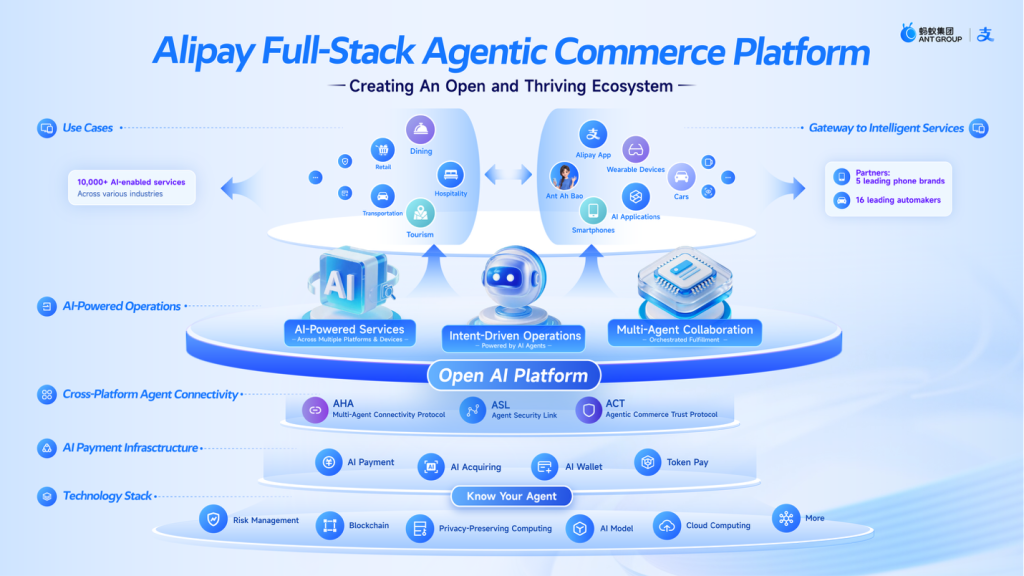
CITIC Securities positions AI Pay as the “trusted commitment” engine of agentic commerce — connecting needs identified by agents to authorization, transaction, and fulfillment. Alipay has extended its mature account, acquiring, risk-control, and post-payment services to agent transactions, with AI Pay, AI Wallet, and protocols such as ACT, AHA, and ASL completing the authorization, collaboration, and trust mechanisms. The numbers are already material. Alipay’s AI Pay has processed 300 million agent-driven transactions as of May 2026 and, according to Alipay’s open platform, serves more than 100 million users across 12 major commercial scenarios.
The competitive logic is worth examining. Ant’s advantage in agentic commerce is not that it has the best AI models. It is that it has spent two decades building the payment processing, merchant relationships, and trust infrastructure that agents need to complete real transactions. A competitor can build a conversational AI. What is harder to replicate, the report suggests, is the ability to settle a payment across 150 million merchants in real time.
Technology Assets Go to Market
The report also highlights three technology businesses that are moving from internal capability to external revenue — and, increasingly, to independent market validation.
OceanBase, the distributed database now benchmarked against Databricks, serves over 4,000 global customers and is evolving from a transactional database into an AI data platform that provides agents with real-time, unified, and trustworthy business context. Ant Digital Technologies, with its Agentar 2.0 enterprise agent development and operations platform, already serves more than 30,000 enterprises worldwide. According to IDC, it ranked first in China’s financial large model and agent application market share in 2025. And Robbyant, Ant’s embodied intelligence unit, is developing a cross-form-factor general-purpose robot brain that connects perception, prediction, and action — extending intelligence from digital systems into the physical world.
These are not side projects. In July 2026, Ant International completed approximately $1.2 billion in Series A financing. OceanBase, Ant Digital Technologies, and Robbyant are said to have each entered their own funding windows. CITIC Securities argues these businesses should be independently assessed as, respectively, a global payments network, an AI data platform, an enterprise agent service provider, and an embodied intelligence foundation.
Globalization as a Multiplier
Globalization functions as a multiplier across all of these businesses. Ant International has evolved from a cross-border payments operation into a full-stack provider covering payments, accounts, foreign exchange, treasury, and fintech services. Its four core brands — Alipay+, Antom, WorldFirst, and Bettr — form this end-to-end capability system. Alipay+ now connects more than 50 international e-wallets and banking apps, covering over 2 billion user accounts and 150 million merchants. WorldFirst extends the offering into business accounts and treasury management for SMEs.
Meanwhile, OceanBase and Ant Digital Technologies are accelerating overseas expansion, taking database, mobile development, digital identity, and enterprise agent capabilities into global markets.
A New Valuation Framework
The report’s most provocative contribution may be its call for a new valuation architecture. CITIC Securities argues that Ant’s valuation should no longer be anchored to a mature fintech multiple. It must now account for the profitability and efficiency gains of the core business, the growth trajectory of AI-native services, the market-discovered value of independent entities, and an organizational premium for the capacity to keep incubating new assets.
“What external capital is validating,” the report concludes, “is not just the standalone value of a few companies, but Ant’s ability to continuously convert real-world scenarios, technology accumulation, and organizational resources into new assets.” The path — group incubation, independent operation, market validation — is forming a closed loop.
The broader significance of the CITIC Securities report is that it attempts to solve a problem that has hung over Ant Group since 2020: how do you value a company whose most important assets are no longer the ones that got regulated? The answer, the report suggests, is to stop looking at Ant as a fintech company that dabbles in AI, and start looking at it as an AI-native platform whose fintech roots gave it an early foothold in the agent economy.
Similar Articles