AsiaTechDaily – Asia's Leading Tech and Startup Media Platform

Holiday Robotics Raises ₩155B Series A to Accelerate Humanoid Robot Commercialization
 by
by

Korean startup plans to deploy its manufacturing-focused FRIDAY robot this year and reach annual production of 1,000 units by 2027
South Korean humanoid robotics startup Holiday Robotics has raised ₩155 billion (about US$105 million) in Series A funding as it prepares to commercialize its manufacturing-focused humanoid robot, FRIDAY. The company said the round, which closed July 10, is the largest Series A funding round for a Korean startup and the largest single-round investment for a domestic humanoid robotics specialist.
The funding comes as humanoid robotics shifts from technology demonstrations toward commercial deployment, with companies increasingly being challenged to prove that robots can perform useful industrial work reliably and at a viable cost. Holiday Robotics plans to commercialize FRIDAY in the second half of 2026, initially targeting repetitive tasks in manufacturing, automotive, semiconductor and logistics environments.
The round included existing investors Stonebridge Ventures, Atinum Investment, Intervest and SpringCamp, along with new investors including IMM Investment, SL Investment, KB Investment, BonAngels Venture Partners, Premier Partners, Ulmus Investment, SJ Investment Partners, Daseong Ventures, Atinum Capital Partners and Goodwater Capital. The Korea Development Bank (KDB) and Industrial Bank of Korea (IBK) also participated.
From humanoid demonstrations to commercialization
Holiday Robotics is positioning the new funding as capital for commercialization rather than simply another stage of product development. While conversing with AsiaTechDaily, a Holiday Robotics spokesperson said the company believes humanoid robotics faces the risk of remaining in the demonstration phase for too long, pointing to autonomous driving and other emerging technologies where technically capable companies struggled to survive lengthy commercialization cycles.
“We have already seen what happens when an industry stays in the demo stage for too long. Over the past decade, in autonomous driving and several other fields, companies with genuinely excellent technology disappeared. They had something in common. There was no clear path to commercialization, the work depended heavily on regulation, and the development timeline was simply too long. Investor and market fatigue set in, the industry froze, and the capital ran out before the technology arrived. We believe humanoids face the same risk. For us, commercialization is less a strategy than a matter of survival.
“So we set a different goal from day one. Not to build the most impressive robot, but to commercialize quickly and safely in industrial manufacturing environments. That means designing a robot that generates ROI immediately and can be deployed fast.”
That approach reflects a wider challenge for humanoid robotics. While recent advances in AI and robotics have produced increasingly capable machines, commercial success depends on more than demonstrations. Robots must operate for extended periods, recover from failures, work safely around people and equipment, and generate enough economic value to justify deployment.
Why manufacturing comes first
Holiday is focusing on manufacturing before expanding into service and home robotics. The company argues that factories offer conditions better suited to the current capabilities of humanoid technology: controlled environments, repetitive tasks and relatively measurable returns on automation. Holiday is already conducting confidential proof-of-concept trials with major domestic and international companies in automotive, semiconductor and logistics applications.
The spokesperson told AsiaTechDaily that manufacturing provides a clearer starting point than consumer environments, where conditions are less predictable and robots interact more directly with people.
“We chose manufacturing because it is where the conditions for that goal actually exist at today’s level of technology. The environment can be controlled, the tasks are highly repetitive, and the ROI calculation is relatively clear. It also matters for safety that the robot works among machines and equipment rather than in close contact with people all day. In service and home environments, every one of those conditions is reversed.”
The strategy also places Holiday in a growing industrial humanoid market. Companies globally are increasingly targeting factories and warehouses as early deployment environments because existing workflows can provide clearer performance and economic benchmarks than general-purpose consumer applications.
Addressing the limitations of conventional automation
Holiday’s argument for humanoids is not simply that they can perform repetitive tasks. The company believes their human-shaped form can provide flexibility in factories that were originally designed around human workers. Conventional industrial automation can be highly effective when production conditions remain stable, but changes to products, processes or production lines can require equipment to be reconfigured.
“Customers do not rebuild their factories for a robot. And those factories were already built around the human body. That is what makes a human-shaped robot a reasonable form.
“Sites also keep changing. Products change, processes change, lines get rearranged. Conventional automation works well when the conditions are fixed, but if the equipment has to be reconfigured every time something changes, it cannot keep pace with that change. Taking over repetitive human work is closer to a baseline assumption; the problem we are actually solving is how quickly, how precisely, and how safely a robot can get back to work after something changes.”
The argument is particularly relevant as manufacturers increasingly need flexibility across production lines. However, a humanoid still needs to demonstrate that its flexibility creates enough value to compete with specialized automation that is already established in industrial environments.
FRIDAY and the company’s VLS approach
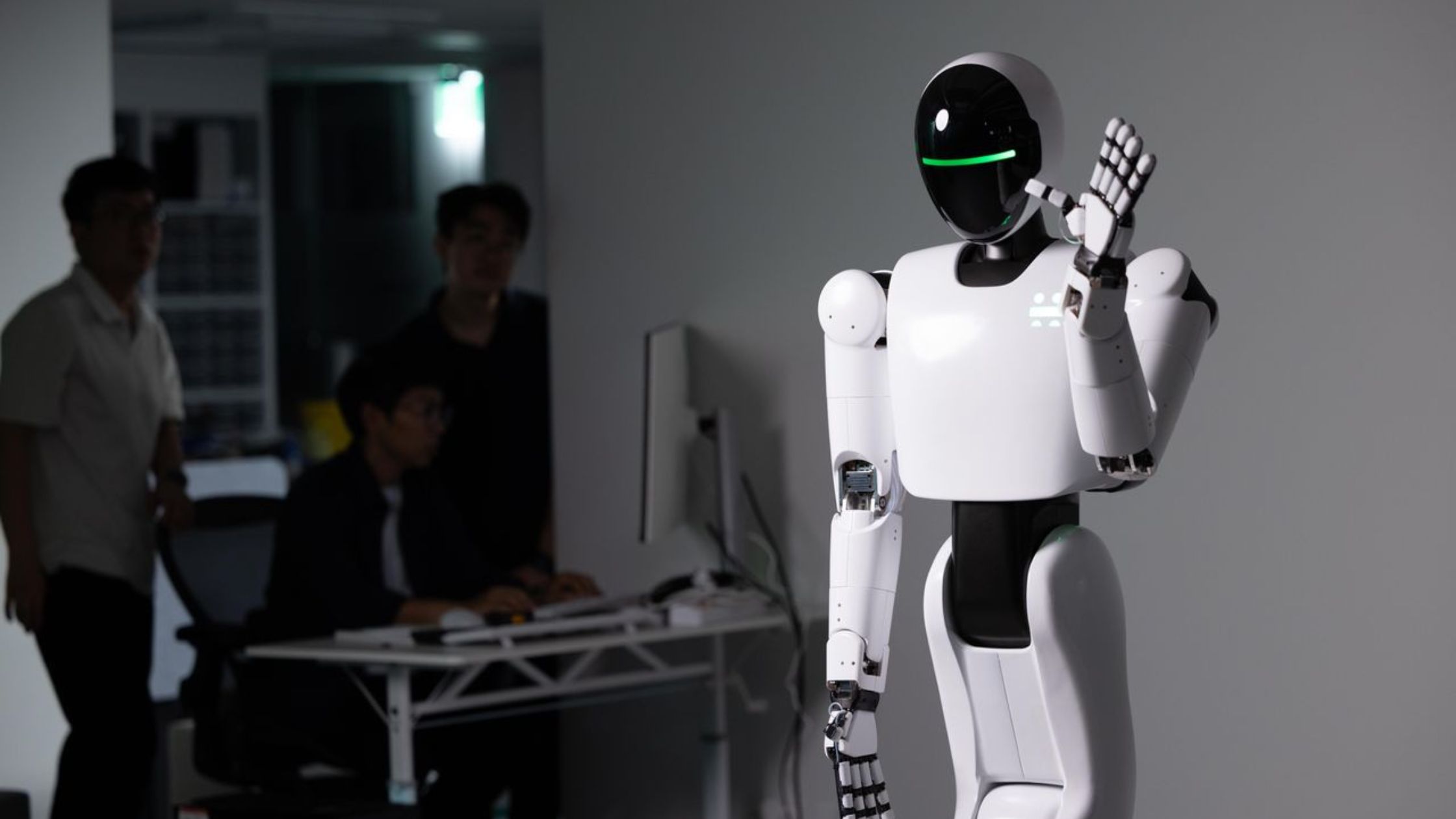
Holiday’s flagship robot, FRIDAY, is a wheeled humanoid or mobile manipulator designed for repetitive industrial work. The company’s current specifications list the robot at 176 cm tall, with 64 degrees of freedom, a 20 kg maximum payload and an average runtime of four hours. Holiday’s current product page lists its weight at 125 kg. Holiday Robotics product specifications
The company is also developing a Vision-Language-Skill (VLS) approach that breaks factory tasks into smaller capabilities such as grasping, screwing and moving. Those skills can then be combined to perform larger tasks.
Holiday says the approach is intended to make deployment faster and failures easier to diagnose.
“That is why we do not train the robot on entire tasks as a whole. We build and validate the smallest units that make up work on the floor, grasping, screwing, moving, as individual Skills, then compose them into a complete task. We call this structure VLS, for Vision-Language-Skill. When a new task comes in, it can usually be handled by recombining units that have already been validated, and when something goes wrong, we can tell which unit it went wrong in. The first is deployment speed and the second is safety, and together they are commercialization speed.”
Holiday has also been investing in robot-learning technology, with its research team receiving an Outstanding Paper Award at the Robotics: Science and Systems 2026 conference for work on FlashSAC.
Scaling from 100 to 10,000 robots
Holiday plans to commercialize FRIDAY in the second half of 2026, with an initial production capacity of 100 units annually in 2026 and 1,000 units annually by 2027.
The company eventually aims to establish manufacturing infrastructure capable of producing more than 10,000 robots per year. It also plans to reduce FRIDAY’s price to approximately ₩100 million through mass production and eventually expand from manufacturing into service and home robotics.
The Series A will fund upgrades to its mass-production system and expand its R&D workforce from around 50 people to more than 100. The company says its development and commercialization teams include researchers and industry experts with backgrounds at MIT, Seoul National University, KAIST and Samsung Electronics.
The real test begins with deployment
The ₩155 billion Series A gives Holiday Robotics the resources to move FRIDAY toward commercial production, but the more important test will be what happens after the funding announcement. The company will need to convert confidential PoCs into commercial deployments, achieve its production targets and demonstrate that a humanoid can deliver reliable performance and measurable ROI in real factories.
For Holiday, the strategy is clear: manufacturing first, commercialization before broader expansion, and flexibility as the key advantage over fixed automation. Whether that strategy works will depend on factors that cannot be demonstrated through a prototype alone: uptime, safety, adaptability, production cost and the economic value generated for customers. The funding gives Holiday the runway to answer those questions. The next milestone is not another humanoid demonstration, but proving that FRIDAY can become a dependable piece of industrial infrastructure.
Quick Takeaways
- Holiday Robotics raised ₩155 billion (about US$105 million) in Series A funding, which the company says is the largest Series A round for a Korean startup.
- The round also represents the largest single funding round for a Korean humanoid robotics specialist, according to the company.
- Holiday plans to commercialize its FRIDAY humanoid robot in the second half of 2026, starting with manufacturing applications.
- The company is conducting confidential PoC trials with automotive, semiconductor and logistics companies.
- Holiday will initially target 100 robots in annual production in 2026, scaling to 1,000 units by 2027, with a longer-term goal of more than 10,000 units annually.
- The company aims to eventually bring FRIDAY’s price down to approximately ₩100 million through mass production.
- Holiday’s Vision-Language-Skill (VLS) approach breaks industrial tasks into reusable skills such as grasping, screwing and moving, which it says can improve deployment speed and failure diagnosis.
- The startup is betting on manufacturing as the first viable market for humanoids, citing controlled environments, repetitive tasks and clearer ROI compared with service and home applications.
- Holiday argues that humanoids can address a flexibility gap in conventional automation because factories are designed around human workers and production environments frequently change.
- The Series A will fund mass-production upgrades and expansion of the R&D workforce from around 50 to more than 100 people.
- The funding comes as South Korea accelerates its broader physical AI and industrial humanoid strategy, creating a growing domestic market and ecosystem for robotics companies.
- The key question now is whether Holiday can turn FRIDAY from a promising prototype into a reliable, scalable and economically viable industrial robot.
Similar Articles