AsiaTechDaily – Asia's Leading Tech and Startup Media Platform

Fighting the “Harvest Now, Decrypt Later” Threat in Asia’s Fragmented 5G Landscape
 by
Byungho Lim
by
Byungho Lim

Why waiting for 6G is a luxury Asian telcos cannot afford, and how early movers are turning post-quantum readiness into a premium enterprise revenue stream.
The global race for quantum supremacy is rapidly compressing the cybersecurity timeline. Historically treated as a distant, theoretical concern for the next decade, the vulnerability of current cryptographic standards has become an active risk management challenge. With major industry players accelerating their deployment roadmaps, security frameworks now openly project full post-quantum migration goals before 2030.
For the telecommunications sector, this shift exposes a massive structural vulnerability. While next-generation 6G networks are being designed with quantum-safe protocols from inception, the commercial rollout of 6G is not anticipated to reach meaningful scale until well into the 2030s. This multiyear gap introduces a severe exposure window driven by a specific, immediate cyber threat: the “Harvest Now, Decrypt Later” paradigm.
The core mechanics of the Harvest Now, Decrypt Later (HNDL) threat undermine the traditional logic of defensive patching. Malicious actors and state-sponsored entities are currently intercepting, cloning, and storing massive volumes of highly encrypted network traffic moving across active 5G networks. While this data cannot be read using classical computational power, it is being archived with the explicit objective of decrypting it the moment cryptographically relevant quantum computers become commercially available.
This makes quantum vulnerability a contemporary risk rather than a future liability. The critical factor for data sovereignty is the shelf life of the information itself. While short-term consumer data loses commercial value quickly, high-assurance assets retain strategic importance for decades.
In a recent discussion with AsiaTechDaily regarding this shifting security landscape, Rahul Tandon, Senior Vice President at IDEMIA Secure Transactions, emphasized that operators cannot afford to tie their mitigation schedules to long-term network generations.
“The ‘Harvest Now, Decrypt Later’ risk means operators cannot tie the post-quantum timeline to the 6G rollout expected around 2030,” Tandon noted. “Encrypted data stolen today could be stored until quantum capabilities make it possible to decrypt them. While 6G will be quantum-safe by design, it faces its own challenges: standards are still ahead of us, adoption will take time, and it is unlikely to become the dominant mobile technology until well into the next decades. This timeline is too late for data and credentials that require protection now.”
The Crypto Agility Illusion in APAC Infrastructure
As global standardization bodies finalize Post-Quantum Cryptography (PQC) specifications, the telecom industry frequently cites “crypto agility”—the structural capability of a network to seamlessly swap cryptographic algorithms without disrupting underlying hardware—as the primary defense mechanism. However, an objective analysis of the Asia-Pacific network architecture reveals a deep divide between theoretical agility and operational reality.
The APAC region features a highly fragmented 5G landscape. Mature tech hubs are aggressively deploying dense 5G-Advanced networks, while major developing markets are concurrently focused on scaling baseline 5G physical infrastructure to hundreds of millions of new endpoints. This regional fragmentation complicates a unified security overhaul.
The challenge lies in the sheer volume of legacy physical components embedded within these networks. Transitioning a network to PQC involves updating or replacing massive installed bases of SIM cards, secure elements, remote provisioning systems, and long-life industrial IoT devices.
During his conversation with AsiaTechDaily, Tandon clarified the scope of this infrastructure friction, pointing out that true readiness remains concentrated among a tiny cohort of market leaders.
“Today, only a small minority of operators are genuinely prepared to transition cryptographic standards without major impact,” Tandon stated. “While some tier-one players are better positioned in software-based environments, most still depend on large installed bases of SIMs, secure elements, provisioning systems, and long-life IoT devices. As a result, crypto agility is a real objective, but not yet an operational reality for most of the industry. The transition will therefore be gradual, hybrid, and asset by asset.”
To address this challenge without triggering unsustainable capital expenditure cycles, the consensus among infrastructure specialists points toward a phased migration strategy. Operators are beginning to implement hybrid security models that overlay post-quantum mechanisms on top of existing classical encryption. This approach allows telcos to secure the most exposed data pathways and critical core interfaces immediately, bypassing the need for an immediate, total hardware overhaul.
Mapping the Commercialization Timeline
Rather than viewing the post-quantum transition strictly as a regulatory compliance burden, forward-looking operators are reframing PQC as a highly differentiated product offering. In an era where corporate data breaches carry severe financial and reputational penalties, sovereign data protection has become a premium asset. Early movers in the telecom space are packaging quantum-safe connectivity as a high-margin business-to-business (B2B) enterprise service.
The rollout and commercialization of quantum-safe hardware solutions, such as specialized 5G SIM cards, is projected to follow a distinct market maturation curve over the next decade.
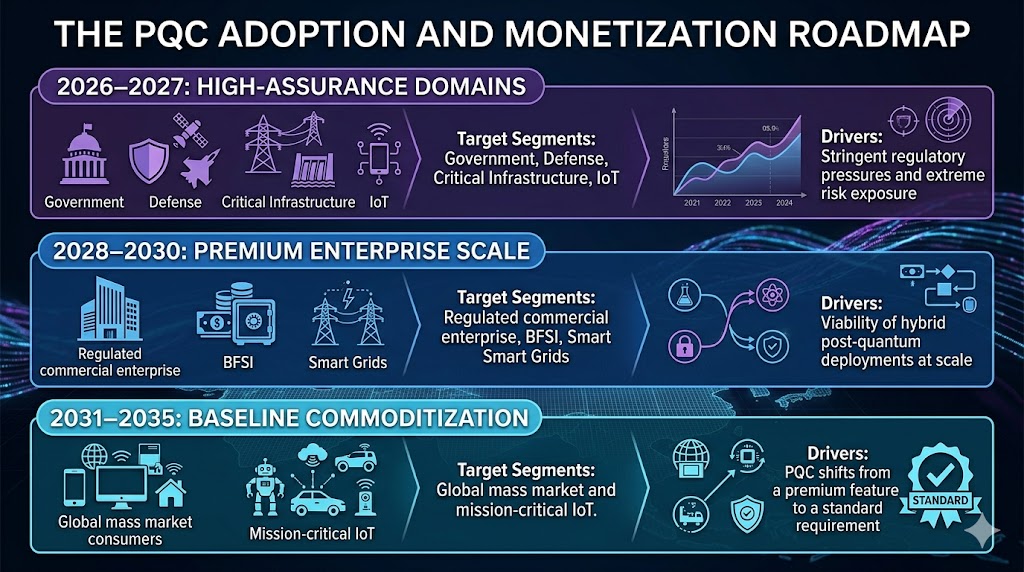
This structural timeline indicates that the next twenty-four months represent a critical window for capital allocation and product differentiation. By embedding post-quantum readiness into active 5G rollout cycles, operators can eliminate the need for costly future retrofits while securing lucrative long-term contracts with high-assurance clients.
“For mobile operators, this is not just about reducing risk,” Tandon explained during the interview. “It is also a chance to create differentiated offers for enterprises, governments, and critical IoT customers. In Asia, where many operators are still expanding 5G, private networks, and IoT, this is a real opportunity to embed post-quantum readiness during current rollout cycles instead of retrofitting later.”
Structural Resilience as the New Standard for Digital Trust
As telecom networks increasingly integrate AI-driven automation and expand edge-computing architectures, the traditional definition of perimeter security becomes obsolete. In a highly distributed network environment, data security can no longer rely on static defensive barriers. Achieving digital trust over the next five years will require organizations to demonstrate verifiable operational resilience. This means deploying independent, certified hardware foundations, such as next-generation Hardware Security Modules (HSMs), to isolate critical cryptographic keys. Furthermore, it demands the operational capacity to manage and update thousands of connected endpoints remotely via cloud-based eSIM provisioning.
Ultimately, the operators that successfully navigate Asia’s fragmented infrastructure to build flexible, crypto-agile frameworks will achieve a dual victory: insulated defense against the immediate HNDL threat, and a position of leadership in the multi-billion-dollar market for trusted enterprise connectivity. This presentation explores how leading technology providers are building hybrid compute frameworks to integrate quantum capabilities with classical systems, offering valuable context on the rapidly accelerating computational timelines that drive the need for immediate post-quantum cryptography.
Key Takeaways
- The “Harvest Now, Decrypt Later” threat is forcing telecom operators to address quantum security during the 5G era rather than waiting for 6G.
- Most telecom networks are not yet crypto-agile enough to transition to post-quantum cryptography without significant operational challenges.
- Legacy infrastructure, including SIM cards, secure elements, provisioning platforms, and long-life IoT devices, remains one of the biggest obstacles to migration.
- Asia’s ongoing 5G, private network, and IoT deployments create a unique opportunity to embed post-quantum security into current infrastructure rather than retrofit it later.
- Early adopters are beginning to view quantum-safe connectivity not only as a cybersecurity necessity but also as a premium enterprise service and new revenue opportunity.
Similar Articles