AsiaTechDaily – Asia's Leading Tech and Startup Media Platform

Agentic AI Is Everywhere, But Many Users Haven’t Changed How They Work
 by
by

As AI agents emerge as one of technology’s fastest-growing narratives, the bigger challenge may not be building smarter systems but changing the way people interact with them.
Artificial intelligence has entered a new phase of industry attention. Over the past year, the conversation has expanded beyond large language models and chatbots toward a newer concept that is increasingly dominating product announcements, venture funding, and technology roadmaps: agentic AI.
Technology giants including OpenAI, Google, Microsoft, Anthropic and startups across the ecosystem are increasingly positioning AI agents as the next evolution of computing. Market expectations are also reflecting that momentum. Analysts have projected that AI agents could become a multi-billion-dollar market over the next several years as enterprises and consumers shift toward systems capable of carrying out tasks autonomously rather than merely generating information.
Yet despite the growing enthusiasm surrounding agents, there may be an important disconnect emerging between where the technology is heading and how people continue to use it. Many users today still interact with AI through a familiar pattern. They ask questions, summarize information, draft emails, generate content, or treat AI systems as enhanced search engines. While the underlying technology is changing rapidly, user behavior may be evolving at a much slower pace.
Speaking with AsiaTechDaily during an exclusive interview, Animoca Brands co-founder and executive chairman Yat Siu argued that much of the market conversation around AI continues to overlook what could become one of the most significant shifts in computing.
“I think what a lot of people are missing in the AI conversation is essentially agentic AI. I don’t think they understand agents because they still are mostly in what I’d like to call ChatGPT mode,” Siu told AsiaTechDaily.
“They’re searching it, they’re using it basically like a better version of Google, but they’re not really making it work for you.”
The observation points toward a broader question surrounding AI adoption. If agentic systems are designed to operate autonomously and execute tasks, are users still approaching them with a mindset shaped by earlier internet experiences?
From information retrieval to delegated work
For decades, digital interaction has largely revolved around finding information. Search engines helped users locate websites. Smartphones placed information in people’s pockets. Social media platforms delivered personalized content streams. Even the first wave of generative AI largely followed a similar pattern by making information retrieval faster and more conversational.
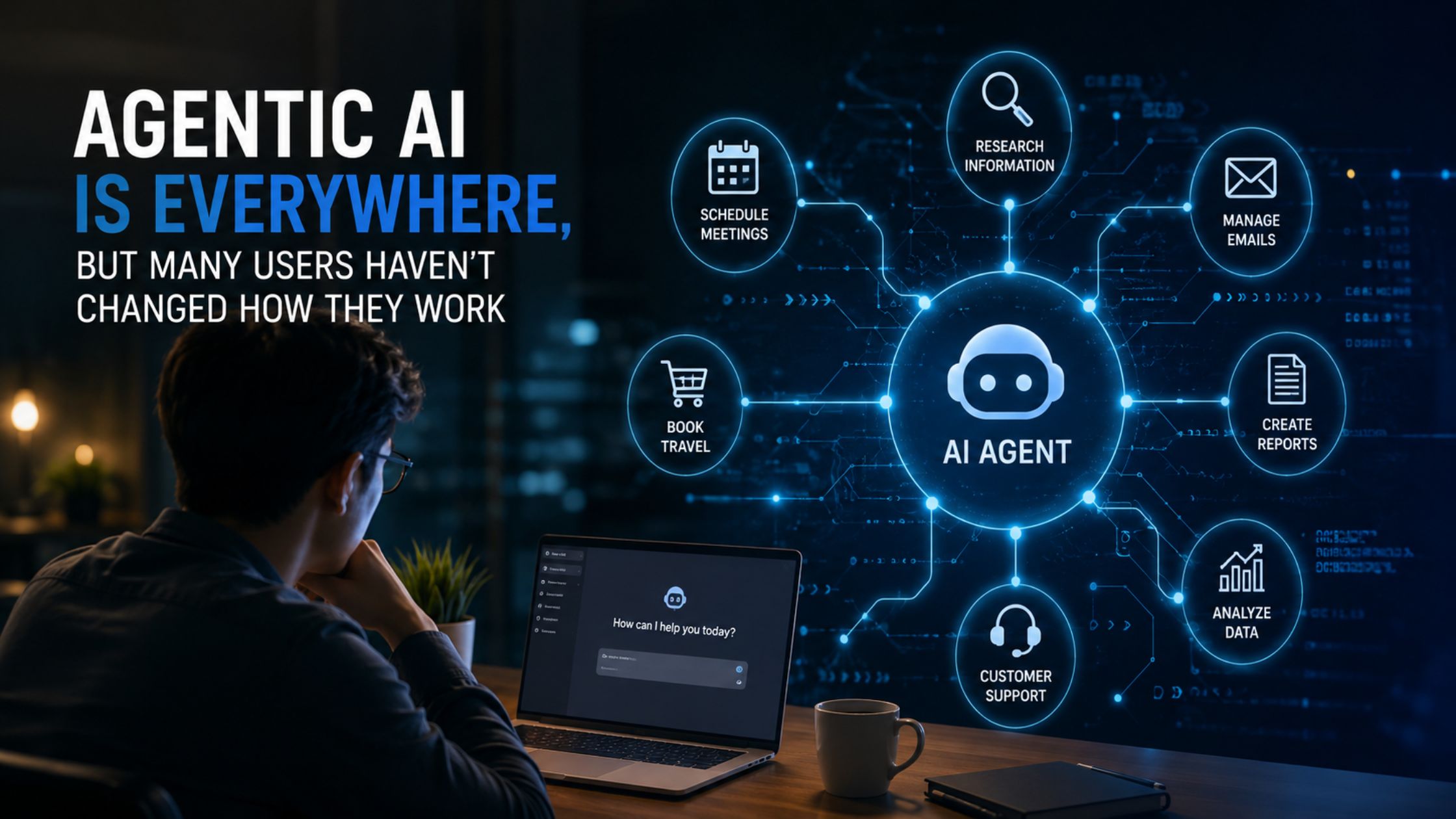
Agentic systems propose a different relationship. Rather than simply providing answers, agents are increasingly designed to carry out actions. This can include scheduling meetings, conducting research, managing workflows, finding customers, executing code, or coordinating activities across multiple applications.
The distinction may appear subtle, but it fundamentally changes the role of AI from an information interface into a productivity layer. Siu described this shift as moving from asking AI for support toward allowing AI to take ownership of tasks.
“Imagine a world where everyone can have a real assistant, not just checking your calendar, but someone who can do actions for you,” he said during his conversation with AsiaTechDaily.
He argues that the larger value lies in unlocking time. Historically, productivity gains often came through support structures. Businesses hired employees, executives relied on teams, and individuals with greater resources could delegate responsibilities to others. The ability to outsource tasks frequently translated into higher productivity.
AI agents, according to Siu, could reduce those barriers.
“People don’t see it because they use AI in a support function, give me the weather, the time, search. But imagine if the agent actually does work for you,” he said.
The implications could extend beyond individual productivity. If millions of users can recover several hours of work each week through automation, the cumulative impact could reshape how labor and digital work are structured.
The technology may be changing faster than user behavior
The gap between technological capability and user adoption is not a new phenomenon. Historically, people often adopt emerging technologies through familiar patterns before discovering their unique advantages. Early websites frequently replicated brochures and newspaper layouts before businesses began building digital-native experiences. Smartphones initially served as improved communication devices before evolving into platforms for ride-sharing, digital payments, and app ecosystems. Cloud computing similarly began as a hosting alternative before becoming a foundation for software development.
Artificial intelligence may be experiencing a comparable transition. Much of today’s AI interaction still revolves around prompts and isolated conversations. Users ask a question. AI responds. The interaction ends. The next interaction begins from scratch. This workflow may remain effective for information retrieval, but it introduces limitations when AI becomes expected to function as an ongoing assistant.
According to Siu, one of the critical differences between traditional AI interactions and agent-based systems lies in continuity and memory.
“Very quickly, one of the challenges with ChatGPT or Google search is it’s a single session with no long-term memory,” Siu told AsiaTechDaily.
He believes agents become more useful when they accumulate context over time.
“An agent has context, and more importantly, the context is mirrored.”
This distinction suggests that future AI systems may become less like tools that answer isolated requests and more like collaborators that understand individual preferences, workflows, and long-term objectives.
The future may involve many agents rather than one assistant
Popular discussions around AI often imagine a single universal assistant capable of managing every aspect of life. The reality may become considerably more fragmented. Siu compared future AI usage to internet browsing habits, suggesting that users may eventually interact with many specialized systems rather than a single all-purpose interface.
“One mental model I like to give people about AI agents is like visiting websites,” he said.
Under that scenario, users could interact with different agents built around specific functions:
- A legal agent that understands contracts and regulations
- A personal productivity assistant that manages schedules and tasks
- A coding agent optimized for software development
- Sales and business development agents focused on customer acquisition
Such specialization could help address one of the broader limitations associated with large language models, including context loss and generalized responses.
Rather than one system attempting to do everything, intelligence may increasingly become distributed across networks of purpose-built agents.
A behavioral challenge rather than a technological challenge
The conversation surrounding agentic AI frequently focuses on technological capabilities including reasoning, memory, orchestration, and infrastructure. However, the larger challenge may ultimately be behavioral.
The technology itself is advancing rapidly. AI systems are becoming increasingly capable of handling multi-step workflows and interacting across applications with minimal human involvement. What may take longer is changing how people think about AI itself.
For years, users have been conditioned to see digital systems as tools that respond when asked. Delegating meaningful work to autonomous systems requires a different level of trust and a different understanding of human-computer interaction.
That transition may not happen immediately. Yet if AI evolves from providing answers to performing actions, the shift could represent something larger than another software upgrade. The internet transformed access to information. Smartphones transformed access to services. Agentic AI may ultimately transform how work itself gets distributed.
The question may no longer be whether AI agents are coming. The technology industry already appears to have answered that. The larger question may be whether users are prepared to stop treating AI like search and start treating it like a collaborator.
Quick Takeaways
- Agentic AI may be advancing faster than user behavior: While AI agents have become one of the industry’s biggest narratives, many users still interact with AI as a smarter search engine rather than an autonomous assistant.
- The next shift may be from information to action: The real promise of AI agents lies not in generating answers, but in carrying out tasks such as scheduling, coding, research, and workflow management.
- AI productivity gains could reshape work patterns: Delegating repetitive or operational tasks to AI agents could unlock significant time savings for individuals and businesses.
- Persistent memory may become a key differentiator: Unlike isolated chatbot sessions, future AI agents are expected to build long-term context and understand user preferences over time.
- The future may involve multiple specialized agents: Rather than one universal AI assistant, users may increasingly rely on networks of purpose-built agents for legal, productivity, coding, and business functions.
- The larger challenge could be behavioral, not technical: The technology for agentic AI is evolving rapidly, but widespread adoption may depend on whether people change how they think about working with AI.