AsiaTechDaily – Asia's Leading Tech and Startup Media Platform

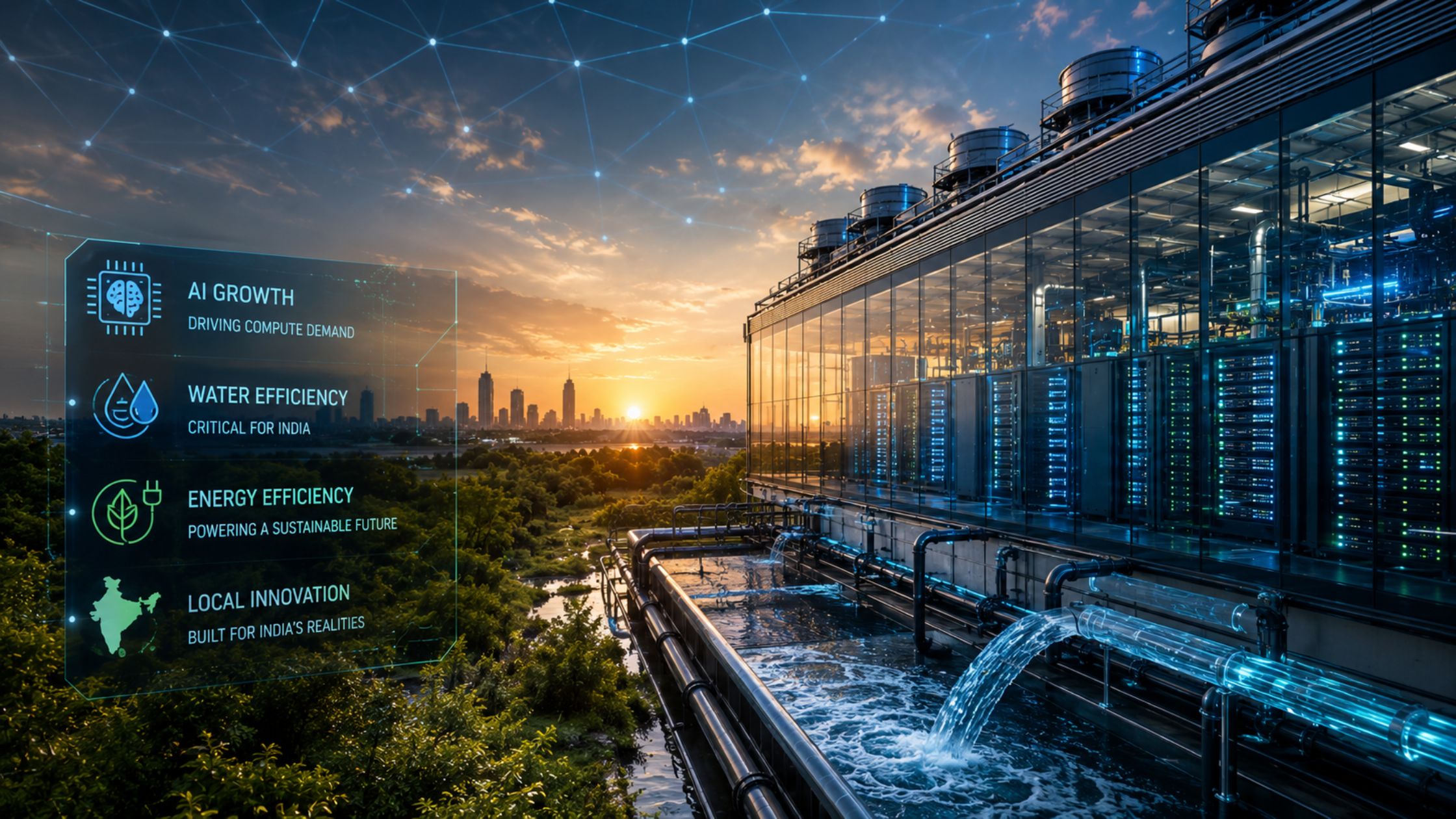
As India Builds More AI Data Centers, Climate-Tech Innovation Is No Longer Optional
 by
by

Momentum Capital’s Bharti Singhla says energy-efficient and water-conscious technologies will become increasingly necessary as India’s AI infrastructure expands — but solutions must be adapted to local conditions.
India’s race to build artificial intelligence infrastructure is accelerating at an unprecedented pace. Hyperscalers, cloud providers, data center operators, and policymakers are investing heavily in the country’s digital backbone as AI adoption expands across industries.
The scale of this expansion is becoming increasingly significant. According to the Council on Energy, Environment and Water (CEEW), India’s installed data center capacity has nearly tripled since 2020, reaching approximately 1.5 GW by mid-2025, with projections suggesting it could reach between 4.5 GW and 6.5 GW by 2030. Total committed investments in the sector between 2019 and 2025 have reached nearly $95 billion.
Government estimates suggest electricity demand from data centers could reach 13.56 GW by 2031–32 as AI workloads, cloud services, and digital infrastructure continue to expand.
Meanwhile, major technology companies are significantly increasing their investments in AI-ready infrastructure across India. In October 2025, Google announced a $15 billion AI hub in Visakhapatnam, Andhra Pradesh — its largest investment in India to date — combining gigawatt-scale data center capacity, large-scale energy infrastructure, and an expanded fiber-optic network. Construction broke ground in April 2026. The project underscores the growing strategic importance of India within the global AI infrastructure landscape.
Much of the discussion surrounding India’s AI ambitions has focused on compute capacity, GPUs, semiconductors, and large-scale investments. However, another conversation is beginning to gain importance: how India will power, cool, and sustain the next generation of AI infrastructure.
For climate-tech investors, this challenge is becoming increasingly difficult to ignore.
Speaking exclusively with AsiaTechDaily, Bharti Singhla of Momentum Capital said the rapid expansion of AI infrastructure is elevating the importance of technologies that improve energy efficiency and reduce resource consumption.
AI Infrastructure Is Increasing Pressure on Energy Systems
The growing demand for AI computing is reshaping infrastructure planning globally. The International Energy Agency (IEA) projects that global electricity consumption from data centers will more than double by 2030, driven largely by the growth of artificial intelligence applications. Data center electricity consumption is projected to grow roughly four times faster than overall electricity demand across all other sectors.
Recent academic research has similarly argued that AI infrastructure is no longer a marginal component of digital economies. Instead, it is becoming an increasingly important factor in long-term power system planning and grid resilience. India is experiencing this shift in real time. Data center capacity expanded significantly during 2025, and industry forecasts suggest total capacity could reach between 4.5 GW and 6.5 GW by 2030 as AI adoption, cloud computing, and enterprise digital transformation continue to accelerate.
As operators scale infrastructure, questions around energy efficiency are becoming increasingly important — encompassing not only electricity consumption but also how facilities manage heat generation and cooling requirements in a country with diverse climatic conditions and growing resource pressures.
Why Cooling Technologies Matter More in India
Data centers generate significant amounts of heat, making cooling systems one of the most critical components of infrastructure design. While traditional cooling approaches have been widely deployed in North America and parts of Europe, investors increasingly believe India’s operating environment requires a different approach.
“We haven’t yet invested in an Indian company specifically focused on data center efficiency, but we do have one in the US called Vern,” Singhla told AsiaTechDaily. “They work with US data centers to improve cooling energy efficiency and convert some of that into a usable power source. We think their solution could have strong applications in India.”
However, she emphasized that India’s infrastructure challenges differ from those of many developed markets.
“In India, water usage is also a critical constraint,” she said. “Some other countries still have relatively abundant water resources, but India is truly water-stressed. We can’t build data centers the way the West or even China has, because our geographical and resource conditions are different.”
Her comments reflect a broader discussion emerging across the infrastructure sector. As AI workloads increase, cooling systems are becoming larger consumers of both electricity and water. Industry studies suggest a single megawatt-scale facility using traditional cooling systems can consume millions of liters of water annually, creating additional pressure in regions already facing water management challenges. This has pushed operators and technology providers to explore alternative approaches, including liquid cooling, direct-to-chip cooling, immersion cooling, and more efficient thermal management systems.
Climate-Tech Innovation Is Becoming Part of the AI Infrastructure Stack
Historically, discussions around AI infrastructure have focused on chips, servers, networking equipment, and cloud platforms. That is beginning to change. As infrastructure scales, technologies that improve cooling efficiency, reduce energy consumption, and optimize resource usage are becoming increasingly important components of data center design. According to Singhla, startups developing such technologies are beginning to attract attention.
“We’re starting to see startups working on liquid cooling and other energy efficiency technologies that also reduce water usage, which will be very important here,” she said.
The shift highlights how climate-tech innovation is increasingly intersecting with AI infrastructure development. Rather than being viewed solely through a sustainability lens, many of these technologies are becoming operational necessities as operators seek to improve efficiency, manage costs, and reduce infrastructure strain. This is particularly relevant in India, where rapid digital growth must coexist with broader concerns around energy security, resource management, and climate resilience.
Why Localization Matters
For investors and founders, one of the most important questions is whether technologies developed in Western markets can simply be deployed in India without significant adaptation. Singhla believes that approach is unlikely to succeed at scale.
“When you look at implementing a US climate-tech model in India, cost will definitely be a hurdle,” she told AsiaTechDaily.
According to her, localization will become increasingly important as infrastructure requirements expand.
“Many of these innovations will either have to originate in India or be localized here very quickly. At the very least, the supply chain needs to be local, even if the core technology or IP comes from outside.”
The argument mirrors broader trends across India’s industrial and technology sectors. Over the past several years, policymakers and businesses have increasingly emphasized domestic manufacturing, localized supply chains, and India-specific infrastructure development across industries ranging from semiconductors and electronics to renewable energy and electric vehicles.
AI infrastructure may follow a similar path. Simply importing technologies designed for different economic conditions, resource availability, and operating environments may not deliver the efficiencies required for India’s long-term growth.
“Simply importing a product from the US or Europe and deploying it as is in India usually won’t work,” Singhla said. “You need local partners, local manufacturing, and some degree of customization to make the economics and operations viable in our context.”
The Next Phase of India’s AI Infrastructure Buildout
The conversation around AI infrastructure is often dominated by announcements involving billions of dollars in investment, new GPU deployments, and hyperscale data center projects. Those developments remain important. However, as capacity expands, infrastructure efficiency is becoming a strategic consideration rather than a secondary concern.
The challenge is not whether India will build more AI infrastructure. The country is already doing so at a rapid pace. The larger question is how that infrastructure will be designed, powered, and sustained over the coming decade. As electricity demand from data centers rises and AI workloads become more intensive, technologies that improve cooling efficiency, reduce resource consumption, and adapt infrastructure to local realities are likely to play an increasingly important role.
For investors such as Momentum Capital, this represents a growing area of focus within the broader climate-tech landscape. More importantly, it reflects an emerging reality for India’s digital economy: the future of AI infrastructure may depend not only on compute capacity and capital investment, but also on how effectively the country integrates energy-efficient and resource-conscious innovation into the foundations of its next generation of data centers.
Quick Takeaways
- India’s AI-driven data center expansion is accelerating, with installed capacity expected to grow significantly over the next decade as demand for AI computing, cloud services, and digital infrastructure rises.
- As data center capacity grows, energy efficiency and cooling technologies are becoming increasingly important components of AI infrastructure planning.
- Water usage is emerging as an important consideration for data center operators in India, where resource constraints differ from those in many Western markets.
- Momentum Capital’s Bharti Singhla believes India cannot simply replicate data center models developed in the US or China, given the country’s unique environmental and operational conditions.
- Technologies such as liquid cooling and advanced energy-efficiency systems are gaining attention as operators look to reduce both power consumption and water usage.
- Localization will be critical, with investors arguing that climate-tech solutions must be adapted to Indian cost structures, supply chains, and infrastructure realities to achieve large-scale adoption.
- The next phase of India’s AI infrastructure buildout will depend not only on compute capacity and capital investment, but also on how effectively energy-efficient and resource-conscious technologies are integrated into data center operations.
Similar Articles