AsiaTechDaily – Asia's Leading Tech and Startup Media Platform

Underwriting the In-Vitro Frontier: Why Biological AI Cannot Be Built on Silicon Timelines
 by
by

Why the venture capital playbook for generative AI crashes when applied to computational biology, and how “venture curation” is restructuring the deep-science cap table.
The global investment ecosystem is currently caught in a profound structural contradiction. While liquid venture capital flows at unprecedented speeds into large language models (LLMs) and consumer-facing software wrappers, a silent, parallel revolution is occurring within the life sciences. Artificial intelligence has moved beyond basic pixel tracking and text generation to interface directly with the fundamental machinery of life: molecular structures, genetic sequences, and the human microbiome.
However, applying the traditional, fast-paced Silicon Valley software playbook to computational biology is proving to be a dangerous operational failure. The venture capital metrics that define success in pure-play digital markets—such as releasing a minimally viable product (MVP), running fast public beta tests, and fixing systemic software errors post-deployment—are structurally incompatible with living systems. In the biological arena, data is scarce, validation takes years, and operational errors carry severe real-world consequences.
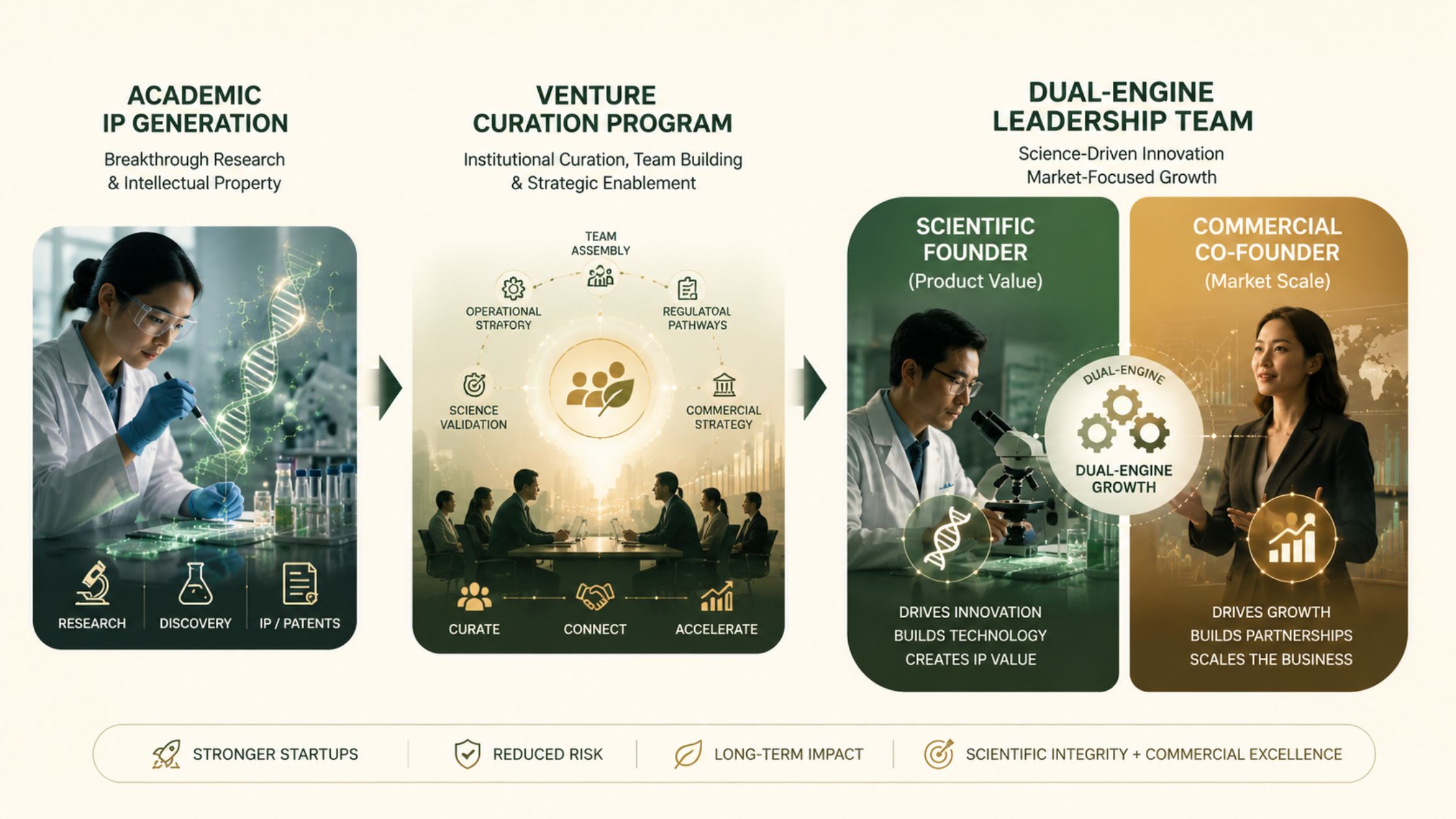
To unlock the massive economic value of biological AI, institutional asset allocators and specialized venture funds are undergoing a profound tactical realignment. The market is transitioning past the hands-off, ten-year fund cycles that favor rapid digital marketplaces. Instead, the current era belongs to “venture curation” frameworks—pioneered by specialized institutions like Axilor Labs—that step in as active institutional co-founders, building dedicated leadership teams around brilliant researchers and matching deep scientific patience with rigorous commercial execution.
The Severe Realities of Biological Data Scarcity
The primary operational constraint separating biological AI from traditional silicon software architectures is the fundamental nature of the underlying data. Traditional generative AI platforms scale exponentially by scraping open-source text, imagery, and code repositories from the public web. When data gaps appear, software engineers can easily generate infinite pools of synthetic training data within a closed loop.
In sharp contrast, biological data cannot be generated by a compiler. Mapping a specific gut microbiome or isolating a novel molecular compound requires slow, manual laboratory work and intensive clinical observations. The generation of this data is inherently bounded by the immutable timelines of organic chemistry and cellular reproduction.
While conversing with AsiaTechDaily regarding these deep systemic constraints, Nidhi Mathur, Venture Partner at Axilor Labs and Chief Business Officer for Algorithmic Biologics, highlighted that computational biology leaves absolutely zero margin for the software world’s traditional “move fast and break things” ethos.
“Biological data is far more difficult to gather,” Mathur explained. “It’s much slower to generate that data. More often than not, it will not be readily available for you. And even after you have built the product, you cannot just roll it out and call it a beta version and let it get tested in real life, and learn as we go, and make mistakes, and say, oops, my—the image that I generated has two right hands. That’s okay. Biological data doesn’t offer you the room to make these kind of mistakes. It needs strong validation, years of observation sometimes, years of scrutiny by regulators before you can have your first user try out your product.”
Because the real-world stakes of human health and molecular programming are absolute, shortcuts are non-existent. Startups operating on this frontier must achieve a near-flawless degree of conviction using scarce, highly fragmented datasets, forcing investors to underwrite long-term scientific integrity over immediate, superficial traffic metrics.
Overcoming the “Build It and They Will Come” Fallacy
The second major bottleneck holding back deep-science commercialization is not a deficit of technical intelligence, but an institutional gap in corporate structuring. Academic research labs are phenomenal engines for generating breakthrough intellectual property (IP), yet the researchers who anchor these labs rarely possess the specialized commercial vocabulary required to build a market-ready enterprise.
For over two decades, a consistent, unresolved challenge has plagued deep-science spin-offs: the persistent architectural assumption among scientists that proving a technical theory inside a lab is equivalent to building a successful business. This “build it and they will come” fallacy frequently results in brilliant technical founders over-indexing on product features while entirely ignoring macro distribution channels, regulatory soft landings, and commercial awareness creation.
To bridge this operational divide, the modern venture landscape is shifting away from standard financing models toward active, top-down venture curation. Rather than forcing a premier scientist to pause their life-saving research to learn the operational nuances of B2B marketing or corporate finance, institutional venture builders are systematically engineering the leadership team right from the cap table’s inception.
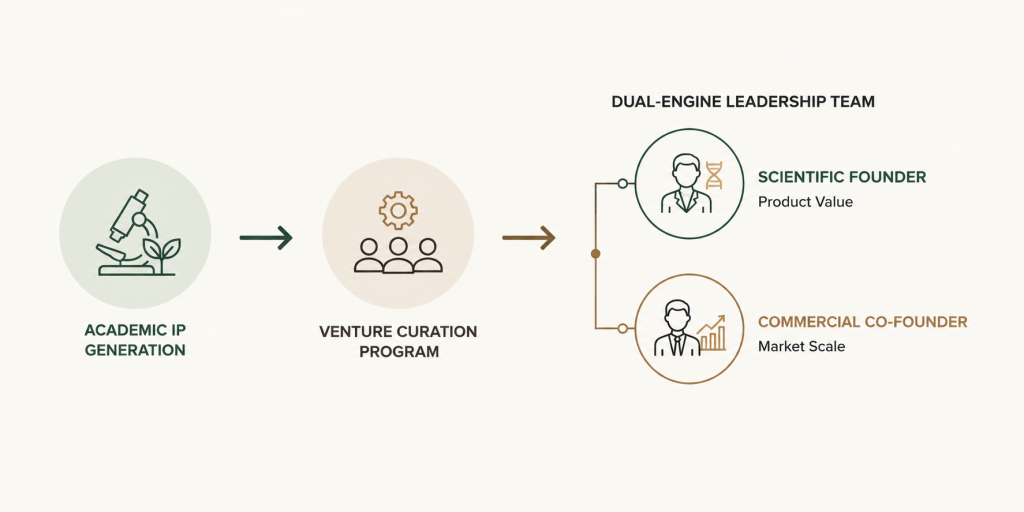
This structural framework splits a deep-tech company into a highly efficient, dual-engine operation:
- The Scientific Value Engine: Anchored by the original research pioneer, focusing entirely on data-driven innovation, evidence-based decision-making, and building world-class product pipelines.
- The Commercial Scale Engine: Managed full-time by embedded venture building partners, focusing exclusively on institutional value creation, market distribution, regulatory navigation, and cap table preservation.
This deliberate pairing ensures that the startup’s core intellectual property remains pristine and well-funded, while a dedicated operational team systematically de-risks the business model before the company ever approaches an institutional Series A round.
Restructuring the Capital Stack for Molecular Scale
Because deep-science and biological AI ventures demand multi-year gestation periods and extensive laboratory validation, their financial requirements are fundamentally different from traditional software startups. Forcing a molecular computing or healthtech startup to compete for capital against a consumer fintech or an e-commerce platform using the exact same underwriting metrics is a recipe for catastrophic failure.
In traditional digital tech, early-stage milestones are judged on immediate user acquisition and monthly recurring revenue. In deep-tech, those metrics are completely meaningless in the early years. The primary metric of success is the systematic verification of the science itself. If an early-stage fund fails to recognize this distinction, it will inevitably subject the company to aggressive down-rounds and massive equity dilution before the technology has a chance to mature.
Speaking with AsiaTechDaily, Mathur emphasized that early-stage deep-tech financing must be restructured to solve for survival rather than optimization, shaking up the conventional venture capital worldview.
“For deep tech startups, death before Series A happens more often than dilution before Series A,” Mathur asserted. “The bigger risk is death before Series A than dilution before Series A. In my head, I’m not worrying about how will I solve for somebody’s dilution. I am thinking, how will I solve for that. Because deep tech… these ideas require a lot of investment—R&D investment, government plus private capital to work together to support multiple cycles of iteration till you see things work. If the idea fails—okay, you held 89% of zero. Big deal. So, solving for not dying is more important, because if you hit Series A, it’s also a validation that your technology worked.”
This reality requires venture builders to implement milestone-gated, internal capital programs that consistently fund a company through multiple internal seed cycles. By keeping a deep-science enterprise properly capitalized in direct alignment with its technological milestones, investors can successfully protect the runtime of the laboratory work, insulating the company from broader market volatility.
The Imperative for Institutional Allocators
The traditional divide between investing in rapid, short-cycle software assets and long-term, capital-heavy deep science has permanently dissolved. In a global technology environment where standard consumer application interfaces are experiencing rapid margin compression, the true long-term enterprise value belongs to platforms that can solve complex, physical-world dependencies.
For cross-border general partners and institutional limited partners, the path to capturing this deep-science alpha requires a complete rejection of passive, hands-off investing. Succeeding on the biological frontier demands a long-term underwriting framework that embraces the slow, rigorous timelines of scientific validation while actively using structured venture curation to manage the operational risks. By building deep-tech portfolios designed to survive long validation cycles and leading with fundamental innovation over cheap compromises, modern allocators can successfully convert complex scientific breakthroughs into permanent, high-yielding global monopolies.
Quick Takeaways
- The Silicon Valley Playbook Failure: The traditional software venture model—which rewards rapid MVPs and fast public beta testing—crashes when applied to computational biology, where organic timelines and regulatory metrics demand absolute precision.
- The Biological Data Barrier: Unlike standard generative AI models that train on infinite web scrapes or synthetic datasets, biological AI must navigate severe data scarcity. Data generation is strictly bounded by the immutable timelines of organic chemistry and clinical observation.
- The Rise of Venture Curation: To bypass the “build it and they will come” fallacy common among brilliant researchers, specialized venture hubs like Axilor Labs act as active institutional co-founders—splitting the cap table into a scientific value engine and a commercial scale engine from day one.
- Solving for Survival Over Dilution: In early-stage deep tech, the primary operational threat is death before Series A, not equity dilution. Sustaining long R&D gestation cycles requires milestone-gated internal capital lines that keep the laboratory work fully insulated from traditional market metrics.
- The Molecular Arbitrage Blueprint: As demonstrated by portfolio innovators like Algorithmic Biologics, true deep-tech alpha belongs to platforms that lead with fundamental scientific innovation—using advanced software algorithms to compress physical laboratory costs by ten times while maintaining uncompromising global performance standards.
Similar Articles