AsiaTechDaily – Asia's Leading Tech and Startup Media Platform

Google, AirTrunk Bring 25 MW Solar Farm Online in Australia as AI Power Demand Surges
 by
by

The Mulwala Solar Farm in New South Wales is set to connect to Australia’s grid, as Google leans on renewable energy partnerships to keep pace with rising AI-driven electricity demand across Asia-Pacific
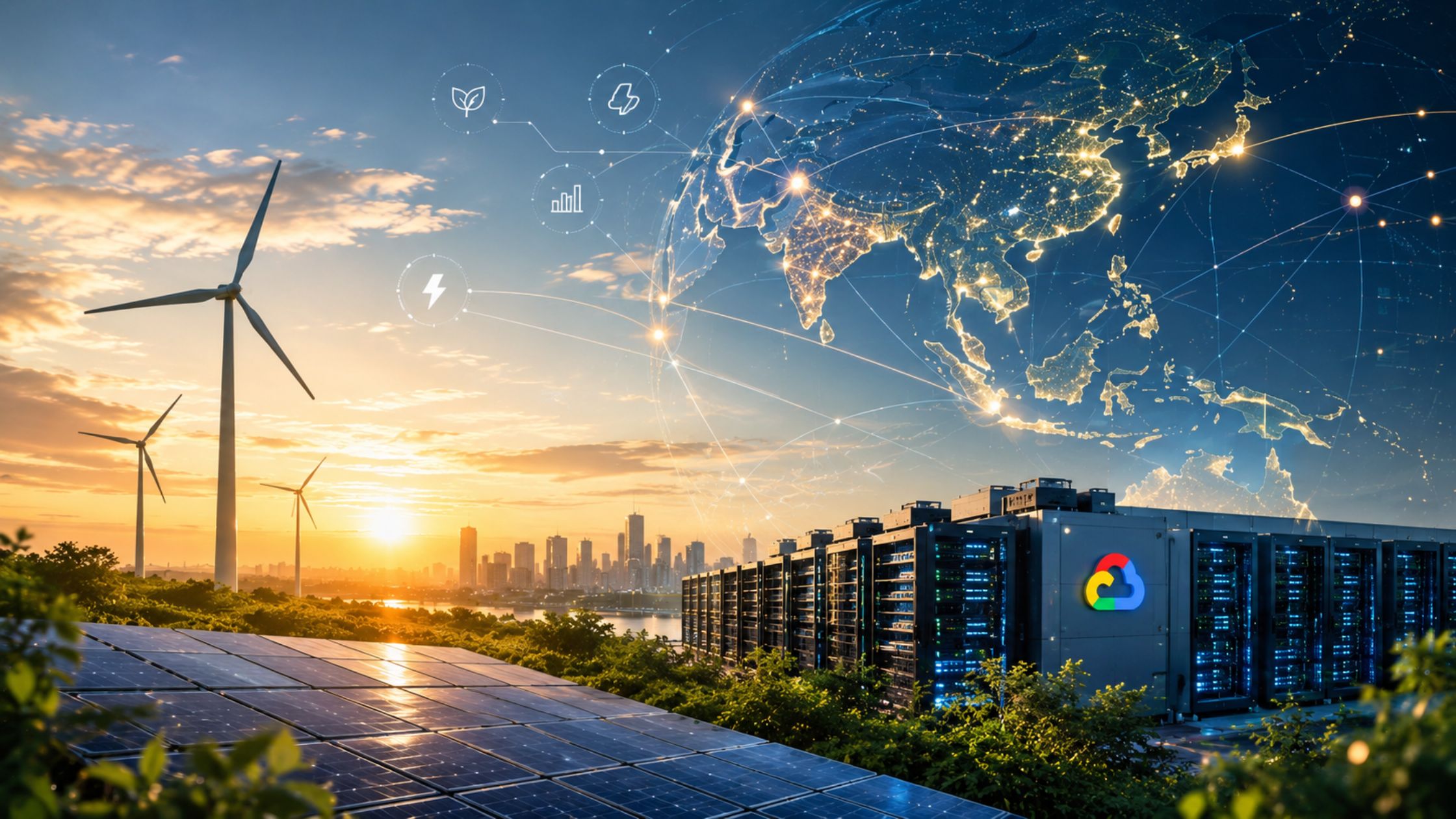
Google, AirTrunk, and European Energy Australia recently announced that their 25-megawatt Mulwala Solar Farm in the Riverina district of New South Wales has reached completion and is set to connect to Australia’s National Electricity Market. The project, first announced in 2023 under a corporate power purchase agreement, adds new renewable generation capacity to the grid and marks the latest move by Google to pair its growing AI and cloud infrastructure footprint in Asia-Pacific with new clean energy supply, rather than drawing on existing renewable resources already serving other customers.
“Australia has ambitious energy goals, and we want to ensure the growth of the nation’s digital economy directly accelerates the transition to a cleaner grid,” said Bikash Koley, Vice President, Global Infrastructure at Google, in the companies’ announcement. “As part of Google’s Digital Future Initiative in Australia, Mulwala Solar Farm is an example of how AI and digital infrastructure can be built the right way, with clear community benefits.”
The announcement comes as technology companies across the region face mounting pressure to secure clean power for data centers at a pace that keeps up with AI adoption. Speaking with AsiaTechDaily, Alexander Smith, Principal, Global Infrastructure and Energy, Asia Pacific at Google, said efficiency gains in hardware are not enough on their own.
“Innovation across hardware and software is critical to secure efficiency gains that help to bend the energy demand curve. Google’s hardware has made incredible strides in recent years, delivering over 6x more compute per unit of electricity compared to five years ago,” Smith said. “At the same time, across the Asia Pacific region, we are seeing demand for Google’s AI and cloud services growing at a rapid pace, which increases the absolute energy demand. That means increasing our procurement of renewable energy is still necessary.”
Google contracted for 8 gigawatts of new clean energy globally in 2024 alone, double the volume secured the year before, according to Smith. The company says it cut data center energy emissions by 12% that same year through a mix of efficiency improvements and new renewable power, even as demand for its AI and cloud services rose.
A Three-Way Partnership
The Mulwala project brings together Google as the long-term power buyer, AirTrunk as a hyperscale data center operator, and European Energy Australia as the project developer — a structure increasingly common as technology companies look to finance new renewable capacity directly rather than purchase credits tied to existing supply.
“We believe hyperscale data centres can help accelerate Australia’s energy transition by supporting investment in new renewable energy and strengthening long-term energy security,” said Damien Spillane, Chief Customer and Innovation Officer at AirTrunk, which operates hyperscale data centers across the Asia Pacific and Middle East region. “This collaboration shows how the industry can work together to bring more renewable energy online while creating lasting benefits for local communities.”
European Energy Australia, the project’s developer, said the deal builds confidence for future renewable buildout in the country. “Partnerships like this one give the industry confidence as we develop more solar and wind farms and bring more renewables online,” said Catriona McLeod, Managing Director of European Energy Australia. “It’s a perfect example of how major tech companies and renewables developers can work together to support the energy transition.”
Google has struck similar agreements elsewhere in the region, including with Shizen Energy, TotalEnergies, ReNew, Baseload Capital, and PacificLight Energy, as part of a broader push to fund new renewable projects tied directly to its data center demand. Since 2010, Google has signed more than 170 clean energy agreements globally covering over 22 gigawatts of capacity, and the company says it has matched 100% of its global electricity use with renewable energy on an annual basis every year since 2017.
Why Inference, Not Just Training, Is Driving Demand
Much of the public conversation about AI’s energy footprint has centered on the cost of training large models. But Google argues that inference — the computing that happens every time someone uses an AI tool to summarize a document, translate text, or run a search — is an increasingly significant driver of electricity demand, particularly as AI features become embedded in everyday consumer and enterprise software.
The company has invested heavily in reducing that cost. Its data centers now deliver six times more computing power per unit of electricity than five years ago, Google says, a gain it attributes to custom silicon, software optimization, and facility-level upgrades.
Central to that effort are its Tensor Processing Units, or TPUs. Google’s newly introduced eighth-generation TPU family splits into two specialized chips: TPU 8t, built for large-scale model training, and TPU 8i, designed for low-latency inference. Both deliver up to twice the performance-per-watt of their predecessor, Ironwood, which had itself been Google’s most efficient custom chip to date.
Google also points to gains from designing its AI models and hardware together. The company says concurrent improvements to model architecture and TPU hardware cut the median energy used per Gemini text prompt by a factor of 33, and its carbon footprint by a factor of 44, over the past year — to the point where the company says a typical prompt now consumes roughly as much energy as nine seconds of television viewing. Additional savings have come from machine learning-based cooling and lighting systems, redesigned power distribution, and optical circuit-switching networks that Google says cut networking power use by up to 40% compared with traditional electrical systems.
Even with those gains, demand keeps climbing — which is why, Google argues, efficiency and new power generation need to move in parallel rather than being treated as substitutes for one another.
Part of a Broader Build-Out
Australia has become an active testing ground for that approach, drawing heavy investment in data centers and AI infrastructure alongside an expanding renewable energy buildout. Its National Electricity Market has increasingly served as a venue for exactly the kind of partnership behind the Mulwala project — one where a technology company’s long-term power purchase commitment helps a developer secure financing for a project that might not otherwise get built.
Google has framed that detail as evidence that its renewable strategy in Australia predates the current AI boom: the Mulwala project was first announced in 2023, before AI infrastructure became a dominant theme in energy markets.
Whether efficiency gains or new supply ultimately matter more will likely keep shifting as AI adoption grows. But for now, Google’s position — echoed by its partners in the Mulwala announcement — is that both will be necessary. As Smith put it: “We are deeply committed to continuing with these efforts to progress our sustainability moonshots, which require broader change and long-term investment across the region.”
Quick Takeaways
- Google, AirTrunk, and European Energy Australia are bringing the 25 MW Mulwala Solar Farm online in New South Wales, adding new renewable energy capacity to Australia’s National Electricity Market.
- The project reflects a broader trend across Asia-Pacific, where hyperscalers are increasingly linking AI and cloud infrastructure expansion with long-term renewable energy investments.
- While Google’s data centers now deliver more than six times the computing power per unit of electricity compared to five years ago, rising demand for AI and cloud services continues to increase overall energy consumption.
- While conversing with AsiaTechDaily, Google said efficiency gains alone are not enough to meet future AI demand, highlighting the need for continued investment in new clean energy generation.
- Google contracted 8 GW of new clean energy globally in 2024, underscoring the growing connection between digital infrastructure growth and energy infrastructure development.
- The Mulwala project also highlights the industry’s increasing focus on “additionality,” where technology companies help finance new renewable energy projects rather than relying solely on existing clean energy supplies.
Similar Articles