AsiaTechDaily – Asia's Leading Tech and Startup Media Platform

Beyond the AI Hype: Why Infrastructure Alone Won’t Build Enduring Companies
 by
Byungho Lim
by
Byungho Lim

As capital floods into AI, a growing disconnect is emerging between technological capability and real-world utility
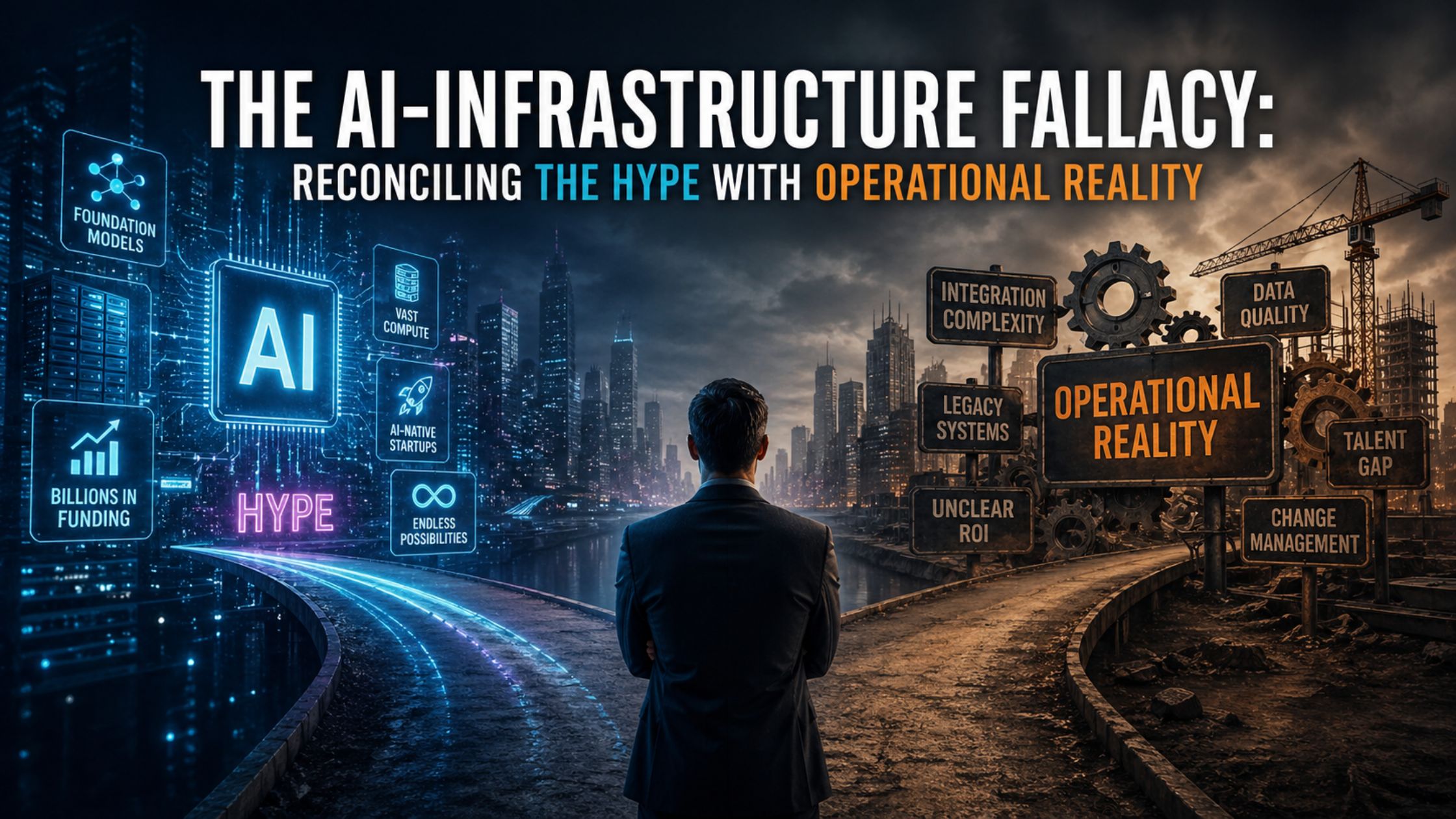
In 2026, the AI sector finds itself in a paradox. On one side, unprecedented capital—estimated at over $190 billion in 2025—has fueled an explosion of “AI-native” startups. On the other, the industry is beginning to confront a harder truth: building with AI is no longer the differentiator it once was. The result is a growing divide between perception and execution. While AI has unlocked genuine gains in productivity—enabling startups to scale faster and operate leaner—it has also created what many investors now see as a structural misstep: the assumption that infrastructure alone creates value.
At the core of this shift is what can be described as the AI-infrastructure fallacy—the belief that access to advanced models, compute, and tooling is sufficient to build defensible businesses.
In practice, the opposite is proving true. As foundational models become more powerful and widely accessible, intelligence itself is rapidly commoditizing. Startups built as thin layers on top of these models—often described as “wrappers”—face limited differentiation and increasing competitive pressure. Without proprietary data, workflow ownership, or clear distribution advantages, these companies struggle to establish durable moats.
This is reflected in failure rates. Industry estimates suggest that startups prioritizing model sophistication over market fit are seeing failure rates as high as 80–90%, underscoring the limits of a technology-first approach. You’re right to push this—this section needs to feel grounded, specific, and harder to dismiss, not just directional. Here’s a sharper, more research-led rewrite:
From Pilots to Production: Where AI Efforts Stall
The disconnect between AI capability and business value is most visible not in product demos, but in enterprise deployment cycles. Over the past two years, companies across sectors have aggressively experimented with generative AI—launching pilots across customer support, marketing automation, coding assistance, and internal knowledge systems. Yet a growing body of industry research indicates that the vast majority of these initiatives fail to progress beyond the experimental stage.
Estimates from enterprise studies suggest that over 80–95% of AI pilots do not reach full-scale production, largely due to challenges that extend beyond model performance. The issue is not whether AI works—it does—but whether it integrates.
Three friction points consistently emerge:
- Workflow misalignment: AI tools are often deployed as overlays rather than embedded into core systems, creating parallel processes instead of replacing existing ones.
- Unclear ROI attribution: While productivity gains are observable in isolation, translating them into measurable financial outcomes—cost savings, revenue lift, or margin improvement—remains difficult.
- Operational risk and governance: Concerns around data privacy, hallucinations, and compliance slow down enterprise-wide adoption, particularly in regulated industries.
The result is a growing backlog of “successful pilots” that fail to convert into budgeted, long-term deployments. For startups, this creates a structural bottleneck. Enterprise buyers are no longer evaluating AI products on capability alone, but on their ability to integrate seamlessly into existing workflows and deliver consistent, auditable outcomes at scale.
In effect, the market is shifting from experimentation to accountability. AI is no longer being judged by what it can demonstrate—but by what it can reliably operationalize.
Investor Reset: From Hype to Fundamentals
The shift away from AI-first narratives is increasingly visible in investor behavior, as capital allocators begin to separate technical capability from commercial viability.
Recent industry research points to a growing disconnect between funding momentum and underlying business performance. According to McKinsey’s 2025 State of AI report, while enterprise adoption of AI has surged, only a small fraction of companies report meaningful impact on EBIT, highlighting the gap between experimentation and value creation. Similarly, Gartner has projected that a significant share of generative AI projects will be abandoned before reaching production, citing unclear ROI and weak alignment with business processes.
This recalibration is also reflected in venture dynamics. Data from PitchBook and CB Insights shows that while AI startups continue to command valuation premiums—often exceeding 100% compared to traditional SaaS benchmarks—investors are becoming more cautious around companies lacking defensibility, particularly those built on top of commoditized foundation models.
In parallel, early-stage investors are placing renewed emphasis on:
- Clear problem-solution fit
- Distribution and go-to-market strength
- Proprietary data or workflow ownership
This marks a shift from backing “AI capability” to backing business fundamentals enhanced by AI.
Urska Vracun, angel investor and member of Epic Angels, echoed this perspective in an interview with AsiaTechDaily:
“I see 98% of startups today—their model is mostly AI-based. There is no differentiation anymore. I am still really looking for a startup that is solving a core problem that isn’t based solely on AI. Because, yes, AI is a perfect tool—it’s a great tool—but it’s not the core of a solution. If you ask me, it’s just infrastructure.
In five years, I think it might prove that we spent too much time focusing on it, and didn’t search for other solutions because we thought it was going to solve everything.”
Her comments underscore a broader shift in how AI is being positioned in the market. Increasingly, it is viewed less as a standalone product category and more as a foundational layer—akin to cloud or internet infrastructure.
In that context, the central question for startups is evolving: not whether they use AI, but whether they can build something defensible, valuable, and scalable on top of it.
The Case for AI-Native—When Done Right
The critique of the infrastructure fallacy does not invalidate the potential of AI-native companies. In fact, the strongest performers are demonstrating the opposite: that AI can be a powerful multiplier—if embedded correctly. Startups that are re-engineering workflows around AI, rather than simply layering it onto existing processes, are achieving significantly higher efficiency. Some are reaching $10 million in annual recurring revenue with teams of fewer than 20 employees, a level of capital efficiency rarely seen in traditional SaaS. The key difference lies in architecture.
Companies with defensible positions tend to share three characteristics:
- Proprietary data that improves model performance over time
- Deep workflow integration, making their product difficult to replace
- Clear ROI, tied directly to operational outcomes
In these cases, AI is not the product—it is the engine driving it.
What is emerging in 2026 is not a rejection of AI, but a reframing of its role. The market is shifting from “AI-native” as a category to “AI-enabled” as a baseline. This transition reflects a maturation of the ecosystem, where the novelty of AI is giving way to expectations of reliability, efficiency, and measurable impact. For founders, this means moving beyond capability and toward application. For investors, it requires evaluating companies not on their use of AI, but on their ability to translate it into sustainable value.
A Market Correction, Not a Collapse
What the industry is experiencing is not a collapse of the AI narrative, but a recalibration of its role. The first phase of the AI boom was defined by access—to models, compute, and tooling. That phase lowered the barrier to entry and accelerated experimentation across industries. But as those capabilities become standardized, the basis of competition is shifting. The next phase will be defined not by who has AI, but by who can operationalize it effectively.
This is where Urska Vracun’s framing becomes instructive. If AI is infrastructure, then its value is inherently indirect. Like cloud or connectivity, it only creates impact when paired with clear problem definition, strong execution, and measurable outcomes.
The emerging winners are already reflecting this shift. Rather than positioning AI as the product, they are embedding it into workflows, building around proprietary data, and tying its use directly to economic value—whether through cost reduction, revenue generation, or productivity gains. In doing so, they move beyond novelty and into necessity. For founders, this implies a reset in priorities: from showcasing capability to demonstrating utility. For investors, it requires a more disciplined lens—evaluating not just technological sophistication, but durability of business models.
The path forward is not to move away from AI, but to place it in its proper context. As a tool, it remains transformative. As a strategy, it is insufficient on its own.
The companies that will define the next cycle are unlikely to be those that simply build with AI, but those that build through it—anchoring innovation in real problems, and using AI as the means, not the message.
Quick Takeaways
- AI investment has surged, but capability is no longer a differentiator
- Many startups face high failure rates due to weak market fit and defensibility
- Enterprise adoption remains constrained, with most pilots failing to scale
- Investors are shifting toward fundamentals over AI-first narratives
- The next phase favors AI-enabled, workflow-integrated, data-driven companies