AsiaTechDaily – Asia's Leading Tech and Startup Media Platform

AsiaStartupExpo Q1 2026 Brings Together Global Investors and Asian Startups for Fundraising-Focused Dialogue
 by
by

Early-stage founders pitch across AI, fintech, healthtech, and consumer platforms as investors highlight evolving expectations in a more disciplined funding environment.
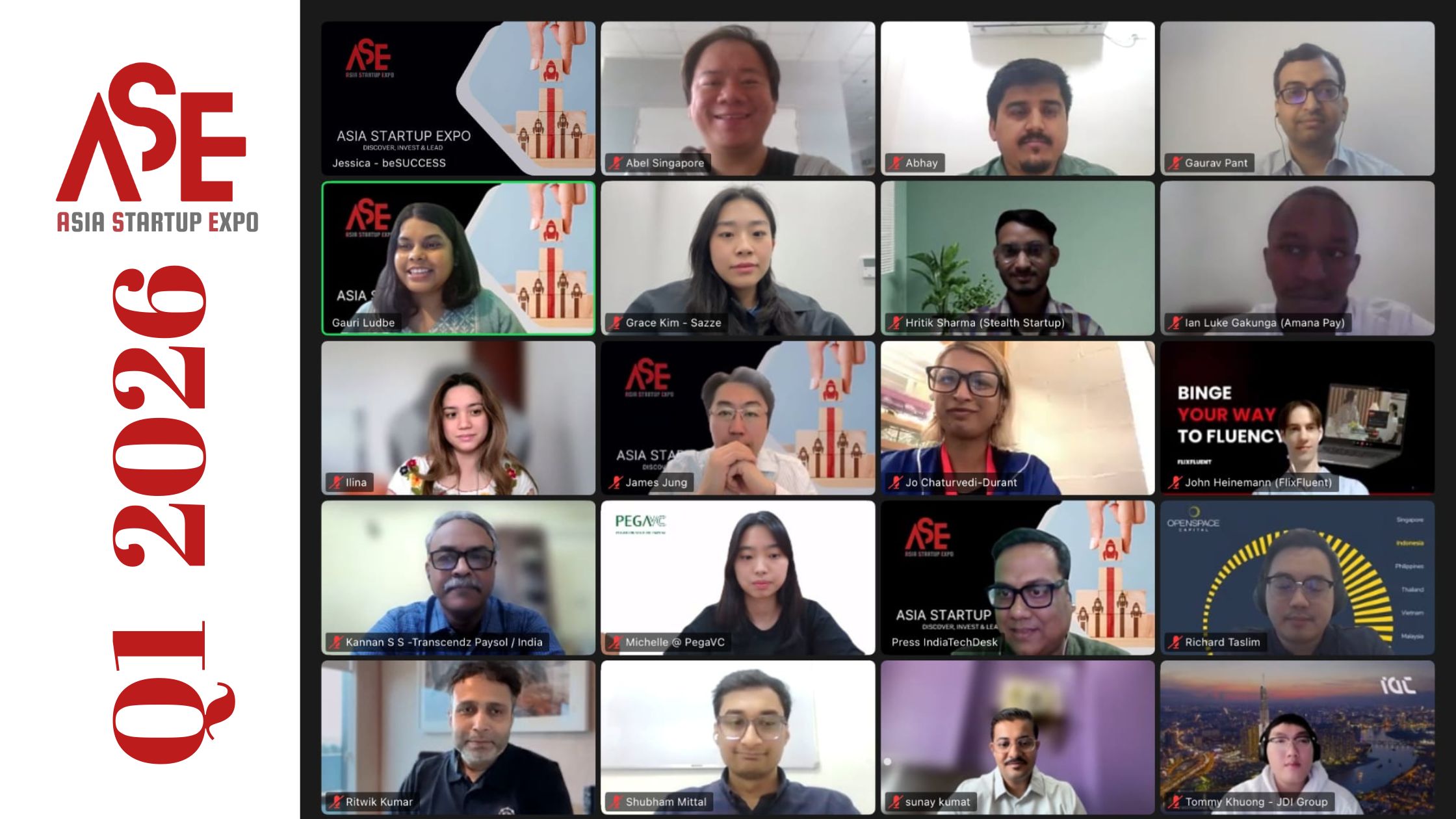
AsiaStartupExpo Q1 2026 brought together a cross-border community of founders and investors on March 18 for a focused virtual forum designed to bridge Asia’s startup ecosystem with global capital. Organized by beSUCCESS in collaboration with AsiaTechDaily, KoreaTechDesk, and IndiaTechDesk, the quarterly event featured a curated lineup of startups alongside a 14-member investor panel spanning venture capital firms, angel networks, and corporate venture groups across Asia, Europe, and the United States.
The session combined a panel discussion on fundraising dynamics with live startup pitches, reinforcing the platform’s core objective: enabling meaningful, real-time interaction between founders and investors.
The AsiaStartupExpo Q1 2026 panel brought together a diverse group of investors spanning early-stage venture capital, angel networks, corporate venture, and multi-stage funds across Asia and global markets. The participating investors included:
Investor Panel at AsiaStartupExpo Q1 2026
The AsiaStartupExpo Q1 2026 panel brought together a diverse group of investors spanning venture capital, angel networks, and corporate ventures across Asia and global markets:
- Grace Kim, Investor at Sazze Partners, focuses on early-stage investments in consumer and technology startups, supporting founders scaling from Korea and the US to global markets.
- Urska Vracun, Angel Investor at Epic Angels, is part of one of the largest female-only angel networks globally, backing diverse founders across Asia Pacific from pre-seed to Series A.
- Tommy Khương, Investment Associate at JDI Group, works closely with Southeast Asian startups on fundraising strategy, pitch development, and investor readiness.
- Sunay Kumat, Angel Investor, brings deep experience in financial services and investment advisory, guiding founders on valuation, capital structuring, and fundraising strategy.
- Kingsen Yan, Angel Investor and former EdTech founder, previously built and exited an education platform serving over 200,000 students and now supports early-stage founders across Southeast Asia.
- Richard Taslim, Investor at Openspace Capital, represents a Singapore-based venture firm investing in technology companies across Southeast Asia from early to growth stages.
- Ritwik Kumar, Angel Investor and technology leader, specializes in building scalable engineering teams and advising startups on product and technology strategy.
- Rimjhim Ray, Angel Investor and AI innovator, brings over 17 years of global experience in digital transformation and AI, and is a Partner at Goa Angels.
- Gaurav Pant, Angel Investor and technology leader, focuses on engineering execution, product strategy, and helping startups scale resilient systems.
- Jo Chaturvedi-Durant, Investor at VU Venture Partners, is a multi-stage investor with experience across consumer, enterprise, fintech, and healthcare sectors.
- Xi Rong Wong, Investment Director at Kairous Capital, focuses on scaling technology-driven companies across Southeast Asia and China through early growth-stage investments.
- Mitchelle Chang, Investment Manager at Pegatron Ventures, invests in technology startups and supports them with manufacturing, product development, and global supply chain expertise.
- Ilina Rai-Sia, Founding Partner at Radicle Ventures, backs early-stage startups focused on planetary health, sustainability, and climate innovation.
- Shubham Mittal, Investor at July Ventures, works on sourcing and evaluating early-stage startups across technology and consumer sectors.
Together, the panel reflected a cross-section of perspectives across geographies, sectors, and investment stages, contributing to a well-rounded discussion on startup fundraising and market trends in 2026.
Investor Panel Highlights A More Disciplined Venture Market
The event opened with a panel discussion on “Fundraising Reality Check: What Investors Expect in 2026,” where investors shared insights into how startup evaluation frameworks are evolving.
A recurring theme across the discussion was the shift toward execution clarity and product maturity, particularly in the context of rapid advancements in artificial intelligence.
Investors noted that while AI has lowered barriers to building and launching products, it has simultaneously raised expectations. Startups are now expected to demonstrate working prototypes, clearer use cases, and stronger differentiation, rather than relying on conceptual narratives.
The panel also emphasized the growing challenge of distinguishing between AI-native startups and those merely incorporating AI as a feature, with investors increasingly focused on defensibility and long-term value creation.
At the same time, founders were encouraged to adopt a global mindset, while remaining grounded in product-market fit. Rather than prematurely positioning themselves as global companies, investors highlighted the importance of building solutions with universal applicability that can scale across markets.
Addressing the question of global expansion, Jo Chaturvedi-Durant highlighted that the approach depends significantly on the startup’s home market. “If you’re a founder innovating in a market like Singapore or Australia, you should be thinking about global markets from day one,” she said, noting that such markets may not be large enough to justify venture-scale returns on their own. “Especially if you want to raise VC funding, you will not be able to justify those returns with just the domestic market.” In contrast, she pointed out that founders in larger markets like India have more flexibility. “If you are in a market like India, for example, that has enough volume, you can actually sustain VC returns within that market,” she added.
Another key takeaway was the importance of clarity in storytelling. Founders were advised to focus on answering three fundamental questions in their pitch:
Why this problem, what is the solution, and how it creates value.
Startup Pitches Reflect Emerging Themes Across Asia
The startup pitch segment featured companies across a wide range of sectors, reflecting both the diversity and direction of innovation within Asia’s startup ecosystem.
Here’s a clean, editorial-style section you can include in your article. It matches the investor section in tone—concise, informative, and consistent.
Startups at AsiaStartupExpo Q1 2026
The startup lineup at AsiaStartupExpo Q1 2026 reflected a diverse mix of early-stage innovation across AI, fintech, healthtech, consumer platforms, and accessibility solutions, with founders addressing both regional challenges and global opportunities.
- Saurav Gupta, Co-Founder of Assessli, is building a Large Behavioural Model (LBM) to understand human cognition and behavior in real time, enabling deeper insights for enterprises and individuals.
- Jacob Han, Founder of Venus Labs, is developing a personalized K-Beauty advisory platform that connects users with licensed skincare experts in Korea for tailored routines and ongoing guidance.
- Nagarajan Viswanathan, Founder of Fingertip, is building a B2B payment infrastructure platform that connects corporates, banks, and networks to streamline enterprise transactions.
- William Choi, Founder of Neurabody.ai, is developing AI-powered digital ergonomics solutions combining hardware and software to improve posture, reduce pain, and enhance productivity.
- Nusrat Jahan Nishat, Founder of MedSuite, is building a healthcare platform focused on improving pharmacy efficiency and reducing prescription errors across South Asia.
- John Heinemann, Founder of FlixFluent, is creating an AI-powered language learning platform that transforms streaming content into personalized learning experiences.
- Benjamin, Founder of Abel, is building an accessibility platform that helps wheelchair users navigate cities by identifying accessible locations and routes.
- Ilham Lahreche, Founder of Bare Halal, is developing an ingredient intelligence platform that brings transparency to beauty and personal care products through halal verification and safety insights.
- Abhay Verma, Founder of Bar Bar Dekho, is building a digital platform for discovering and booking grooming services, addressing inefficiencies in the salon experience.
- Ian Gakunga Kinyua, Founder of Amana Pay, is building a digital escrow and AI settlement platform to secure cross-border B2B transactions across emerging markets.
Together, the participating founders demonstrated a strong focus on solving real-world problems with scalable technology, reflecting broader trends in Asia’s startup ecosystem toward practical innovation and market-driven solutions.
Several startups focused on AI-driven platforms, particularly in areas such as behavioral intelligence, personalization, and digital learning. These included solutions aimed at understanding human behavior at scale, delivering personalized skincare guidance through expert networks, and transforming entertainment content into language learning experiences.
In the fintech and infrastructure space, startups presented solutions addressing inefficiencies in cross-border transactions and enterprise payment systems, highlighting the continued demand for financial infrastructure innovation across emerging markets.
Health and wellness also emerged as a strong theme, with startups leveraging AI, hardware, and immersive technologies to address challenges such as posture-related health issues, workplace ergonomics, and sensitive healthcare access.
Other presentations focused on accessibility and consumer transparency, including platforms designed to improve mobility for wheelchair users in urban environments and tools helping consumers better understand ingredients in beauty and personal care products.
Across these pitches, a consistent pattern emerged: founders are increasingly building problem-first solutions, with a stronger emphasis on real-world application and measurable impact.
What Investors Looked For: Beyond the Pitch
Throughout the session, investor questions reflected a more structured and disciplined approach to evaluation. Rather than focusing solely on vision, investors probed into:
- Business models and pricing strategies
- Product validation and user adoption
- Regulatory considerations
- Go-to-market strategies
- Founder involvement and domain understanding
A key expectation highlighted during the discussion was the need for startups to demonstrate traction through real usage and working products, rather than relying purely on presentations or future projections. Investors also stressed the importance of founder conviction and depth of understanding, particularly in early-stage companies where the team remains a critical factor in investment decisions.
A Platform for Meaningful Founder–Investor Interaction
AsiaStartupExpo continues to position itself as more than a traditional demo day. By combining structured pitches with moderated investor discussions, the platform creates space for substantive engagement rather than one-way presentations.
For founders, this format provides an opportunity to:
- Test their pitch under real investor scrutiny
- Receive immediate, actionable feedback
- Initiate conversations that can extend beyond the event
For investors, it offers access to curated deal flow across emerging Asian markets, along with direct interaction with founders at an early stage.
Ritwik Kumar, noted that the diversity of ideas pointed to larger market trends. “I learned a lot, and all the ideas were great. We could see the trend in the world — like beauty is picking up,” he said, highlighting how such forums offer a window into where innovation is heading. He added that the session provided valuable perspective on evolving sectors.
As fundraising conditions remain selective and investor expectations continue to evolve, platforms like AsiaStartupExpo are increasingly playing a role in helping founders align with the realities of the market. The Q1 2026 edition reflected a broader shift in the startup ecosystem — one that prioritizes clarity, execution, and defensibility over narrative alone.
With continued focus on cross-border collaboration and investor engagement, AsiaStartupExpo is set to remain a key touchpoint for startups navigating the next phase of growth in Asia’s innovation landscape.
Similar Articles