AsiaTechDaily – Asia's Leading Tech and Startup Media Platform

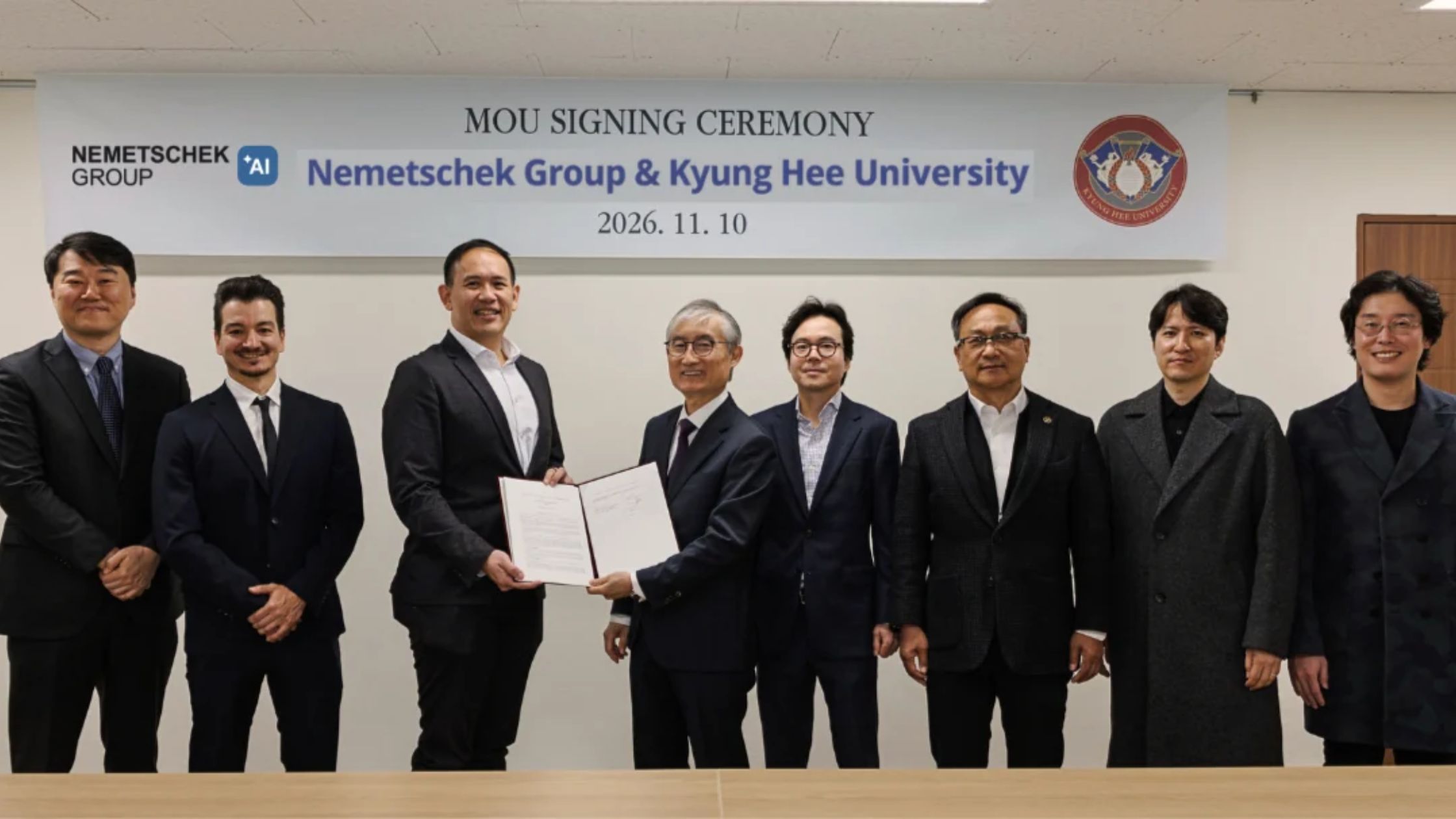
Nemetschek Partners with Kyung Hee University as South Korea Pushes to Expand BIM Adoption
 by

The three-year agreement will provide eligible students and faculty access to six technologies across design, engineering and construction workflows, as the country’s transition towards model-based project delivery highlights the need for stronger digital construction skills.
Germany-based software provider Nemetschek Group has signed a three-year Memorandum of Understanding (MoU) with the College of Engineering at Kyung Hee University, marking its first academic partnership in South Korea. Announced on November 16, 2026, the collaboration will provide eligible students and faculty access to six technologies across architectural design, engineering, model coordination, documentation and construction workflows.
The agreement comes as South Korea works to move beyond conventional drawing-based processes towards more integrated, model-based project delivery. However, the transition involves challenges extending beyond technology adoption, including the availability of skilled professionals, consistent data standards and the integration of digital information across different stages of construction.
South Korea has been expanding BIM adoption through public-sector policies and procurement requirements. However, the country’s experience highlights the difference between mandating digital tools and ensuring their effective use across construction projects. A July 2026 report by the Korea Research Institute for Construction Industry (CERIK), titled Diagnosis of Structural Barriers to BIM Adoption and Directions for a Policy Paradigm Shift, identified shortcomings in pricing standards, administrative systems, workforce development and data standardization. Its expert analysis ranked economic incentives as the largest category of barriers, accounting for 50.5%, while uncertainty over return on investment (ROI) was the leading individual factor at 17.6%. The report also found that BIM data frequently remains confined to design-stage deliverables rather than being carried through construction and facility management.
The challenges were also highlighted in a November 11 discussion hosted by South Korea’s Public Procurement Service (PPS) and the Korea BIM Society. The forum examined how BIM design outputs could be used more effectively in permitting documentation, alongside revisions to fee standards and greater design standardization. It also addressed the practice of conducting BIM work separately from conventional two-dimensional design processes.
These developments indicate that South Korea’s digital construction transition requires more than wider software deployment. It depends on professionals who can manage structured project information, coordinate across disciplines and maintain data continuity throughout a project’s lifecycle.
Engineering skills must extend beyond individual software tools
The workforce implications are central to Nemetschek’s decision to expand its academic engagement into South Korea. While conversing with AsiaTechDaily, Jonathan Ng, Managing Director, Southeast Asia, Nemetschek Group, said the country is at an important stage in its digital construction journey, with BIM adoption expanding through public-sector requirements while traditional 2D and model-based workflows continue to coexist.
“That creates a skills challenge that goes beyond learning a different piece of software. Architects and engineers need to understand how project information is created, exchanged, checked and maintained across different disciplines and systems. At the same time, graduates entering the industry need to be comfortable operating in an environment where 2D documentation and BIM models will continue to coexist,” Ng said.
He also pointed to the Public Procurement Service’s examination of international BIM implementation approaches, including the use of public procurement to support the transition towards model-based workflows and extend BIM information beyond design into construction and facility management.
“That is important because digital transformation is not achieved simply by introducing a new technology. The underlying information, processes, skills and governance have to evolve with it. Individual technologies will continue to change, but information fluency, interdisciplinary thinking and professional judgement will remain important regardless of which tools professionals ultimately use,” he added.
Ng’s comments reflect a broader industry challenge: preparing graduates to work with connected project information rather than limiting their training to individual design and documentation applications.
Six technologies to support digital construction education
Under the agreement, eligible students and faculty at Kyung Hee University will receive academic access to six technologies from Nemetschek’s portfolio: Archicad, Allplan, Bluebeam, GoCanvas, Solibri and Vectorworks. The tools cover different functions across the built environment, including architectural design, engineering, model coordination, construction documentation and field operations. The partnership will also include learning content, curriculum input and training programmes for faculty and students. Certification opportunities and potential internships or placement access through Nemetschek’s industry network are expected to follow as the collaboration develops. The university will retain responsibility for its curriculum and academic delivery, with Nemetschek providing industry-informed input to relevant civil and architectural engineering programmes.
Jin Hwan Choi, Dean of the College of Engineering at Kyung Hee University, said the collaboration would give students and faculty greater exposure to digital tools and workflows used across the built environment while complementing the university’s existing engineering education.
“We look forward to strengthening the connection between academic learning and industry practice and creating more opportunities for our students to develop capabilities that will support their future careers,” Choi added.
Nemetschek expands academic engagement across Asia
The South Korean agreement extends Nemetschek’s existing academic engagement in Asia, where it has worked with institutions in Singapore, Vietnam and the Philippines to strengthen digital capabilities and align education with changing industry requirements.
Founded by Professor Georg Nemetschek in 1963, the group provides software for the architecture, engineering, construction and operations (AEC/O) and media industries. Its technologies support workflows spanning building design, planning, visualization, construction, operation and renovation. The company reports more than seven million users worldwide and employs over 4,500 people globally. It is ISO 27001-certified and has been listed on the MDAX and TecDAX since 1999.
For 2025, Nemetschek reported revenue of EUR 1.19 billion and EBITDA of EUR 371.1 million. The MoU with Kyung Hee University will remain in effect for three years, during which both parties may explore additional areas of collaboration. South Korea’s BIM transition will ultimately depend on whether digital project information can be used consistently beyond design and integrated into construction and facility management. While academic partnerships can help prepare the workforce for this shift, the country’s broader challenges around procurement, economic incentives, data standards and institutional processes remain significant. The effectiveness of initiatives such as the Nemetschek-Kyung Hee collaboration will therefore depend not only on access to digital tools, but also on how effectively students develop the skills to apply them in increasingly connected construction environments.
Quick Takeaways
- Nemetschek Group has signed its first academic partnership in South Korea through a three-year agreement with Kyung Hee University’s College of Engineering.
- The partnership will provide eligible students and faculty access to six technologies: Archicad, Allplan, Bluebeam, GoCanvas, Solibri and Vectorworks.
- South Korea’s push to expand BIM adoption in public construction is increasing demand for engineers with digital construction and information management skills.
- Industry research highlights persistent barriers to BIM adoption, including inconsistent data standards, workforce shortages, inadequate pricing frameworks and uncertainty over ROI.
- Nemetschek’s Jonathan Ng told AsiaTechDaily that future engineers must understand how project information is created, exchanged, checked and maintained across disciplines, rather than simply learn individual software tools.
- The collaboration includes training, learning content, curriculum input and potential certification, internship and placement opportunities.
- The partnership builds on Nemetschek’s academic engagement in Singapore, Vietnam and the Philippines.
Similar Articles