AsiaTechDaily – Asia's Leading Tech and Startup Media Platform


Why Venture Capital Alone Can’t Build Central Asia’s Startup Ecosystem
 by
Gauri Ludbe
by
Gauri Ludbe

An AsiaTechDaily conversation with Yoshlar Ventures’ Shakhzod Ismoilov on why capital alone is not enough, and how founder pipelines, execution patterns, and market structure are shaping Central Asia’s startup ecosystem.
Central Asia is entering a pivotal moment in its startup evolution, one where momentum is no longer theoretical, but increasingly measurable. In 2025, venture funding across the region reached a record ~$320 million, according to RISE Research, signaling growing investor interest. Yet the headline number masks a more complex reality: much of that capital remains concentrated in a handful of large deals, while the broader ecosystem continues to operate at the earliest stages. However, only a small share of startups successfully raise venture capital, showing a deeper structural challenge of limited pipeline of venture-ready companies despite the capital availability.
Uzbekistan is at the center of such transition. The country’s venture market has expanded rapidly over the past few years, supported by policy reforms, rising founder activity, and increasing participation from both local and international investors. More than 15 active venture funds now operate in the market, and early exit signals are beginning to emerge.
This is where firms like Yoshlar Ventures come into focus. Backed by Uzbekistan’s broader push to develop its startup economy, the firm operates as an early-stage investor, and ecosystem builder, working directly with founders through pipeline programs, early-stage support, and market access initiatives. In an exclusive conversation with AsiaTechDaily, Shakhzod Ismoilov, who works closely in the investment space and ecosystem development at Yoshlar Ventures, offers a grounded view of what is actually happening on the ground and where the region is headed next.
From redefining Central Asia as a frontier market to explaining why venture capital alone cannot build an ecosystem, the conversation spans several structural shifts shaping the region. It also unpacks the realities of scaling across fragmented markets. Together, these insights show how Central Asia is moving from capital inflow to capability creation and what that means for founders, investors, and global tech players watching the region.
Redefining the Market: From “Developing” to Frontier
Rather than viewing Uzbekistan’s venture capital space and by extension Central Asia region as an ecosystem still trying to catch up, Ismoilov frames it as one that has already crossed into a more consequential phase, where early participants have outsized influence. He explains that the distinction between “developing” and “frontier” is not just semantic, but defines how the market should be approached:
“I don’t think Uzbekistan is a developing market; it is an emerging frontier. That distinction matters a lot because ‘frontier’ means that the rules are still being written, and the people writing them now will get to decide what the next decade looks like. If you say ‘developing,’ it’s like we don’t know what is happening, but now we are at the frontier. We are defining the rules, and whoever comes to Uzbekistan will be the first of the winners.
What shaped our conviction is that the Uzbekistan venture market hit 11 times expansion in three years. 2021 was the beginning point where the chapter started opening. In 2022, we saw the very first VCs opening. Now, in 2025, seven new domestic venture firms launched, and in 2026, we saw those same firms, or a few new ones, bringing in more and more capital. On paper, that sounds like very good momentum, but when you look closer, around 80% of the deals in 2025 were under $200,000. That tells you exactly where we are: early stage!
It is not per se a strategic choice for the ecosystem; it is the way the ecosystem is right now. Whoever invests thoughtfully at this stage gets to shape what comes next. Also, in terms of timing, the capital base is still small enough that a single thoughtful check can meaningfully change a founder’s trajectory, but the ecosystem has crossed the threshold where global-quality companies have been built.”
This duality, rapid expansion alongside structural immaturity defines the current state of the ecosystem. Capital is entering, but it is still concentrated at the earliest stages, leaving a clear gap between funding availability and scalable outcomes.
From Investing to Ecosystem Building
In most mature startup ecosystems, venture capital operates on a relatively clear premise: capital flows toward already validated founders, established pipelines, and predictable growth trajectories. Central Asia does not yet offer that depth. While funding activity is increasing, the number of venture-ready startups remains limited, however, the supporting infrastructure from founder networks to early-stage mentorship is evolving.
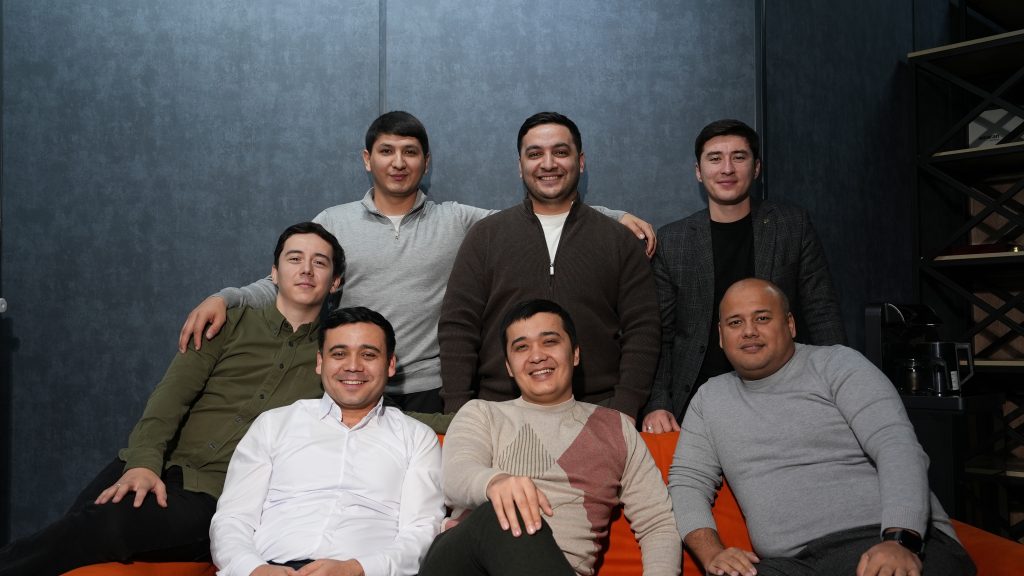
This structural gap changes the role of investors. Rather than simply allocating capital, firms are increasingly required to help create the conditions in which that capital can be deployed effectively. Yoshlar Ventures operates within this reality. It is not just as an investor, but as an active participant in building the ecosystem itself. Ismoilov describes how this changes the definition of venture capital in a frontier environment:
“Ecosystem building and investing aren’t two jobs; they are the same job. Because we are in an emerging market, it is a frontier. When you enter a market where startups are growing in both quality and quantity, writing checks doesn’t do the whole job itself. You have to help produce the founders that are worth backing.
That is why at Yoshlar Ventures, we operate on both sides. We invest with clear check sizes from $40,000 all the way to $400,000, but we also build pipelines. One of our programs was a accelerator program called ‘UzCombinator,’ a 45-day accelerator designed to turn builders into global startups and make the founders true leaders. We have an in-house media team, which no other fund in the region has, that gives our founders reach from day one. Our positioning under the Agency for Youth Affairs gives us access to students and young founders at the earliest possible moment,” Shakhzod adds.
There is a deeper structural need across Central Asia: the challenge is not just deploying capital, but ensuring there are enough founders and companies, ready to absorb it effectively.
Correcting Global Misconceptions about Central Asia
Despite the visible progress within the ecosystem, external perception continues to lag. For many global observers, Uzbekistan is either too early to consider or overly shaped by state influence. Ismoilov addresses both assumptions directly, starting with the idea that the ecosystem is still in its infancy:
“To clear the misconception, Uzbekistan is still at a pre-ecosystem stage, that nothing really is happening yet, and that foreign investors should check back in five years. That has not been true for a while. Now we have, I think, over 15 active VC funds, real exit cases, and founders raising international rounds—YC, 500 Global, international angels—and a startup pipeline that is growing every quarter. The ecosystem itself is not yet mature, but it is past the stage where you can dismiss it.
The second big misconception is that when outsiders hear the concepts of the Agency for Youth Affairs, presidential decrees, or state matching programs, they assume this is a top-down, government-driven ecosystem and that founders are executing a governmental mandate. That is completely wrong. The state created conditions—regulatory reforms, matching capital, and visa pathways—but the founders are building companies that are private, scrappy, and internationally ambitious. They are not building because the government asked them to; they are building because they see the opportunity the state has created for them. That state alignment is very rare in most emerging markets. Founders are usually fighting with the government and institutions, but here, the government is clearing the runway. At the end of the day, the companies are founder-driven, not state-driven.”
This distinction is critical. While institutional support exists, the momentum of the ecosystem is increasingly driven by founders and market opportunity—not policy alone.
Scaling in a Fragmented Region
As the conversation shifted from Uzbekistan to the broader Central Asia region, a key challenge emerged: fragmentation. While often grouped together geographically, the region does not function as a unified market. For founders, this creates a very different scaling dynamic compared to more integrated ecosystems. Ismoilov outlines how this plays out in practice:
“Founders who assume from the start that Central Asia is one market because it looks like one on the map lose time and money learning the hard way. The fragmentation is real: different languages, different regulatory regimes, different payment infrastructure, and different consumer behavior. A product that works in Tashkent, the capital of Uzbekistan, does not automatically work in Almaty, and Almaty doesn’t automatically transfer to Bishkek. Uzbekistan and Kazakhstan have meaningfully different tax codes, licensing requirements, and cross-border capital rules.
The fragmentation is real, and we have to be realistic about it, but I think that also creates an opportunity. A lot of the Uzbekistan cross-border venture flow goes to Kazakhstan, not because Kazakhstan is easy, but because the founders who figure out the corridor to Kazakhstan early build a moat around them in defense against the competition. The same will be true for Uzbekistan, Kyrgyzstan, and Tajikistan down the line. The first founders who crack regional expansion will have advantages that are hard to catch up to.
For Yoshlar Ventures, this shapes how we think about scaling support. We don’t tell founders to ‘go regional’ as a slogan; we tell them to pick one neighboring market, learn deeply, and build the operational muscle for cross-border expansion before you try to be pan-regional. Central Asia will eventually function more like one region, but right now, scaling here is a series of deliberate, country-by-country moves, not a single expansion.”
This reality reinforces the need for precision in expansion strategies—something that differs significantly from more integrated markets like the European Union.
Exit Pathways: Early Signals, Emerging Structure
Exit conversations in Central Asia have long been shaped by uncertainty, with limited precedent and evolving capital markets. That is beginning to change. A small but growing number of transactions is offering early validation and giving investors clearer signals on how exits may take shape in the region. For firms like Yoshlar Ventures, these developments are starting to inform expectations around timelines, returns, and viable exit routes. In this context, he states,
“Generally speaking, exit pathways shape everything—the time horizon, check sizes, and how we at Yoshlar Ventures think about follow-on investments for startups focused on Uzbekistan and Central Asia.
The exit market here is forming. One example I can give you is a startup called Billz that was acquired by TBC Bank last year. I think the valuation was around $20 million, which gave investors a 4x return on their invested capital. That example is a very important proof point; it showed that strategic acquirers in the region are real, it is happening, and there are meaningful exits to be found in Central Asia. That proves we don’t have to wait for US or European buyers.
Exits will generally come from three paths: strategic acquisition by regional corporates, big sharks, or banks; secondary sales during Series A or B rounds to international funds as the company scales; and eventually, IPOs will start becoming a reality, although the local IPO infrastructure is still maturing.”
These early signals suggest that while the exit environment is still developing, it is becoming increasingly predictable—particularly through regional strategic acquisitions.
Global Strategy: Intent vs Execution
As founders look beyond domestic markets, the question of going global becomes central. However, Ismoilov emphasizes that ambition alone is not enough. He draws a clear distinction between intent and execution:
“There is a big difference, and founders who don’t understand that distinction get into a lot of trouble. Even within a country, state-to-state or province-to-province regulations differ. Now, imagine you are from Uzbekistan and you want to start selling to the Gulf; that requires a different trust-building cycle and a specific playbook. Founders who say ‘we are global’ as a slogan, without a defined go-to-market strategy, end up serving nobody well.
I always tell founders: if you are trying to sell globally from day one, that is amazing, but focus on it. If you are gathering customer feedback from a sample of 30 businesses, focus on the specific market you want to enter. Build your product ‘global by design,’ not ‘global by default.’ Pick one international market, deliberately learn it, and expand there. Founders who do that are often able to scale, while those who treat the globe as a slogan burn through a lot of capital and land nowhere.
If you start with a local problem, that is okay. Uzbekistan has a strong market, the buying power is there, and the population is growing. Most likely, if Uzbekistan is facing that issue, neighboring countries in Central Asia face it too. But do not use ‘global’ just for the sake of trying it out, because once you start local and then try to pivot to global, the cost of changing becomes harder. However, if you are planning to go global right away, start there and expand within that market.”
What Investors Actually Look For
For many early-stage founders, fundraising is often approached as a milestone tied to traction—revenue, early customers, or user growth. In frontier ecosystems like Central Asia, however, those signals are often incomplete or inconsistent. As a result, investors tend to evaluate something less visible but more telling: how quickly founders are learning, adapting, and moving toward product-market fit. Ismoilov reframes this shift in how early-stage companies are assessed:
“One common question I hear is, ‘When is the right time for me to get investment, and how do I indicate I am ready?’ Founders often talk about traction, which is important—revenue and demand are great—but I prefer to look at velocity. Velocity is about how fast founders are deploying and learning, how big the sample group of customers they are talking to is, and whether they have true product-market fit.
We prefer to see founders move up the stack: instead of just a design partnership or a demo, show us short-term revenue contracts or, even better, long-term recurring revenue with significant companies.
My advice on co-founders is: don’t just pick someone you met at a hackathon. Pick someone you have worked with, someone with whom you have a deep understanding. I want to see the history of the team working together.
If you hear ‘no’ from investors, do not let that be a losing point; it is a learning curve. A YC founder once told me he listened to 200 rejections before he got a ‘yes,’ and that process was exactly what enabled him to succeed. Ultimately, people don’t just believe in your product; they believe in you as a founder. If you want to build something meaningful, work on yourself, stay ambitious, and keep pushing. At some point, the dynamic shifts—and investors start coming to you.”
Based on what emerges from the conversation, Ismoilov’s view of early-stage investing is less about identifying polished traction and more about interpreting how founders operate in uncertain and evolving conditions. Rather than treating his responses as isolated observations, a pattern becomes clear: investment decisions in this environment are shaped by signals that go beyond surface-level metrics.
Summarizing his points, the evaluation framework shifts from static indicators to directional progress, with greater weight placed on founder behavior, learning speed, and team dynamics.
In practice, this shifts how founders should think about readiness and progress:
- Velocity over static traction
Early revenue matters, but investors place greater weight on how quickly founders are iterating, learning from users, and refining their product. - Depth of engagement, not just numbers
A few meaningful customer relationships or contracts can signal more than a larger but shallow user base. - Clear movement toward product-market fit
Progression from pilots or demos to repeatable, revenue-generating use cases is a stronger indicator than early experimentation alone. - Team cohesion as a signal of execution ability
Founders with prior working history tend to demonstrate stronger alignment and resilience under pressure. - Rejection as part of the process
Investor “no’s” are treated less as failure and more as iteration points in building both the product and the narrative. - Founder credibility over product alone
At the earliest stages, investors are often underwriting the founder’s ability to navigate uncertainty rather than the current state of the product.
Taken together, this is a broader reality: in early and evolving ecosystems, investment decisions are less about what a company is today, and more about how effectively it can evolve.
From Capital to Capability
Central Asia’s startup ecosystem is no longer starting from zero. The foundations, including early-stage capital, active founders, and initial exit pathways, are already in place. What is changing now is the pace at which these capabilities are being built and connected. The region is still early, but it is no longer undefined. Venture activity is becoming more structured, founder quality is improving, and cross-border expansion, while complex, is beginning to take shape through deliberate and market-specific strategies. At the same time, the presence of local capital and early institutional support suggests that the ecosystem is increasingly capable of sustaining its own growth.
What remains uneven is depth. Late-stage capital, integrated regional markets, and scalable infrastructure are still evolving. But the direction is clearer than before. As the discussion with Yoshlar Ventures highlights, the shift underway is not from absence to presence, but from fragmentation to coordination. The capability exists. It is now being refined, expanded, and tested. For external investors and operators, this changes the nature of engagement. The opportunity is less about entering an unformed market, and more about understanding a system that is already in motion and positioning accordingly.
About Yoshlar Ventures:
Yoshlar Ventures is an early-stage venture capital firm based in Uzbekistan, focused on investing in pre-seed and seed-stage startups across Central Asia. The firm typically deploys checks ranging from $40,000 to $400,000, targeting high-potential founders building scalable, technology-driven businesses. Beyond capital, Yoshlar Ventures positions itself as an ecosystem builder, working closely with founders through pipeline development programs, including its pre-accelerator initiatives.
Quick Takeaways
- Central Asia is no longer “developing”—it is a frontier market
The ecosystem has moved past early experimentation and is now at a stage where early participants can shape long-term outcomes. - Capital is growing, but the pipeline remains limited
Venture funding is increasing, yet most deals are still early-stage, highlighting a gap between capital availability and venture-ready startups. - Investors are becoming ecosystem builders
In the absence of mature infrastructure, firms like Yoshlar Ventures are not just funding startups, but actively developing founder pipelines and market readiness. - Fragmentation defines how startups scale
Central Asia does not function as a single market. Founders must expand country by country, adapting to regulatory, cultural, and operational differences. - Exit pathways are emerging, but still early
Strategic acquisitions within the region are beginning to validate the market, though late-stage depth and IPO infrastructure remain limited. - “Global” is an execution challenge, not just ambition
Founders must approach international expansion deliberately, with clear market focus and operational readiness, rather than treating it as a broad objective. - Investors prioritize velocity over static traction
Early-stage evaluation is shifting toward how quickly founders learn, iterate, and move toward product-market fit, rather than just early revenue signals.
Similar Articles