AsiaTechDaily – Asia's Leading Tech and Startup Media Platform

What It Takes to Turn Deep-Tech Research Into a Global Company
 by
by

As Asia’s research and deep-tech ecosystems mature, the journey from scientific breakthrough to commercial scale increasingly depends on customer discovery, industrial validation, patient capital and global market access.
For years, the deep-tech conversation in Asia has centered on research capabilities, scientific talent and investment. Those foundations remain critical, but a different question is becoming increasingly important: what happens after the technology works?
Singapore offers a useful lens into that transition. Under its RIE2030 plan, the country is committing S$37 billion to research, innovation and enterprise between 2026 and 2030, with a stronger emphasis on translating research into economic and societal impact. Yet the journey from intellectual property to commercial business remains long. Singapore’s public research institutions filed around 8,000 patents over the past decade, of which approximately 20% were commercialized through licensing or assignment. First commercialization typically took two to four years.
The figures do not suggest that research without immediate commercialization lacks value. Rather, they highlight a fundamental reality of deep tech: scientific validation and commercial validation are different milestones.
From Science to Customer
A laboratory can establish that a technology works. A company has to establish that the technology solves a sufficiently important problem for someone who is willing to pay for it. That distinction is increasingly shaping how Singapore builds deep-tech ventures. National GRIP, for example, has incubated more than 400 startups and supported 160 university spin-offs, while its commercialization pathway explicitly begins with market validation and customer pain points before moving into venture creation and incubation.
The implication is important for university spinouts across Asia. Customer discovery cannot necessarily be treated as a sales activity that begins after technical development. For technologies involving industrial systems, advanced materials, biotechnology or climate infrastructure, customer feedback can influence the technology itself, including its specifications, economics and deployment model.
The Prototype Is Only the Beginning
The next transition is from a functioning prototype to a product that can operate repeatedly and economically in the real world.
Deep-tech companies may have to demonstrate:
- Reliability under operating conditions
- Manufacturability and cost competitiveness
- Regulatory and certification readiness
- Integration with existing industrial systems
- Scalability beyond pilot production
Singapore has been building infrastructure around precisely this translational stage. Its translational platforms support areas including drug development, diagnostics and additive manufacturing, while the National Additive Manufacturing Innovation Cluster works with industry and research institutions on test-bedding and commercial scale-up.
This intermediate layer matters because the conditions of a laboratory are rarely the conditions of a factory, hospital, ship, farm or energy facility. For deep-tech founders the financing journey can stretch across research, prototyping, pilots, certification, manufacturing and market expansion. That makes patient capital particularly important, alongside investors who understand technical development cycles.
It also makes strategic networks valuable. The right corporate partner can provide an industrial testbed; an experienced operator can help navigate commercialization; and an early customer can provide the validation needed for the next financing round.
Globalization Starts Before Scale
Deep-tech companies also face a different globalization equation from many software startups. The relevant customer, manufacturing partner or investor may be outside the company’s home market from the beginning. For Singapore, whose domestic market is relatively small, international access is particularly important.
Enterprise Singapore has been expanding that infrastructure. More than 250 Singapore companies now have a presence across 45 US states, while EnterpriseSG’s Global Innovation Alliance connects startups with overseas innovation hubs and demand markets. From April 2026, support under its GIA+ initiative increased to as much as 70% of qualifying costs for eligible companies, including deep-tech startups. The question is therefore not simply when a startup is ready to expand internationally. For deep tech, international customer discovery may need to happen while the product is still being shaped.
Building the Bridges From Research to Global Company
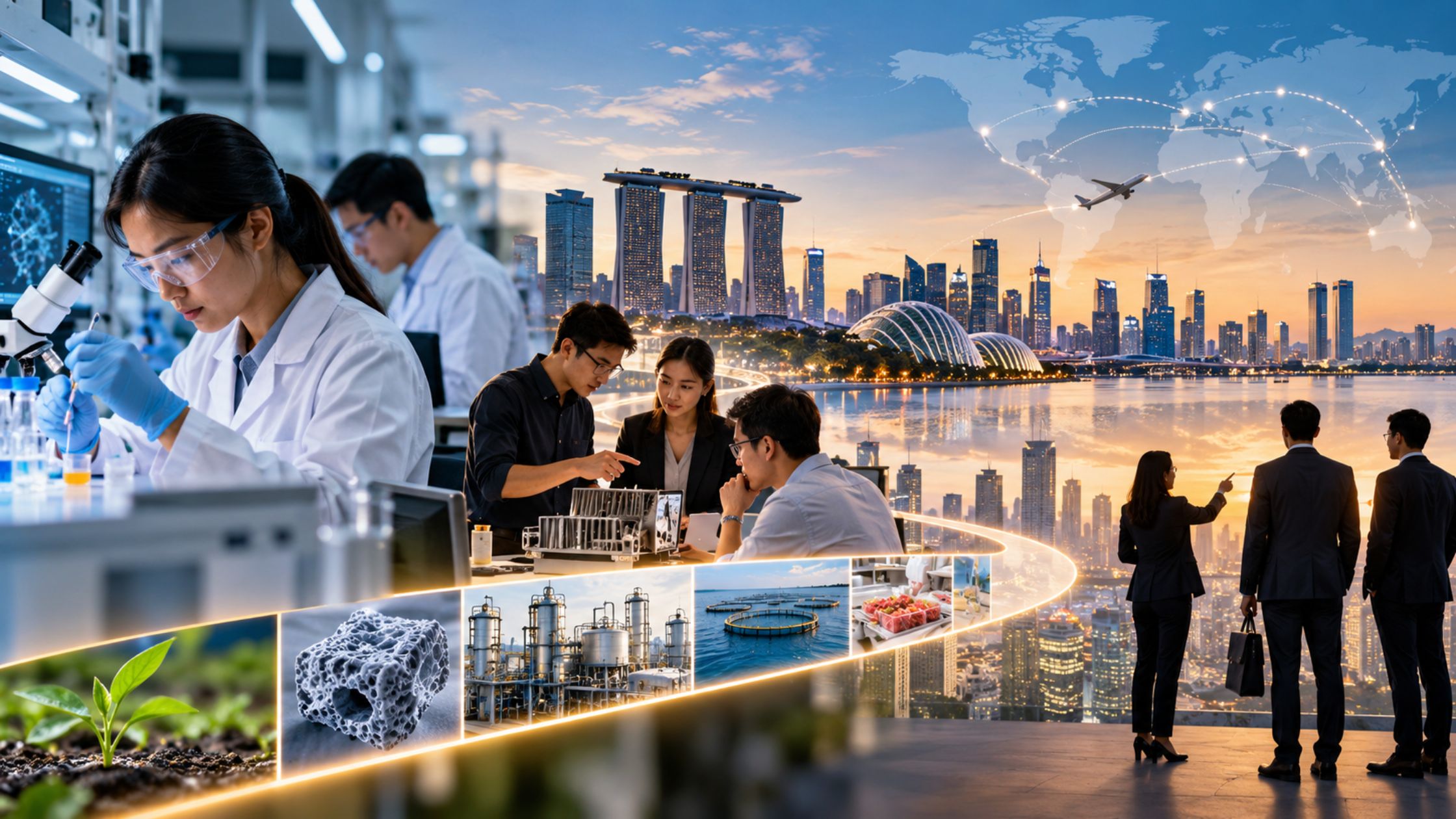
The emerging model is increasingly about connecting capabilities that traditionally operated in separate stages: research institutions, founders, customers, industrial partners, investors and international markets. Singapore’s new Activate Global Fellows programme illustrates that direction. Its inaugural cohort includes five deep-tech startups working across green methanol, carbon capture, metal additive manufacturing, sustainable aquaculture feed and food preservation. Each fellow receives up to S$200,000 in funding and stipend, alongside mentorship and US immersion opportunities. Four of the five startups came through National GRIP.
While conversing with AsiaTechDaily, Anuj Jain, Project Lead and Director of Activate Global Fellows – Singapore at NTU and Director of National GRIP, described the commercialization journey this way:
“Singapore has built an impressive foundation for deep-tech innovation with world-class research institutions, strong scientific and engineering talent, government support, and increasingly sophisticated pathways for translating research into companies. From my experience working across National GRIP and now Activate Global Fellows – Singapore, I would say the challenge is increasingly less about generating good science and more about helping founders navigate everything that comes after the science is validated. The first gap is customer discovery and market understanding. Researchers are trained to ask whether something can work while viable companies need to ask whether someone will pay for it, why they will buy it, and what has to be true for the technology to be adopted. In deep tech, this often means engaging customers much earlier than founders are accustomed to by default. Often this means reshaping the product around a real customer problem rather than simply commercialising with technology first lens from the original research output.
The second is the journey from technical validation to an industrially relevant product. A technology that works in a laboratory can still face significant challenges around reliability, manufacturability, cost, regulation, integration and scale. The quest is to make the technology work repeatedly, economically and within the constraints of a real customer environment. The third is access to the right networks and capital at the right stage. Deep-tech companies often require patient capital because technical development, pilots and industrial validation take time. But founders also need access to potential customers, strategic partners, investors and experienced operators, who can help them make those transitions.
Ultimately, I see the fellowship as helping founders cross three important bridges – from science to customer, from prototype to product, and from a Singapore-based venture to a globally competitive company.”
Singapore’s experience points to a broader shift across Asia. As governments and research institutions invest more heavily in frontier science, the competitive advantage will increasingly depend on what happens between discovery and scale. The ecosystems that can connect researchers with customers, prototypes with industrial environments, and startups with patient capital and international networks will have a better foundation for turning scientific breakthroughs into enduring businesses.
For deep tech, the journey from laboratory to global market is not a single commercialization step. It is a sequence of translations, each requiring different expertise, capital and relationships. The next generation of Asian deep-tech companies will be built not only on what their scientists can invent, but on how effectively their ecosystems can help those inventions find customers, survive industrial reality and compete in global markets.
Similar Articles