AsiaTechDaily – Asia's Leading Tech and Startup Media Platform

The Future of Event Technology Is Real-Time Decision Making
 by
by

As enterprises seek greater returns from exhibitions and conferences, event technology is evolving beyond lead collection into AI-powered intelligence platforms that help businesses qualify opportunities, optimize sales performance, and make strategic decisions while events are still underway.
Trade shows, conferences, and industry exhibitions have long been among the most important channels for business development. Every year, companies invest millions of dollars in booth design, product demonstrations, travel, sponsorships, and sales teams with the expectation that face-to-face conversations will translate into long-term business relationships. Yet despite advances in customer relationship management (CRM), marketing automation, and digital sales platforms, one persistent challenge remains: converting hundreds of event conversations into measurable business outcomes.
Historically, event success has been measured by metrics such as visitor counts, business cards collected, or the number of leads scanned at a booth. Increasingly, however, those indicators are proving insufficient. Enterprise leaders want to understand which conversations are most likely to convert, how sales teams are performing in real time, and what actions should be taken before an event concludes rather than weeks afterward. This shift is driving a new generation of event technology built around artificial intelligence, real-time analytics, and workflow automation.
While conversing with AsiaTechDaily, Ravindraa Thakre, Founder & CEO of Eynthra Solution LLP, observed that one of the biggest lessons from exhibiting at GITEX AI Asia Singapore was that businesses rarely struggle to generate conversations. Instead, the real challenge begins once the exhibition ends and organizations attempt to transform those conversations into structured sales opportunities. His observation reflects a broader transformation taking place across the event technology industry, where the focus is moving beyond lead capture toward real-time decision support.
The Real Challenge Begins After the Exhibition
For many organizations, the most demanding phase of an exhibition starts after the final visitor leaves the venue. Sales representatives return with notebooks, business cards, mobile contacts, photographs of whiteboards, voice notes, and hundreds of conversations accumulated over several days. Organizing this information often depends on manual processes that vary across teams and individuals.
By the time leads are categorized, assigned to account managers, entered into CRM systems, and followed up, valuable momentum may already have been lost. Industry research consistently shows that response speed has a direct impact on sales outcomes. Prospects who express interest during exhibitions often continue evaluating alternatives immediately after an event, making rapid follow-up a competitive advantage rather than simply an operational task. As a result, businesses are increasingly shifting attention from generating more leads to improving how those leads are managed, prioritized, and converted into revenue. This change is redefining what organizations expect from event technology.
From Lead Collection to Real-Time Intelligence
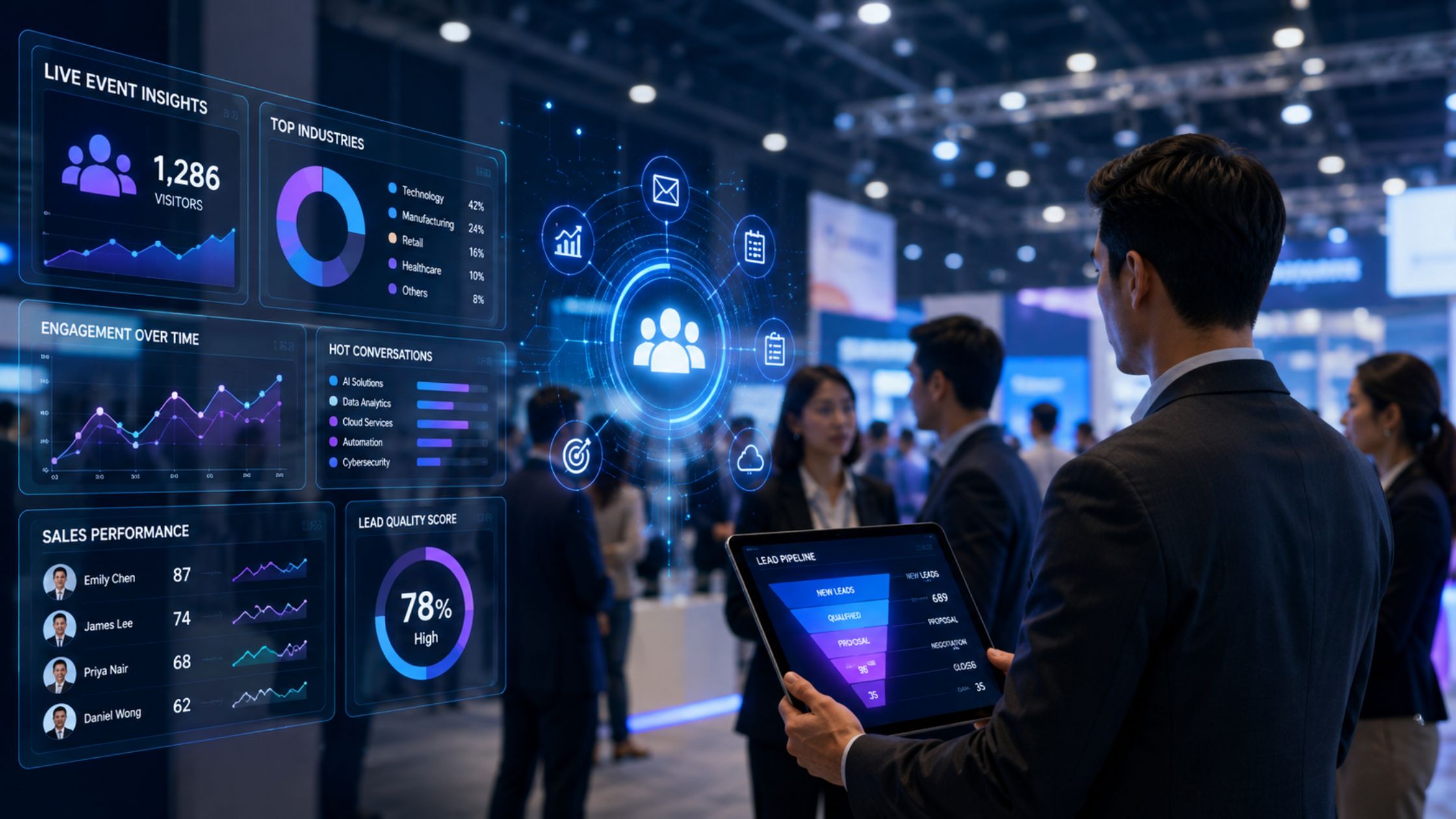
Traditional event technology focused primarily on simplifying registration, attendee management, and lead capture. The next generation of platforms is expanding far beyond these administrative functions. Increasingly, exhibitors expect event technology to provide live operational intelligence that supports decision-making while the event is still in progress. Rather than waiting until after the exhibition to evaluate performance, businesses increasingly want immediate visibility into questions such as:
- Which visitor segments are generating the strongest commercial opportunities?
- Which industries are engaging most actively with the company’s solutions?
- Which sales representatives are capturing the highest-quality conversations?
- What adjustments should be made to demonstrations, staffing, or messaging before the next exhibition day?
Artificial intelligence enables these insights by analyzing conversations, integrating CRM data, summarizing interactions, identifying buying intent, and highlighting emerging trends as they develop. This represents a significant shift in the role of event technology. Instead of simply documenting activity, platforms are increasingly becoming decision-support systems that actively help exhibitors optimize performance throughout the event lifecycle.
AI Is Narrowing the Gap Between Conversations and Conversions
Artificial intelligence is also changing what happens immediately after customer interactions. Modern enterprise sales platforms increasingly automate tasks that previously consumed significant amounts of manual effort.
These include:
- generating conversation summaries,
- assigning leads to appropriate team members,
- prioritizing prospects based on engagement signals,
- recommending personalized follow-up actions,
- synchronizing information across CRM and marketing platforms,
- and tracking the progression of opportunities through the sales pipeline.
The objective is not simply to reduce administrative work. Instead, AI is helping organizations preserve the momentum created during face-to-face conversations by ensuring that valuable opportunities receive timely attention before interest begins to decline. As enterprise software increasingly incorporates agentic AI and workflow automation, event technology is becoming another area where intelligent systems actively support commercial decision-making rather than merely recording business activity.
Events Are Becoming Strategic Sources of First-Party Data
Another factor accelerating this transformation is the growing importance of first-party data. As digital privacy regulations evolve and organizations reduce reliance on third-party tracking mechanisms, exhibitions have become valuable environments for collecting high-quality customer insights directly from prospective buyers. Every conversation provides information that extends beyond basic contact details.
Businesses now seek to understand:
- customer intent,
- purchasing priorities,
- industry-specific challenges,
- competitive positioning,
- product interest,
- and decision-making timelines.
When combined with AI, this information becomes significantly more valuable because it enables platforms to identify patterns across thousands of interactions while recommending actions that improve future engagement.
For many enterprises, exhibitions are no longer viewed solely as marketing events. They are increasingly becoming strategic data collection opportunities that strengthen long-term sales intelligence.
Event Success Is Being Measured Differently
While discussing these changes with AsiaTechDaily, Ravindraa Thakre said conversations with exhibitors at GITEX AI Asia highlighted a consistent pattern across industries.
“One of the most valuable aspects of participating in international technology events is that you get to observe how businesses from different industries approach the same challenge. Whether the exhibitor is an AI startup, a software company, a manufacturing business, or a service provider, the post-event workflow often looks remarkably similar.
Everyone works incredibly hard during the exhibition. Teams spend months preparing their products, marketing material, demonstrations, and customer meetings. Yet once the exhibition ends, they return with hundreds of conversations and very little structure around how those conversations should be managed.
Several AI and software companies we interacted with shared a common challenge. They generated a large number of meaningful discussions during previous events but struggled to follow up consistently because everything depended on manual processes. Sales teams were busy travelling back, catching up on regular work, and organizing notes collected throughout the exhibition. By the time follow-up started, many opportunities had already cooled. That reinforced something we had believed from the beginning. The problem is rarely lead generation. The problem is maintaining momentum after the conversation.”
Organizations increasingly view exhibitions as extensions of their revenue operations rather than isolated marketing campaigns. Consequently, event success is shifting away from measuring booth activity toward understanding pipeline quality, sales execution, and business outcomes.
The Future of Event Technology Is Intelligent Decision Support
The evolution of event technology mirrors a broader transformation taking place across enterprise software. Artificial intelligence is changing business platforms from passive systems that record historical information into active systems that guide decisions in real time. CRM platforms no longer simply store customer information. Analytics platforms no longer merely generate reports. Increasingly, enterprise software is expected to recommend actions, prioritize opportunities, and improve operational performance as work unfolds.
Events are following the same trajectory. Rather than acting as standalone networking opportunities, conferences and exhibitions are becoming dynamic intelligence environments where customer interactions, AI analysis, sales execution, and operational insights converge to influence business outcomes while opportunities are still developing.
For startups building event technology, this represents a significant opportunity. The next generation of platforms is unlikely to compete solely on registration capabilities or digital badge scanning. Instead, differentiation will increasingly come from helping exhibitors understand what is happening in real time, identify their highest-value opportunities, and respond quickly enough to convert conversations into lasting customer relationships. In an increasingly data-driven business environment, the future of event technology will belong to platforms that enable organizations not just to collect information, but to make better decisions when those decisions matter most.
Quick Takeaways
- Event technology is moving beyond lead capture. Businesses are increasingly looking for AI-powered platforms that provide real-time insights and support decision-making while events are still in progress.
- The biggest challenge is no longer generating leads. For many exhibitors, the real issue is maintaining momentum after the event by organizing, prioritizing, and following up with hundreds of conversations before opportunities go cold.
- AI is accelerating post-event sales execution. Intelligent automation can summarize conversations, qualify leads, assign ownership, recommend follow-up actions, and synchronize customer data across CRM and sales platforms, helping teams respond faster.
- Exhibitions are becoming valuable sources of first-party data. Every interaction at an event generates insights into buyer intent, industry trends, customer needs, and purchasing behavior, making events increasingly important for long-term sales intelligence.
- Success metrics are evolving. Organizations are shifting their focus from booth traffic and lead volume to pipeline quality, conversion potential, sales productivity, and measurable revenue outcomes.
- Real-time analytics are becoming a competitive advantage. Businesses increasingly want live visibility into visitor profiles, conversation quality, sales performance, and booth effectiveness so they can adjust strategy before an event concludes.
- Exclusive insight: While speaking with AsiaTechDaily, Ravindraa Thakre, Founder & CEO of Eynthra Solution LLP, said exhibitors consistently reported that the biggest challenge was not generating leads but maintaining momentum afterward. He noted that businesses increasingly expect event technology to deliver intelligent insights and operational visibility in real time, enabling better decisions during the event rather than after it has already ended.
Similar Articles