AsiaTechDaily – Asia's Leading Tech and Startup Media Platform

The Agentic Shift: Why AI Is Moving Beyond the Chatbox
 by
Gauri Ludbe
by
Gauri Ludbe

As enterprises shift from “knowledge engines” to “execution systems,” Animoca Brands’ Yat Siu explains why agentic AI could redefine how work, value, and digital economies operate.
The first phase of mainstream artificial intelligence has been defined by a simple interface: a prompt box, a blinking cursor, and a user waiting for a response. It marked a breakthrough moment—making AI accessible, usable, and widely adopted across industries. But it also created a bottleneck. Across global enterprises in 2026, the strategic pivot is absolute. The race is no longer to build better chatbots; the race is to replace them. Enterprises are shifting from “Knowledge Engines” to “Execution Engines.”
The data confirms the scale of this cognitive re-architecture. As of Q1 2026, 40% of enterprise applications have moved beyond simple text generation to embed task-specific AI agents. These deployments are delivering a 37% faster task completion rate, with high-performing organizations realizing an annual savings of approximately $340,000 per deployed agent.
Speaking recently in an exclusive deep-dive with AsiaTechDaily, Yat Siu, co-founder and executive chairman of Animoca Brands outlined a fundamental pivot currently underway in global boardrooms. ‘They’re using AI basically like a better version of Google,’ Siu told AsiaTechDaily, ‘but they’re not really making it work for you. For Yat Siu, the current obsession with “GPT-mode” is a misdiagnosis of AI’s true potential. To Siu, treating AI like a better Google search isn’t just inefficient, it’s a failure to understand that we have entered the era of machine agency.
The promise of 2026 isn’t a smarter search bar. It is a world where autonomous agents are capable of planning, reasoning, and error correction and handle the heavy lifting of production. What was once the luxury of the ultra-wealthy, a fleet of human assistants is becoming the baseline infrastructure of the digital economy.
This distinction between assistance and execution becomes the foundation of what is now being described as agentic AI.
“One of the first instances where AI agents really became very powerful is coding because they can write the code for you very well. That was the early beginning where people started to realize an AI agent can do the work from beginning to end. But it can do it for everything in your life. Imagine a world where everyone can have a real assistant, not just checking your calendar, but someone who can do actions for you.”
What Siu is pointing to is not an incremental improvement in AI interfaces, but a shift in how intelligence is applied. The first wave of generative AI created systems that could respond, explain, and generate. The next phase is about systems that can act.
Beyond the Interface: Why the Chatbox Model Breaks
Despite the rapid progress in AI capabilities, the dominant interface remains the chatbox. It is intuitive, accessible, and effective for certain tasks. But structurally, it imposes limits. Siu highlights this limitation not as a usability issue, but as an architectural one:
“Very quickly, one of the challenges with ChatGPT or Google search is it’s a single session with limited long-term memory. It answers your question, then you do a new session with a mixed history of your context. It has limited memory, so it’s not really valuable long-term except for information.
An agent has context, and more importantly, the context is mirrored. When I talk to this agent, I know I’m talking to this agent about this stuff. If I have a legal agent for legal reasons, I’m not going to ask it where to have dinner tonight. He’s your lawyer, and you treat him that way. There’s specialization that happens both ways. We used to go to specialized websites; now you have specialized agents.”
What emerges here is a different model of interaction, one that is persistent, contextual, and role-based. Instead of a single interface serving all purposes, users engage with multiple agents, each with defined responsibilities and memory.
This mirrors how human systems already operate. Expertise is distributed, context matters, and relationships persist over time.
The Productivity Unlock: From Assistance to Delegation
The most immediate implication of agentic AI is not technical but that it is economic. It fundamentally alters how human time is allocated. Siu frames this through a lens that is both simple and revealing:
“That’s very valuable because think about how many hours of time you unlock to do more productive things if you have an agent do that type of task. Historically about productivity, I have a housekeeper, you have a driver. On one hand, that’s luxurious. On the other hand, it unlocks productivity because that individual now has extra hours to do other things that are relatively more important to their ability.
But that’s also a limiting factor because you could have all the talent, the idea, but you don’t have the money to outsource part of your life. I firmly believe places like Hong Kong, Dubai, Singapore have very high GDPs, very high output because they have a lot of support. It’s not one person doing the work, it’s one person with an entire fleet of people or services that support them.
With AI agents, that becomes the unlock that everyone could have for a fraction of the cost. That means hours and hours per person productivity unlocked. Imagine a billion people with a few more hours to do other work. At a global scale, you’re talking anywhere from 20 to 50 to 100 billion hours of more time to do important things every week. That’s huge.”
The comparison is deliberate. What was once a function of wealth, access to human assistance becomes a function of infrastructure. Agentic AI, in this sense, does not just improve productivity; it democratizes leverage.
This reframes the entire “job displacement” debate. When productivity is no longer constrained by the cost of human support, the bottleneck to output shifts from human capacity to human intent.
In the 2026 enterprise, the value proposition is no longer about automating the worker; it is about providing every individual with the support infrastructure that was previously reserved for the ultra-wealthy.
We are moving away from a world where labor is a linear cost. The more you want to produce, the more people you must hire to a world where output scales through orchestrated agency. For your readers in the BFSI and tech sectors, this means the competitive advantage will go to those who can best manage this “fleet.” The question is no longer “How do I do more work?” but “How do I manage the agents doing the work for me?”
From Tools to Systems: The Swarm Economy
If individual agents are specialized partners, their collective behavior, the “Swarm” is a new engine of industrial-scale production. Yat Siu highlights that agentic AI introduces a self-replicating growth cycle that bypasses human-constrained software development:
“I’m no longer creating agents; I’m cloning them. Because they possess your specific skills and are built to self-improve, they become ‘living’ software. As they iterate on their own error-correction loops, they essentially create the next, more capable version of themselves.”
This changes the fundamental math of production. Scaling software traditionally requires human labor—designing, coding, and deploying. Here, production moves to machine agency.
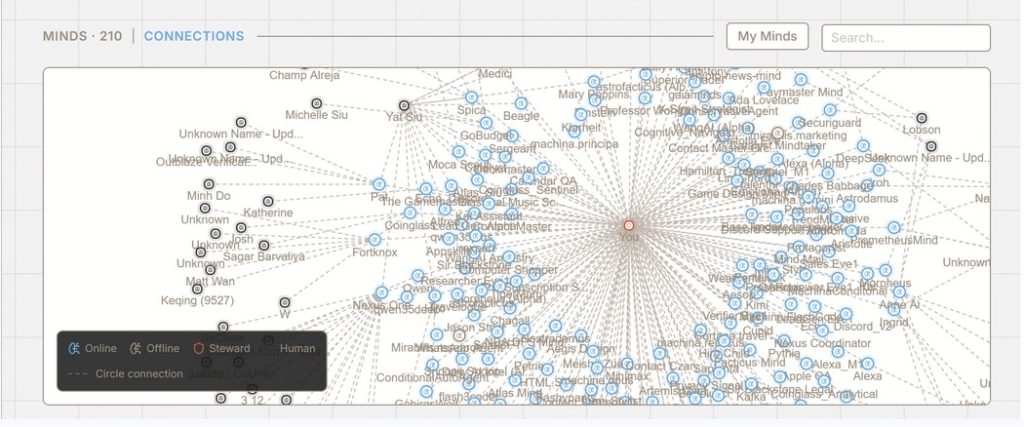
“Think about how many websites you visit in a year,” Siu explains. “That is exactly how many agents you will eventually use. But unlike the early internet, where sites were built by hand, agentic production is 24/7. It doesn’t sleep, and it doesn’t wait for a human to hit ‘deploy.’ We are seeing a shift where agents produce content, software, and even other agents at a pace that will only accelerate.”
This is the shift from linear development to continuous production. By moving from a human-in-the-loop model to a machine-autonomous model, enterprises no longer hire for capacity; they orchestrate a decentralized, high-velocity swarm.
Inside Animoca Minds: Building the Agent Layer
Within this broader shift, Animoca Minds is positioned as an attempt to make agentic AI accessible and scalable. Siu frames the product not as a technical tool, but as an interface designed for everyday use:
“The idea of Animoca Minds is it’s a kind of AI assistant and coworker that my mom should be able to use. Things like Claude coworker are kind of hard, and OpenAI is even harder. As a tool, it’s useful, but Animoca Minds has a personality like your human experience. That’s why we want you to interface over email or chat—it feels like dealing with a coworker, not a robot in a chat box.
With just an email, it forms, and next thing you know, you have your staff, assistant, or health coach. It’s that simple.”
Beneath this simplicity lies a more complex architecture built around shared capabilities and distributed intelligence.
“It’s built on swarm architecture, so when I’m building skills or capabilities, I can easily share those skills and get paid. From a creator standpoint, you create content and applications that other agents buy for human usage, generating income. It’s like a creator economy, a skills playlist.
With YouTube, creators taught you how to do things. Now AI agents can do things. Creators who were teaching how to do it are building skills where you go from ‘how to do it’ to the agent actually doing it.” This transition from teaching to execution represents a significant shift in how value is created and captured.
Blockchain: A Natural Extension in the Agentic Stack
As agents begin to operate continuously and at scale, the question is no longer just what they can do, but how they transact, verify, and coordinate with one another. At that level, infrastructure becomes a constraint. For Yat Siu, blockchain is not an optional layer added to Animoca Minds, it is a requirement that emerges naturally once machines begin interacting economically.
“How do agents pay each other? Credit card? Bank account? PayPal? No. If an agent performs 100 transactions an hour which is trivial- a 2.5% fee structure means you’ve paid a lot in fees. Transaction costs must approach zero, and assets provable on-chain.”
The limitation here is structural. Traditional financial systems were designed for human-scale transactions, not machine-to-machine activity happening continuously. At agent scale, even small inefficiencies compound into system-wide friction. But payment is only one part of the equation. Identity and reputation become equally critical, arguably more so than in human systems.
“Proving who you are or your reputation is more important for agents than it is for humans. Agents need to know which agents belong to whom and whether an agent has a reputable performance record or is a scam agent, for example.”
If agents are the primary interface for consuming and acting on information, the underlying business model of the web begins to change. In that context, blockchain functions less as a user-facing technology and more as a coordination layer—handling identity, settlement, and verification in the background, allowing agent-driven systems to operate without the latency and friction of human-mediated processes.
“Agents are comfortable with blockchain. They read hashes, and do security that humans struggle with.”
CLOSE: The Era of Agentic Sovereignty
The transition to agentic AI is not merely a design update; it is a fundamental reconfiguration of the internet itself. We are moving away from an ad-supported “Attention Economy,” where humans are the product being sold, toward an “Agentic Economy,” where machines act as our proxies to protect our time, manage our capital, and execute our intent.
For the modern enterprise, the competitive advantage will no longer be determined by who builds the most engaging user interface. It will be decided by who can best orchestrate an autonomous swarm. The companies that thrive will not be those that simply automate their existing manual processes, but those that empower their human teams to act as “Architects of Agency”—creating, managing, and governing the specialized agents that drive their production.
As Yat Siu’s vision suggests, the future of the internet is not artificial intelligence in the abstract; it is agentic intelligence with economic sovereignty. By using blockchain as the verifiable settlement layer, these agents gain the ability to hold identity, trade assets, and fulfill contracts without the friction of legacy financial rails. The chatbox was the gateway. But the change belongs to the systems that no longer wait for a prompt because they already understand the goal.
About Animoca Minds
Animoca Minds is an AI platform by Animoca Brands that enables users to deploy AI agents as functional collaborators rather than chat-based tools. Designed for simplicity, it allows agents to be created and used through familiar interfaces like email or chat.
Built on a swarm architecture, the platform supports multiple specialized agents that can share capabilities and work together, while also enabling a skills-based model where creators can develop and monetize agent capabilities.
Quick Takeaways
- AI is shifting from “knowledge engines” to “execution systems,” moving beyond chat-based responses to systems that can complete tasks end-to-end.
- Most users are still in “GPT mode,” treating AI like a better search tool instead of deploying it as autonomous agents that work on their behalf.
- The real impact of agentic AI is economic, unlocking billions of hours of productivity by enabling individuals to operate with a “fleet” of digital workers.
- The chatbox model breaks at scale due to lack of memory, continuity, and specialization, pushing the need for persistent, role-based agents.
- The next phase is not single AI tools but multi-agent “swarm” systems that operate continuously, self-improve, and scale without human constraints.
- This shift changes how software is built, moving from human-driven development to machine-driven, 24/7 production.
- Blockchain becomes essential infrastructure, enabling low-cost transactions, identity, and trust for machine-to-machine interactions.
- The broader transition is from an attention economy to an agentic economy, where systems act on behalf of users rather than waiting for instructions.
Similar Articles