AsiaTechDaily – Asia's Leading Tech and Startup Media Platform

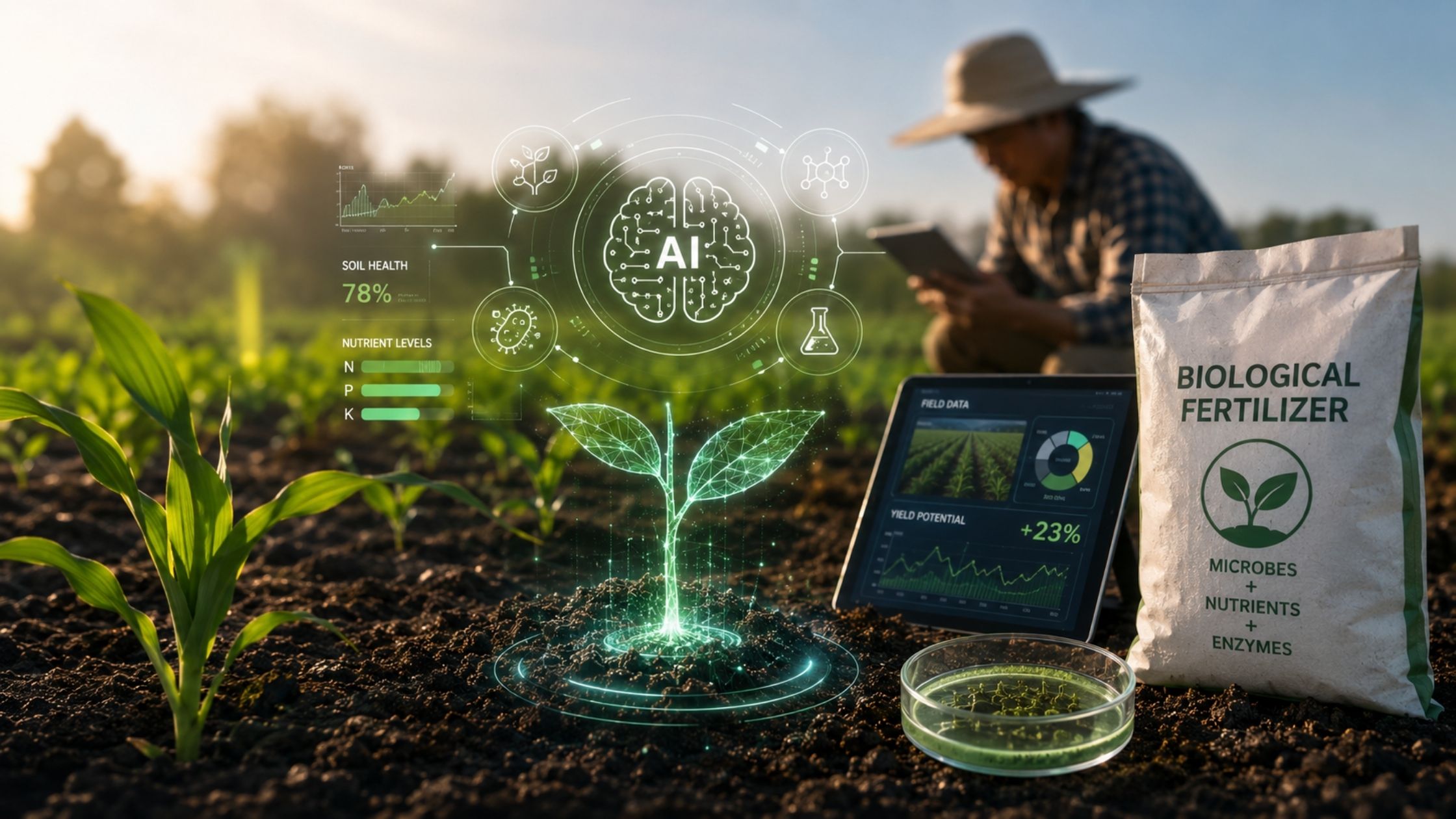
Can AI Make Biological Fertilizers Commercially Viable at Scale?
 by
Byungho Lim
by
Byungho Lim

AI is accelerating biological research and formulation, but making bio-based crop inputs commercially viable will depend on field performance, farmer economics, manufacturing and regulation
Agriculture is entering a period in which the case for biological inputs is becoming stronger, but so is the difficulty of making them work consistently at commercial scale. In Southeast Asia, where agricultural systems are dominated by smallholders and exposed to tropical soil conditions, climate variability and imported input costs, the challenge is particularly pronounced.
The region is also facing renewed pressure to reduce dependence on conventional fertilizers. A recent analysis by the ISEAS-Yusof Ishak Institute argued that ASEAN should strengthen support for agricultural biologicals and reconsider fertilizer policies that can favor conventional inputs, while noting that more regional research is needed on soil health, yields and resilience.
Artificial intelligence is emerging as a potential tool in this transition. Recent research shows that AI is increasingly being applied across agricultural biotechnology, including soil and nutrient management, crop improvement and microbial biotechnology.
The bigger question, however, is whether AI can solve more than the research problem. For biological fertilizers to become commercially viable, companies still have to demonstrate consistent field performance, develop products that make economic sense for farmers, navigate regulatory systems and manufacture and distribute them reliably.
Biologicals face a consistency problem
Unlike conventional fertilizers, biological inputs can interact differently with crops, soils and environmental conditions. Microorganisms, biological compounds and plant-microbe interactions can be affected by temperature, soil composition, crop variety, moisture and application timing. That variability creates a fundamental commercialization challenge. A biological product that performs well under controlled conditions does not necessarily produce the same result across thousands of farms.
The experience of Brazil’s soybean sector demonstrates both the potential and the importance of local adaptation. Research and field programs around nitrogen-fixing bacteria have helped make biological inputs widely used in Brazilian soybean production, but the underlying microbial solutions were developed around local crops and conditions rather than treated as universally transferable products.
AI could help address part of this problem by allowing companies to process far larger volumes of scientific and field data when developing formulations.
AI can shorten the formulation cycle, but field trials still matter
For biological-input companies, one of AI’s most important applications may be connecting scientific knowledge with observations from actual farms.
Avika Narula, COO of Living Roots, explained to AsiaTechDaily that the company’s Hypha system is designed around this approach:
“Hypha is our AI engine grounded in first-principles biochemistry. It’s built on a knowledge graph from over 2 million scientific papers, protein-structure models, and 1.2 million data points from our own fields. It maps how a crop’s enzymes, nutrients, and yield connect, so every recommendation traces to a biochemical reason. This is data from smallholder farmers built from ground truth data. In product development, it works like this: plant sap and soil diagnostics tell us what is actually limiting a farmer’s field, not what a textbook says should be. Hypha proposes formulations for that specific crop, soil condition, and growth stage: which microbes and cofactors, at what dose, and in which window of the season. Our team finalizes every formulation, and field trials keep the veto. Measured results feed back into the model, so accuracy compounds with every acre. Our products are not customized for each acre, they are general products, but through data we learn how nutrients are actually moving in the plant. The advantage is speed and scale. Conventional biological formulation produces one static product, designed once, usually for temperate US row crops, then sold unchanged everywhere. Tropical smallholder farming is the opposite of static: soils vary from field to field, and monsoon stress shifts the limiting factor within a season. Agronomic expertise does adapt, but it doesn’t scale; one good agronomist can only walk so many fields. Hypha encodes what our best agronomists and the literature know and applies it to every field at once, cutting formulation iteration from months to weeks. Pairing that with data grounds this knowledge with how nutrients actually flow through land.”
The significance of this model is not that AI eliminates agricultural experimentation. Rather, it can potentially reduce the time and cost involved in generating and testing new hypotheses.
That distinction is important. Recent research into AI-driven microbial biotechnology identifies applications ranging from microbial profiling and metabolic modeling to the discovery of biofertilizers and biocontrol agents, while also highlighting challenges around data quality, interpretability, standardization and validation.
Commercial viability starts with the farmer
Even if AI makes biological product development faster, adoption ultimately depends on farm-level economics. For smallholders, the decision is unlikely to be based on the sophistication of the underlying model. Farmers need evidence that an input can deliver sufficiently reliable improvements in yield, input efficiency or resilience to justify its cost and the risk of changing established practices.
This is already visible in Southeast Asia’s experience with regenerative agricultural practices. A 2026 study examining biochar adoption across the region found that sustained adoption among smallholders remains limited, with labor requirements and opportunity costs among the barriers. Adoption was stronger where farmers had specific production needs or sufficient scale to support the economics. The same principle applies to biological fertilizers. A product can be scientifically promising but commercially weak if farmers cannot access it, apply it correctly or see a predictable economic return.
Regulation and manufacturing remain outside the AI model
Biological inputs also face challenges that software cannot solve. Regulatory systems differ across countries, and biological products can be difficult to classify and evaluate because their mechanisms and compositions may not fit neatly into frameworks designed around conventional agricultural chemicals. Quality control and manufacturing create another challenge. Biological products must be produced consistently, transported and stored appropriately, and delivered to farms within the relevant agricultural cycle. These issues become particularly important in Southeast Asia, where agricultural systems span multiple countries with different regulatory structures and highly varied production environments.
The region’s fertilizer economics also make the opportunity more urgent. Recent disruptions to fertilizer and fuel supply chains have increased pressure on farmers in major Southeast Asian agricultural markets, while climate risks are adding another layer of uncertainty to production.
AI may be an enabler, not the entire business model
Living Roots’ recent funding from Epic Angels reflects growing investor interest in biological inputs designed specifically for tropical agriculture. The company has positioned its technology around biological fertilizers, field data and AI-driven formulation, while expanding its work with agricultural businesses across Southeast and South Asia. But the broader investment thesis will depend on whether companies in this category can demonstrate repeatable commercial outcomes. The opportunity for AI is therefore less about replacing agronomists or creating a universal fertilizer formula. Its greater potential may be in making biological R&D more iterative, data-driven and responsive to regional conditions. That could lower one of the industry’s development bottlenecks. It does not remove the others.
AI could make biological fertilizers faster to formulate and easier to adapt to the complexity of tropical agriculture. But commercial viability will ultimately be determined beyond the model. Farmers need predictable economic returns. Manufacturers need consistent production. Regulators need credible evidence. Distributors need products that can move efficiently through fragmented agricultural markets. For biologicals, the next stage of growth is therefore unlikely to be defined by AI alone. The stronger businesses will be those that connect AI and biological science with field validation, manufacturing, distribution and farmer economics. In that sense, AI may not make biological fertilizers commercially viable by itself. It may instead make it possible to build the data and development infrastructure required to find out which biological solutions actually can scale.
Quick Takeaways
- AI could help overcome a key bottleneck in agricultural biologicals: slow and expensive product development and formulation.
- Tropical agriculture is particularly challenging because soil, climate, crops and farming conditions can vary significantly across farms.
- Field data is critical: AI can combine scientific research with real-world farm data to identify nutrient and biological relationships that may not be apparent from conventional agronomic knowledge alone.
- AI does not replace field trials or agronomists. Its value is in accelerating formulation and making expert knowledge more scalable.
- Farmer economics remain the ultimate test. Biological fertilizers must demonstrate reliable yield, productivity or input-efficiency benefits that justify their cost.
- Regulation, manufacturing and distribution remain major barriers that AI cannot solve on its own.
- Southeast Asia could be an important proving ground because of its large smallholder farming base, diverse agricultural conditions and growing interest in biological inputs.
- The broader investment question is whether AI can reduce the commercialization risk of biologicals, turning promising agricultural science into repeatable, scalable businesses.
Similar Articles