AsiaTechDaily – Asia's Leading Tech and Startup Media Platform

AI Is Turning Creative Professionals Into Quality-Control Systems
 by
by

Generative AI is taking over more of the production process, but the human role is shifting toward directing, evaluating and correcting machine-generated work. That could make creative judgment more valuable while disrupting how the next generation learns the craft.
Generative AI has made producing creative content dramatically faster. Images, layouts, campaign concepts and variations that once required hours of manual work can now be generated in minutes. But as the cost of producing creative output falls, another part of the workflow is becoming more important: deciding whether the output is actually good enough to use.
That shift is already visible in the labor market. Adobe’s June 2026 research, based on two waves of US job postings, a survey of 1,433 working creatives and an 11-country study of 3,300 people training to enter creative professions, found evidence of redistribution rather than outright replacement. US creative professional job postings increased 8% between September 2025 and April 2026, while the share explicitly requiring AI skills rose from 10% to 15%. Adobe’s research suggests creative work is moving away from first-pass production toward selection, direction, client negotiation and accountability.
The result could be a new role for creative professionals: not simply producing content, but becoming the quality-control layer between AI and the audience.
From making the work to judging the work
Traditional creative workflows generally moved from brief to concept, production, editing and approval. Generative AI compresses much of that production stage. A designer can generate dozens of concepts. A photographer can create multiple environments around a product. A retoucher can automate complex editing. The resulting abundance changes where human expertise matters. If a team can generate 100 images instead of five, the problem is no longer simply producing enough content. Someone has to determine which image accurately represents the product, fits the brand, avoids visual errors and is appropriate for publication.
Adobe’s research points toward precisely this transition. The company found that AI is increasingly being used at the beginning of creative workflows for ideation and at the end for production and post-production, while human work is moving toward selection, direction and accountability. That makes creative judgment a potential bottleneck.
What this looks like inside commercial production
Vincent Chow, Founder and General Manager of SnappyFly, sees the transition directly in commercial product photography. The company has moved from traditional photography to automated production and AI-assisted workflows. That has changed what its photographers, designers and retouchers are expected to contribute.
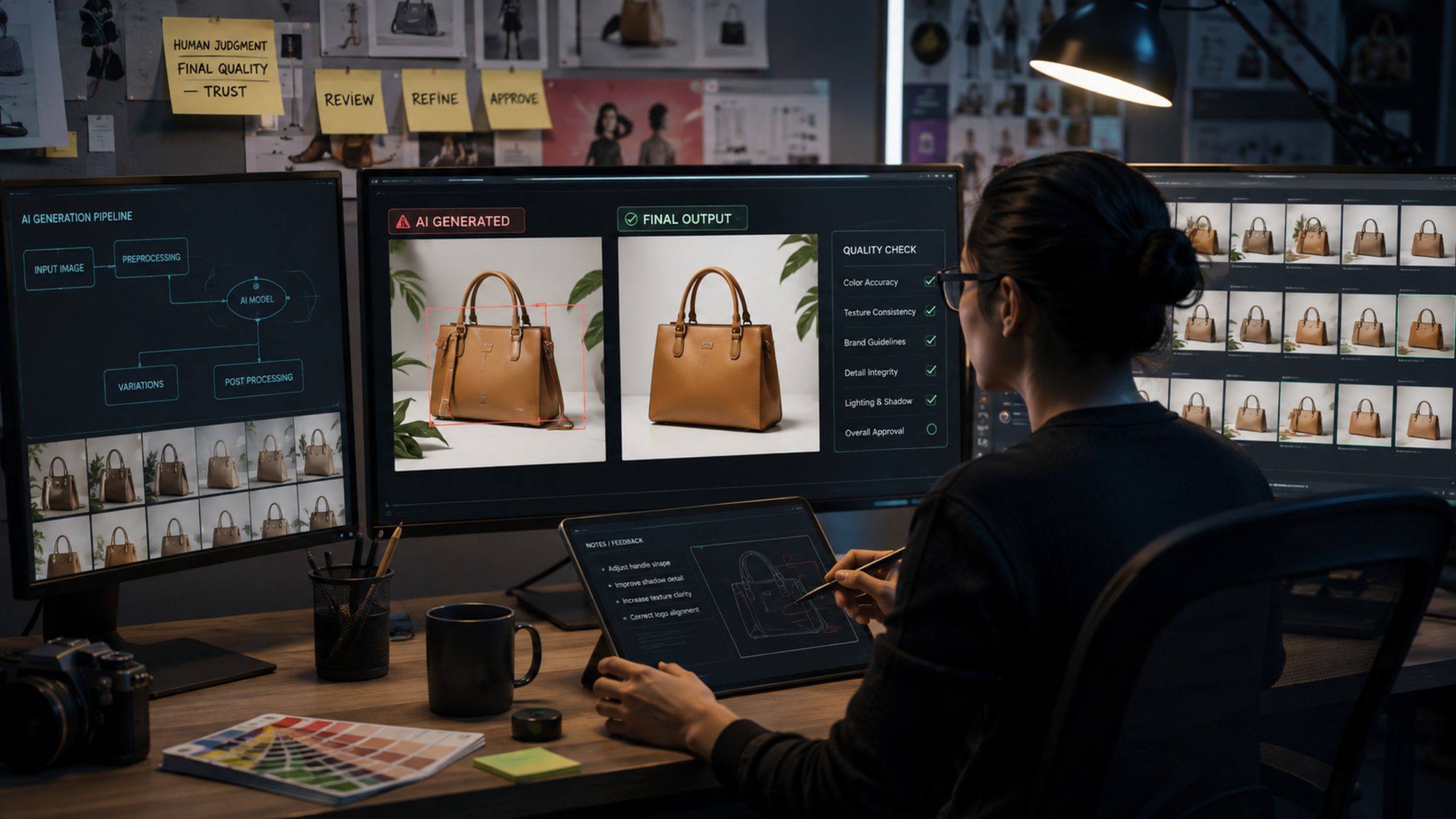
While conversing with AsiaTechDaily, Chow explained that AI is reducing demand for some traditional production tasks, but that the roles themselves are being reorganized: “Absolutely. There is no hiding that AI will reduce demand for such roles. As generative AI technology continues to improve, it will become even more accurate, faster and more easily available. There are tasks that photographers, retouchers, designers and content creators perform today that will increasingly be automated with AI. That said, I don’t expect roles to be fully replaced, but rather, roles will evolve. Skillsets of photographers, designers and retouchers, will be redeployed in different ways to support content production using AI. That is the case with our team as well. In our own workflow, our product photographers’ value is no longer limited to skillsets in controlling lighting, operating the camera and creatively styling the sets. Instead, our photographers now need to understand how a product should be captured with his or her skillets, so that it can be used downstream by our AI platform. With knowledge of how generative AI works, they need to be creative in deriving methodologies to generate specific types of images accurately and reliably. One of our designer’s tasks now will be to study AI-generated outputs and spot how they differ from actual shot images. Thereafter, to deduce how we can refine our generation techniques, to create better images. Our retouchers are now trained to spot differences in generated outputs and original product image, so as to carry out post-editing to ensure accuracy in final deliverables.”
The example illustrates a broader shift. The photographer becomes responsible for creating a reliable source asset for an AI system. The designer increasingly evaluates machine-generated results. The retoucher becomes a verification layer. The human is still inside the creative process, but closer to its decision points.
When creative output becomes abundant, judgment becomes scarce
The economics of generative AI make this shift particularly important. Adobe’s April 2026 research found that creative professionals were using AI on more than 40% of their projects on average, while nearly nine in 10 said generative AI had improved their work. The productivity gain, however, does not necessarily mean that human input becomes less important. In fact, the opposite may happen. When AI can rapidly generate multiple plausible options, humans need stronger criteria for selecting among them. A visually convincing image can still contain a distorted product, an incorrect detail or a brand inconsistency. The faster machines generate content, the greater the potential volume of content that needs evaluation.
Adobe’s August 2026 research on Indian creators illustrates this tension. Ninety-eight percent of creators surveyed said creative AI helps them produce content faster, but 72% said AI outputs typically require moderate or extensive editing before they are ready to share. Seventy-seven percent said human judgment remains essential to creative taste. AI therefore does not remove the need for a human decision. It can increase the number of decisions that humans have to make.
The emerging creative professional will need more than traditional craft expertise. Increasingly, the valuable combination may include:
- Understanding how AI systems behave and where they fail
- Evaluating outputs for accuracy, originality and brand consistency
- Designing workflows that combine human and machine capabilities
- Applying cultural and contextual judgment that automated systems may miss
- Taking responsibility for the final published result
The World Economic Forum’s Future of Jobs Report similarly identifies AI and big data as among the fastest-growing skills through 2030, while creative thinking, analytical thinking, resilience and lifelong learning are also expected to increase in importance.
The implication is not that traditional creative skills suddenly become irrelevant. Instead, they increasingly have to operate alongside technological and evaluative skills.
The problem AI could create for the next generation
There is, however, a deeper labor-market risk. Creative careers have traditionally been built through repetitive, entry-level work. Junior designers learn by producing variations. Photographers learn by assisting on shoots. Retouchers build judgment through hundreds of corrections. Many of those tasks are now among the easiest for AI to automate.
Adobe’s research found a sharp difference between established creatives and people trying to enter the profession. While experienced professionals are selectively incorporating AI into existing workflows, many entrants see AI as a way to access creative careers. Adobe is also studying how this may alter the traditional apprenticeship path into creative work.
That creates a paradox: AI may make experienced creative professionals more productive while simultaneously reducing some of the work through which inexperienced professionals become experienced.
The real transformation is not replacement
The debate over AI and creative work is often framed as a question of whether machines will replace photographers, designers and other creative professionals. The more consequential question may be where humans remain responsible. As generation becomes cheaper and faster, the value of the creative professional could increasingly shift toward knowing what should be generated, identifying what is wrong, improving what the machine produces and deciding what deserves to reach the audience. That does not guarantee that creative employment will remain unchanged. Some production tasks will disappear, teams may become smaller and expectations for output will rise.
But the emerging model is more complicated than replacement. AI can produce the image. It can generate the variations. It can automate the repetitive work. Someone still has to decide whether the machine got it right. And as creative production becomes increasingly automated, that judgment may become the most valuable part of the job.
Quick Takeaways
- AI is shifting creative work from production to judgment. Photographers, designers and retouchers are increasingly expected to direct, evaluate and refine AI-generated content.
- The human role is becoming a quality-control layer. Accuracy, brand consistency, visual judgment and final approval remain difficult to automate reliably.
- Creative output is becoming abundant, making selection more valuable. As AI generates more variations at lower cost, deciding which outputs are commercially useful becomes a bigger part of the workflow.
- SnappyFly’s workflow shows this transition in practice. Its photographers now prepare source images for downstream AI use, while designers and retouchers evaluate and correct generated outputs.
- AI skills are becoming part of creative careers. The emerging skill set combines traditional creative expertise with AI fluency, evaluation, workflow design and quality assurance.
- There is a potential apprenticeship problem. If AI eliminates routine entry-level creative tasks, newcomers may have fewer opportunities to develop the practical judgment traditionally gained through that work.
- AI will not affect every creative role equally. Routine production work is more exposed, while roles involving direction, judgment, context and accountability may become more important.
- The central shift is from “making” to “deciding.” AI can increasingly produce the content, but creative professionals still need to determine whether the machine got it right.
Similar Articles