AsiaTechDaily – Asia's Leading Tech and Startup Media Platform

Teaching robots to feel, how does Robbyant’s LingBot-Touch tackle the challenge?
 by

Robbyant’s answer is a unified tactile language trained on nearly 5,000 hours of touch. Meta, academic labs and Chinese sensor startups are chasing the same goal — with no shared scoreboard to settle who leads.
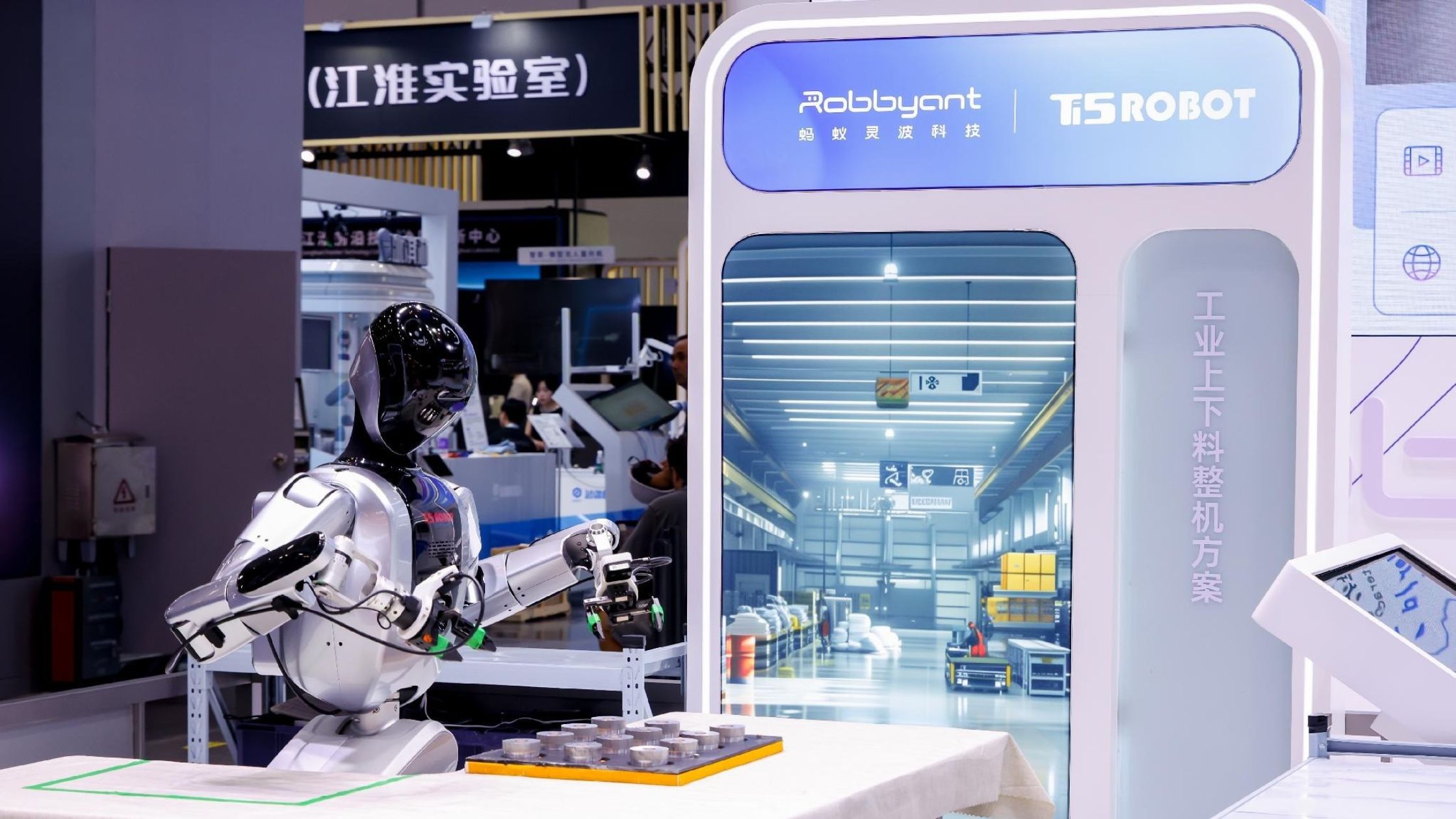
The hardest part of machine touch is that touch does not travel. Sensors split across piezoresistive, magnetic and camera-based families, each speaking its own signal language: a model trained on one hand rarely survives a change of hardware. Robbyant, the embodied AI company under Ant Group, is the latest lab to tackle that challenge. Its answer, open-sourced on 10 November, is LingBot-Touch — a tactile foundation model pretrained on nearly 5,000 hours of touch recordings that turns the three families’ signals into one set of reusable tactile tokens. Adding its frozen features to four robot action policies lifted average task success by 13.9 to 24.8 percentage points across 26 real-world tests. The release is the newest entry in Robbyant’s open “LingBot” family, which has drawn more than 1,800 teams into a competition with a real-robot final in Shanghai this month.
A crowded, young field
Robbyant’s answer lands in a crowded field: since late 2024, Meta, academic labs and Chinese sensor startups have published open models, datasets and sensor designs chasing touch that transfers across hardware. The closest analogue is Meta FAIR: in October 2024 the lab released Sparsh — which it calls the first general-purpose encoder for vision-based tactile sensing, pretrained on more than 460,000 tactile images — alongside Digit 360, a fingertip sensor with more than 8 million taxels that registers forces as small as 1 millinewton, with GelSight signed up to manufacture it and Wonik Robotics building a tactile-enabled Allegro hand.
Academic groups shipped their own: UniTouch (CVPR 2024) aligns camera-based touch with vision, language and sound; T3 (CoRL 2024) aggregates more than 3 million data points from 13 sensors; and FTP-1 (2026), a generalist tactile policy pretrained on roughly 3,000 hours from 21 sensors, reports a 31 per cent success-rate gain on sensor setups it never saw during training.
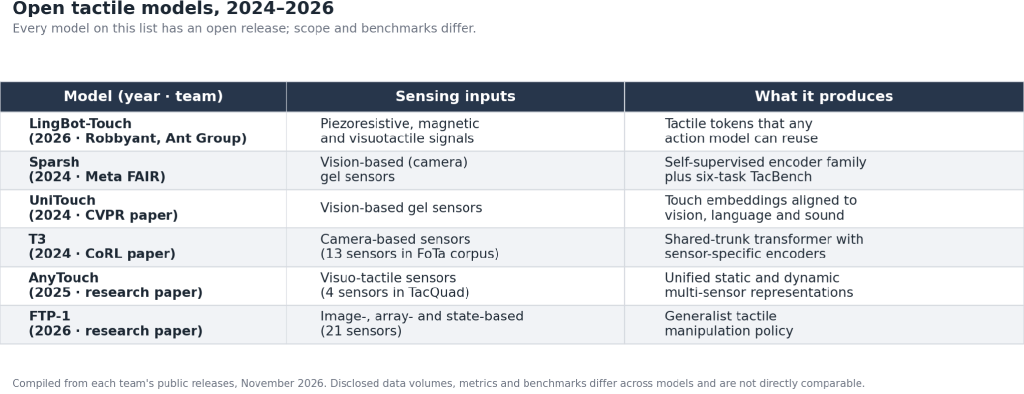
Open tactile models published since 2024, as each team describes its own release. Compiled by Asia Tech Daily from public documentation.
Below the model layer, Shenzhen’s PaXini says it has shipped more than one million tactile chips and raised more than 4 billion yuan from investors including BYD and Samsung, while Shanghai’s Xense Robotics raised a 100 million yuan pre-Series A round in October 2025. Those companies sell the body; the model builders are bidding to supply the shared brain.
Three bets on what machine touch is
Most open models — Sparsh, UniTouch, T3, AnyTouch — learn from camera-based gel sensors, the cheapest tactile data to collect. FTP-1 trains a manipulation policy rather than a reusable representation. Of the models surveyed here, only LingBot-Touch’s pretraining spans all three families at once, mapping every sensor’s taxels into one canonical fingertip space for a shared transformer — its direct answer to the fragmentation problem. It is also small: the Tiny encoder carries 5.46 million parameters, and its 4,983-hour corpus is the largest recording-hours figure disclosed among these releases, though hours, images and data points measure different things.
A scoreboard that does not exist
Every team reports wins; none runs the same experiment. Robbyant’s figures come from 26 real-robot tasks on two dexterous hands, Sharpa Wave and XHand, with frozen features added to four action models at post-training: LingBot-VLA, Physical Intelligence’s open π0.5, Diffusion Policy and T-Rex. Mean success rose from 21.6 to 35.6 per cent for Diffusion Policy and from 48.3 to 73.1 per cent for LingBot-VLA, and the tactile features won 89 of 104 task-and-policy combinations, according to the technical report.
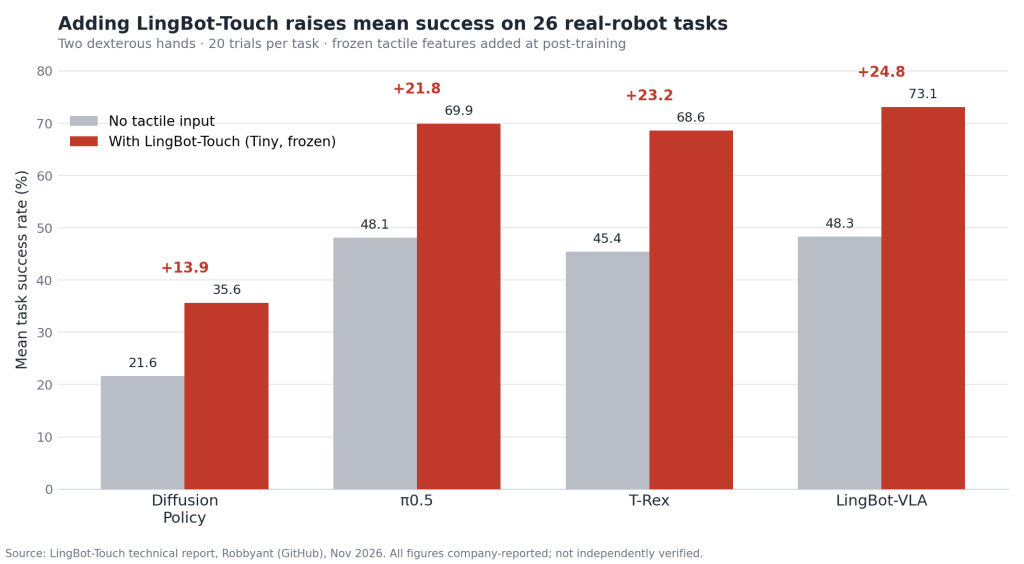
Company-reported mean success rates for four action policies on 26 real-robot tasks, with and without LingBot-Touch. The figures have not been independently verified.
The rivals’ numbers answer different questions: Meta reports Sparsh beating task-specific training by an average of more than 95 per cent on its six-task TacBench, and Robbyant’s report pits its model against FTP-1 on probing tasks only. All of the figures are self-reported, and none has been independently replicated. One honest limit: a brand-new taxel layout still needs a one-off geometric calibration before the encoder can read it.
Open weights, open hardware, closed numbers
The strategies differ as much as the architectures. Meta opened models, sensor designs and manufacturing partnerships at once, betting an open ecosystem makes its hardware the default. Robbyant’s bet is compatibility — a representation any hand or policy can reuse, tied to the open competition around its LingBot-VLA models. NEURA Robotics went the other way in October, folding touch into its closed commercial model, Neuron AI.
How far the answer travels, though, depends on a scoreboard the field does not share: a common benchmark — same sensors, same hands, same tasks — of the kind ImageNet gave computer vision. Until then, Robbyant’s 4,983 hours of contact recordings are its strongest argument: in machine touch, the scarce resource is not architecture but data.
Similar Articles