AsiaTechDaily – Asia's Leading Tech and Startup Media Platform

Geekplus’s New RoboShuttle Hyper Targets the Next Bottleneck in Warehouse Automation
 by
Byungho Lim
by
Byungho Lim
The climbing AMR is designed to increase throughput and robot concurrency within existing warehouse footprints as fulfillment operations face faster inventory cycles and rising order volumes
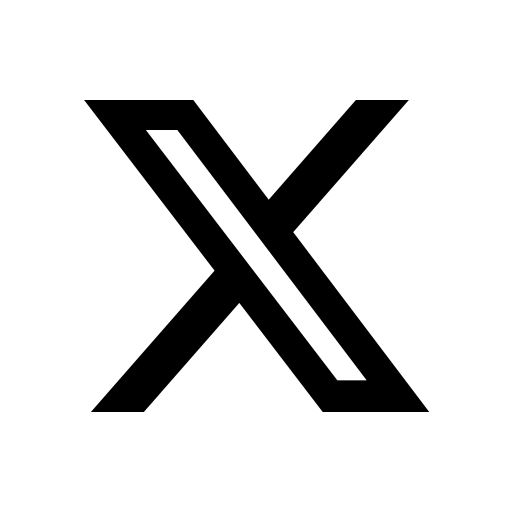
Geekplus has launched RoboShuttle Hyper, a new climbing autonomous mobile robot (AMR) for high-volume goods-to-person warehouse operations, as fulfillment operators face increasing pressure to process more inventory without expanding their physical footprint.
The system is designed for B2C ecommerce, fresh food and cold-chain fulfillment, consolidation warehouses and micro-fulfillment centers. Geekplus says RoboShuttle Hyper can handle up to 6,000 totes per hour per 1,000 square meters and support 50% higher robot concurrency than the industry norm. Geekplus has identified faster inventory turnover among some customers as one factor driving that requirement. The company says inventory cycles for some customers have shortened from around 30 days to 15 days, and in some cases to 10 days.
The Asia Pacific warehouse automation market is expanding alongside ecommerce, manufacturing and logistics investment, increasing demand for systems that can handle higher volumes while making efficient use of available warehouse space. Geekplus itself currently describes RoboShuttle as a high-bay, high-density tote-to-person system capable of operating in racks reaching up to 11 meters.
The development of Hyper follows the limits Geekplus encountered with its existing RoboShuttle Flex system. Jason Zang, Global Product Line Leader for RoboShuttle Hyper at Geekplus, told AsiaTechDaily that changes in customer inventory cycles were a significant factor behind the new system.
“Over the past few years, some customers have seen their inventory cycles shorten from 30 days to around 15 days, and in some edge cases as short as 10. This translates to a 2-3 times increase in throughput per square meter. We found this throughput had reached the limits of our Roboshuttle Flex solution. To address this changing market demand, we began developing a higher throughput solution in 2024 and released the Roboshuttle Hyper product in 2026.”
Higher robot concurrency is central to the design
Geekplus says RoboShuttle Hyper can operate with 50% higher robot concurrency than the industry norm. The system uses parallel horizontal and vertical climbing, allowing multiple robots to operate across adjacent rack columns. According to the company, only two rack columns need to be locked during operation, compared with four to six columns in conventional configurations. Hyper also supports dual-robot operation within the same column.
Its double-deep, dual-pass and bidirectional retrieval configuration is designed to reduce climbing cycles and increase storage density. Geekplus says two aisles running beneath a single rack increase robot path density by 30% compared with the industry average. These changes address a fundamental issue with adding robots to an automated warehouse. Increasing the number of machines does not necessarily produce a proportional increase in output if robots have to wait for access to storage positions or for other machines to clear their routes.
The objective with Hyper is therefore not simply to increase the number of robots, but to increase the number that can operate concurrently without creating additional constraints within the storage system.
Climbing tracks presented the main engineering challenge
The move toward higher concurrency also created a significant engineering challenge around the system’s climbing infrastructure. Zang said the company had to develop tracks that would allow multiple robots to climb simultaneously while maintaining operational stability and keeping installation requirements manageable.
“As is well known in warehouse automation, achieving higher robot concurrency requires enabling more robots to climb shelves simultaneously. The most challenging aspect was designing the climbing tracks. How to allow multiple robots to climb simultaneously while ensuring stable operation and simple installation required significant effort and extensive testing.”
Hyper can climb at speeds of up to 1.5 meters per second, according to Geekplus. The company says new motion-control algorithms are intended to improve travel and positioning accuracy, while a 1:10 charge-to-discharge ratio is designed to maintain robot availability during peak operating periods. The system’s scheduling software can coordinate up to 5,000 robots across 50,000 square meters and three million storage locations, according to Geekplus. The accompanying Max Workstation uses dual-point continuous tote feeding and can exceed 800 totes per hour, the company says.
Increasing the number of robots operating within a warehouse also increases the importance of system reliability. A failure, misaligned tote or interruption in a densely utilized system can potentially affect multiple downstream processes. Geekplus says Hyper addresses this through a column-rail-integrated structure with decoupled beam loading, multi-layer fall protection that limits tote fall distance to 50 millimeters or less, and real-time tote misalignment detection and re-centering.
The system is also compatible with Geekplus’ RoboSafe safety vest solution. These features are relevant to the economics of high-throughput automation. A system’s maximum theoretical throughput is only useful if it can maintain consistent performance under variable order volumes and peak operating conditions.
The actual output achieved in a warehouse will also depend on factors such as SKU distribution, order profiles, workstation capacity, software integration and system utilization. Geekplus’ stated throughput figures should therefore be understood as company-reported system specifications rather than guaranteed operating performance across all deployments.
Hyper expands Geekplus’s tote-to-person portfolio
RoboShuttle Hyper joins two existing systems in Geekplus’ tote-to-person portfolio. RoboShuttle Air is designed for stable, fixed-takt operations in finished-goods and manufacturing warehouses, while RoboShuttle Flex is designed to accommodate large SKU ranges, different container types and fluctuating order volumes. Hyper is aimed at environments where throughput and storage density are the primary requirements, including high-volume ecommerce, fresh food, cold-chain operations, consolidation warehouses and micro-fulfillment centers.
The company has also been expanding the broader RoboShuttle platform. In March, Geekplus introduced RoboShuttle V5, integrating its Robot Arm Picking Station with tote-to-person operations. Geekplus identified manual picking at workstations as a potential bottleneck in conventional tote-to-person systems and designed V5 to automate that stage.
Hyper is compatible with Geekplus’ Robot Arm Picking Stations as well as its Gino 1 general-purpose humanoid robot, connecting the new climbing system with the company’s broader warehouse automation architecture. Geekplus says more than 950 global industry leaders use its robotics solutions. Its current portfolio spans tote, shelf and pallet automation as well as sorting and intralogistics systems.
Quick Takeaways
- Geekplus has launched RoboShuttle Hyper, a next-generation climbing AMR designed for high-throughput goods-to-person warehouse automation.
- Geekplus says Hyper can handle up to 6,000 totes per hour per 1,000 square meters, targeting higher output without proportionally increasing warehouse footprint.
- The system is designed for B2C ecommerce peaks, fresh food and cold-chain fulfillment, consolidation warehouses, and micro-fulfillment centers.
- The development was driven by changing inventory cycles. Geekplus says some customers have seen cycles fall from 30 days to around 15 days, and in some cases 10 days, creating a need for 2 to 3 times more throughput per square meter.
- 50% higher robot concurrency is one of Hyper’s key design changes. Multiple robots can climb and operate within adjacent rack columns simultaneously.
- Hyper requires only two rack columns to be locked, compared with four to six under what Geekplus describes as the industry norm, and supports dual-robot operation within the same column.
- The system uses double-deep, dual-pass and bidirectional retrieval to reduce climbing cycles and increase storage density.
- Geekplus says two aisles beneath a single rack increase robot path density by 30% compared with the industry average.
- The Max Workstation supports dual-point continuous tote feeding and can exceed 800 totes per hour, according to Geekplus.
- Hyper can climb at up to 1.5 meters per second and uses motion-control algorithms designed to improve travel speed and positioning accuracy.
- Geekplus says its scheduling system can coordinate up to 5,000 robots across 50,000 square meters and 3 million storage locations.
- The main engineering challenge was designing climbing tracks that allow multiple robots to operate simultaneously while maintaining stability and simplifying installation, according to Jason Zang, Geekplus’ Global Product Line Leader for RoboShuttle Hyper.
- Reliability features include tote misalignment detection and re-centering, multi-layer fall protection, and a column-rail-integrated structure.
- Hyper joins Geekplus’ existing RoboShuttle Air and RoboShuttle Flex solutions, giving the company separate systems for different warehouse requirements.
- The broader takeaway: warehouse automation is increasingly moving beyond simply replacing manual movement toward maximizing throughput, robot concurrency and output per square meter within existing facilities.
Similar Articles