AsiaTechDaily – Asia's Leading Tech and Startup Media Platform

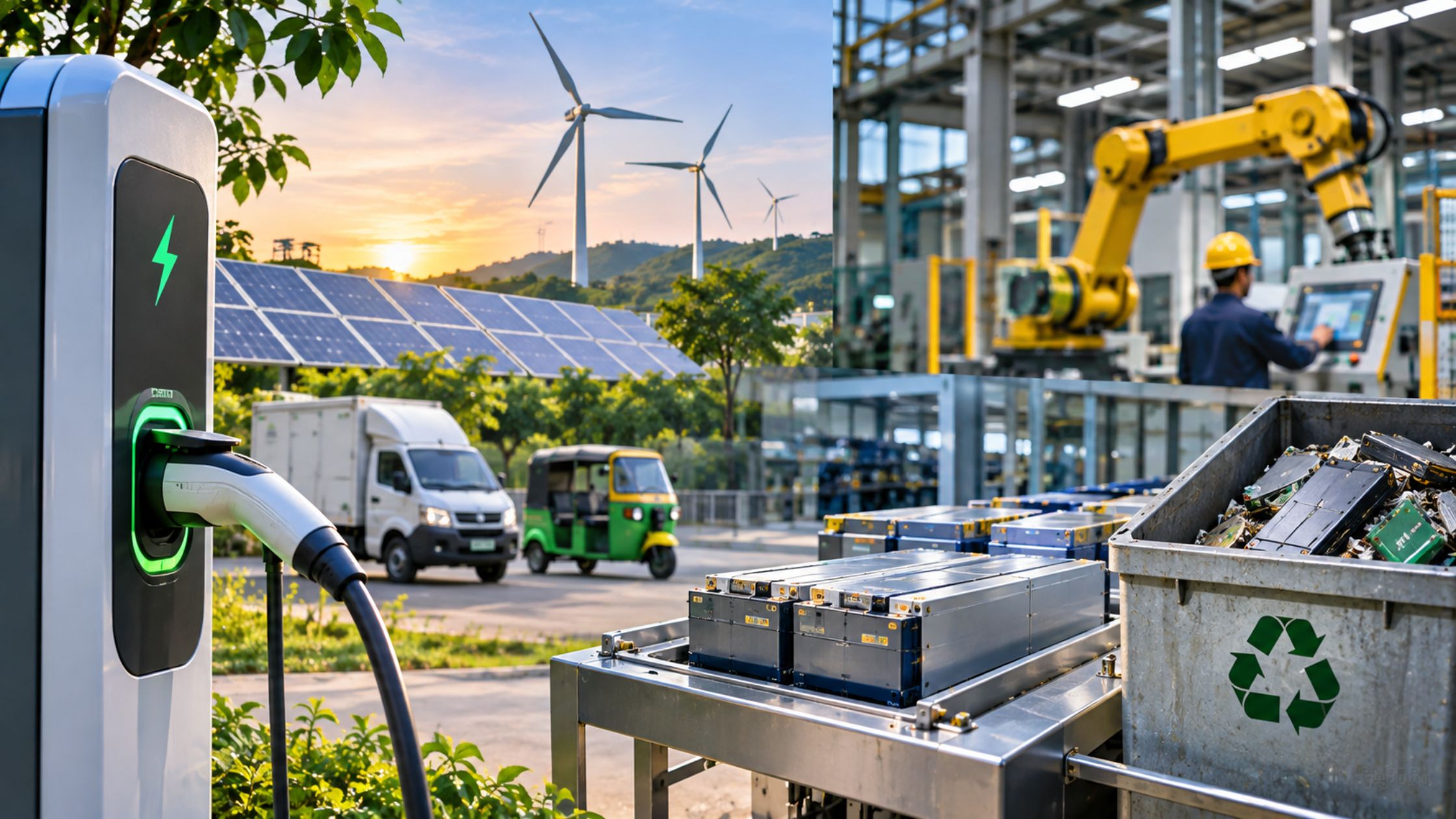
India’s Climate-Tech Opportunity Is Moving Beyond Solar and Wind
 by

As energy security and domestic manufacturing reshape investment priorities, EV components, battery recycling, charging infrastructure and supply-chain technology are emerging as critical parts of India’s clean-energy transition.
India’s climate-tech investment landscape is shifting beyond renewable-energy generation towards the technologies, components and infrastructure needed to scale the energy transition. Between January and May 2026, Indian climate-tech companies raised US$791 million across 74 equity funding rounds. However, five late-stage deals accounted for US$564 million, or 71% of the total, highlighting how capital remains concentrated in a small number of large transactions, according to Ostara Advisors’ Climate Tech and Deep Tech Review: 2026 in Deals, and What 2027 Looks Like. The figures point to a market attracting substantial capital but with investment concentrated in a relatively small number of transactions. Ostara’s outlook for 2027 identifies deep technology, energy storage, green-asset financing and energy-efficient data-center infrastructure as priority areas. The broader shift reflects a growing recognition that India’s energy transition depends not only on deploying clean energy, but also on strengthening domestic supply chains and addressing infrastructure bottlenecks.
Electric vehicle manufacturers and battery technologies have attracted considerable attention, but businesses supplying components, charging infrastructure and recycling systems are also essential to the transition. Vasudha Madhavan, founder and CEO of Ostara Advisors, said, “While EV OEMs and battery tech get most of the attention, critical areas like component manufacturing, B2B charging infrastructure, battery recycling, and supply chain tech are still underfunded. These segments are essential to building a resilient ecosystem but often get overlooked due to longer gestation cycles and complex models.”
These businesses can be harder to finance than consumer-facing platforms. Component manufacturers must invest in production capabilities and meet technical requirements, while charging operators need suitable locations, grid connections and sufficient utilisation to generate returns. Battery recycling companies must establish collection networks and demonstrate that material recovery can be commercially viable.
Battery Recycling Becomes a Resource-Security Issue
Battery recycling is increasingly relevant not only to waste management but also to India’s efforts to strengthen access to critical materials. Recovering lithium, cobalt, graphite and other materials from used batteries could support domestic supply chains, although the economics depend on collection volumes, processing costs, recovery rates and battery chemistry.
In May 2026, India and the European Union announced a €15.2 million joint initiative to advance EV battery recycling. The programme supports advanced material recovery, digitalised collection and sorting systems, and a jointly developed pilot line in India to demonstrate recycling processes under real-world conditions. It aims to improve recovery of strategic materials and strengthen a circular battery value chain.
Ostara’s report identifies battery recycling and rare-earth alternatives as part of a broader investment opportunity in domestic manufacturing and critical technologies. It points to companies operating across recycling and materials recovery, including Lohum, ACE Green Recycling, BatX and Recyclekaro. However, recycling cannot eliminate import dependence on its own. Its contribution will depend on the availability of end-of-life batteries, effective collection systems and the ability to recover materials at competitive costs and the required quality.
EV Adoption and Infrastructure Must Develop Together
India’s clean-mobility market also differs from those of Western economies. Two- and three-wheelers and commercial applications, including logistics and last-mile mobility, play an important role in adoption. Affordability and operating economics therefore influence demand alongside environmental considerations.
Madhavan highlighted this distinction while conversing with AsiaTechDaily: “One of the common misconceptions about the Indian clean mobility market is that it tracks global trends! The Indian clean mobility market stands out in its uniqueness as well as its similarity to other emerging markets rather than the western markets. Firstly, two- and three-wheelers account for almost 75% of the EV market in India. Also, EVs used as commercial vehicles for logistics or last-mile mobility drive far greater adoption and growth. Even for the EV car segment, cost and value-for-money plays a key role in purchase decisions. Once the Indian consumer gets this value proposition, there is no looking back! Hence, a solution built for India has to factor in local market realities.”
She also said charging infrastructure in Tier 2 and Tier 3 cities is generally lagging behind adoption, citing limited grid capacity, fewer commercial incentives and slower returns as obstacles. The gap creates opportunities for charging operators and related infrastructure businesses, but their expansion will depend on utilisation, power availability and viable business models.
The financing needs of climate-tech companies vary significantly. A software business tracking supply chains may scale without owning major physical assets, while a component manufacturer, charging network or recycling facility may require substantial investment before reaching commercial maturity.
Madhavan said infrastructure-heavy businesses commonly combine debt and equity to finance growth. “Low-cost debt from Development Financing Institutions (DFIs) or Energy Transition-focused financing institutions can go a long way in supplementing high-cost equity when investing in critical infrastructure or assets required to grow these businesses.”
Ostara’s report identifies a growth-capital gap for deep-tech companies moving from early-stage funding towards larger commercial operations. It also points to the development of India-domiciled growth funds and the government’s Research, Development and Innovation scheme as potential sources of support. Whether these mechanisms can consistently finance companies through manufacturing and deployment remains an important question.
A Broader Climate-Tech Investment Landscape
Beyond mobility and recycling, Ostara identifies energy storage, green-asset financing and energy-efficient data-center infrastructure as areas to watch in 2027. Storage can help manage the variability of renewable power, while green financing can support clean-technology adoption among households and businesses. Data-center expansion could increase demand for reliable electricity, cooling, water management, grid equipment and storage.
The report also highlights green hydrogen, nuclear power, compressed biogas, carbon markets and solar manufacturing as areas where policy developments could influence investment through FY2027-FY2028. These remain distinct markets, with different technology, regulatory and commercial risks.
India’s climate-tech opportunity is therefore becoming more diverse, but a wider range of investment themes does not guarantee that all will attract capital or achieve commercial scale. The next phase of the transition will depend on whether India can convert growing demand and policy support into durable domestic capabilities. Beyond solar and wind, the challenge is to build competitive supply chains, reliable infrastructure and financing models that allow critical technologies to move from development to deployment. The measure of progress will be not only how much capital is raised, but how much value and technological capability can be built in India.
Quick Takeaways
- Climate-tech investment is broadening: Capital is moving beyond renewable-energy generation towards energy storage, EV components, battery recycling and supporting infrastructure.
- Funding remains concentrated: Indian climate-tech companies raised US$791 million across 74 equity rounds between January and May 2026, but five late-stage deals accounted for 71% of the total.
- EV supply chains present an opportunity: Component manufacturing, B2B charging infrastructure, battery recycling and supply-chain technology remain underfunded despite their importance to a resilient EV ecosystem.
- Battery recycling is gaining strategic importance: India-EU collaboration is supporting efforts to recover critical materials and strengthen domestic battery supply chains.
- Infrastructure is a key constraint: Charging networks face challenges involving grid capacity, utilisation and commercial viability, particularly beyond major cities.
- Financing needs to match business models: Capital-intensive climate-tech companies may need a combination of equity and lower-cost debt to scale.
- New investment areas are emerging: Energy storage, green-asset financing, energy-efficient data centers, green hydrogen, nuclear power and carbon markets could shape the next phase of investment.
- Commercial viability will determine winners: Policy support and investor interest must translate into scalable technologies, competitive domestic manufacturing and sustainable business models.
Similar Articles