AsiaTechDaily – Asia's Leading Tech and Startup Media Platform

AI’s Move From Pilot to Production Is Changing What Enterprises Expect From Kubernetes
 by
by

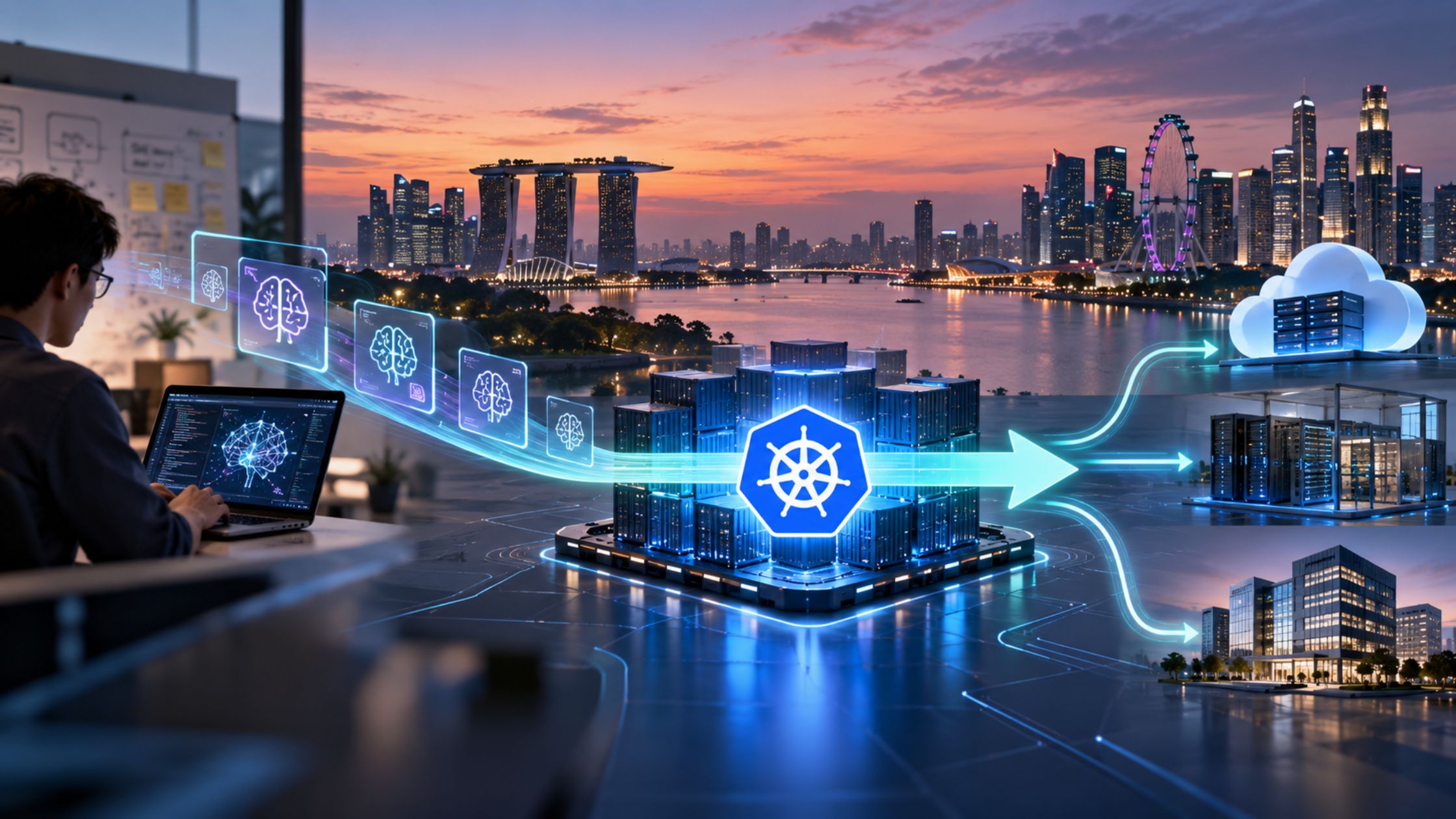
As organizations take AI beyond experimentation, Kubernetes is evolving from a container orchestration platform into part of the operating infrastructure for inference, agents and enterprise AI.
Kubernetes is becoming a more important part of the infrastructure behind enterprise AI, but organizations are still figuring out how to run AI workloads reliably at scale. The Cloud Native Computing Foundation’s 2026 Annual Cloud Native Survey found that 82% of container users now run Kubernetes in production, up from 66% in 2023. At the same time, 66% of organizations hosting generative AI models use Kubernetes for some or all of their inference workloads. Yet AI operations remain far less mature: only 7% of organizations deploy AI models daily, while 47% do so occasionally. The gap is shifting attention from simply deploying AI to building the infrastructure, reliability and operational controls required to keep it running in production.
This makes Kubernetes more than a platform for containerized applications. As AI moves beyond pilots into inference, agents and enterprise workflows, organizations are increasingly asking whether their Kubernetes environments can support the performance, scalability, governance and resilience that production AI demands.
The numbers reveal an important gap. Kubernetes has reached production maturity, but enterprise AI operations are still catching up. As AI moves from pilots into continuous workloads, enterprises are discovering that running a model is only one part of the problem.
From a Working Model to a Reliable AI System
A successful AI pilot can operate under relatively controlled conditions. Production AI cannot. Once models serve customers or employees continuously, infrastructure teams have to manage latency, availability, accelerator utilization, model versions, deployment rollouts, observability, security, governance and cost. CNCF describes this transition as the move from a working model to a reliable AI system, with many of these requirements falling squarely into the traditional responsibilities of cloud and platform engineering.
This is changing what enterprises expect from Kubernetes. The platform increasingly has to accommodate expensive and specialized resources such as GPUs, support predictable inference and provide the scheduling and networking capabilities required by distributed AI workloads. Kubernetes itself is evolving accordingly.
The latest Kubernetes 1.37 release, for example, advances Workload-Aware Scheduling, with workload and PodGroup APIs, gang scheduling and workload-aware preemption moving to Beta. These capabilities are designed to handle complex distributed workloads where multiple components need to be scheduled together, a requirement increasingly relevant to AI and other high-performance computing workloads. The significance is broader than a new set of Kubernetes features. AI is changing the infrastructure expectations around Kubernetes itself.
The evolution of the surrounding ecosystem reinforces that shift. In August 2026, CNCF graduated Kubeflow as a mature, production-ready platform for cloud-native AI and machine learning operations. Its scope spans data processing, distributed training, fine-tuning, inference and model serving across public, private and hybrid clouds. CNCF explicitly connected the project’s graduation to enterprises seeking to move AI from experimentation into production.
At the same time, the Kubernetes ecosystem is expanding toward workloads that go beyond conventional model serving. Persistent AI agents can maintain state, interact with tools, execute tasks and potentially operate for much longer periods than a conventional inference request. That creates a different infrastructure problem. Enterprises need platforms that can manage not only where a model runs, but also how AI workloads are scheduled, monitored, secured, scaled and recovered. In other words, Kubernetes is becoming part of an AI operating layer rather than simply a place to deploy containers.
Asia’s AI Adoption Is Moving Into the Harder Phase
The transition is particularly relevant across Asia, where governments and enterprises are pushing AI adoption while confronting the practical challenges of implementation. Singapore offers a useful illustration. A Ministry of Manpower study released in April 2026 found that 28.5% of firms had adopted AI, but only 3.8% were integrating it into core processes. Among the firms that had adopted AI, implementation costs and lack of in-house expertise were significant barriers, while larger companies cited integration complexity and data security concerns.
Singapore’s Infocomm Media Development Authority has similarly described the next challenge as moving from pilots to secure, scalable implementation, citing technical barriers, operational complexity and cybersecurity risks.
This distinction matters for the wider Asian market. As enterprises move AI into core workflows, infrastructure decisions that may have been secondary during experimentation become business-critical.
That includes data protection and recovery. While conversing with AsiaTechDaily, Mark Tan, Vice President, Tech Data Singapore & Tec D Malaysia, described a shift he is seeing in conversations with customers and partners across Singapore and Malaysia:
“What we are seeing is a change in the questions customers and partners are asking. Kubernetes is increasingly supporting applications and workloads that organisations depend on, so the conversation is no longer only about how quickly they can develop and deploy. It is also about what happens when something goes wrong – how quickly they can recover, what data is at risk, and what the impact is on the business.
AI is accelerating that shift as more organisations look at how they move workloads from pilots into production. Considerations such as data residency and sovereign AI are also influencing where workloads and data are hosted. For many organisations, the reality will be a mix of public cloud, private cloud and on-premises infrastructure, making resilience across those environments increasingly important.
What this means in practice is that data protection is starting to become part of the conversation much earlier. Customers and partners are thinking about how workloads will be protected and recovered as part of the overall architecture, alongside infrastructure and security. Once Kubernetes is supporting applications the business depends on, that becomes a business continuity question, not simply an IT consideration.”
His observation reflects a broader change in the definition of production readiness. An AI system that performs well but cannot be monitored, secured, scaled or recovered reliably is not necessarily production-ready in an enterprise sense.
What Enterprises Will Expect From Kubernetes
As AI workloads become more central to business operations, enterprises will increasingly evaluate Kubernetes across several dimensions:
- Performance: efficient allocation of GPUs and other specialized resources
- Reliability: predictable operation, scaling and recovery
- Observability: visibility into infrastructure, model and application behavior
- Governance: control over data, models, access and workloads
- Resilience: recovery of applications and data after failures
- Portability: movement across public cloud, private cloud and on-premises environments
These requirements suggest that the next stage of Kubernetes adoption will be less about simply running containers and more about providing a dependable operating foundation for increasingly complex AI systems.
The movement from AI pilots to production is therefore also a test of enterprise infrastructure maturity. Kubernetes has already established itself as a production platform. The next challenge is making the infrastructure around it capable of supporting AI continuously, economically and reliably. That changes the question enterprises should be asking. It is no longer simply whether Kubernetes can run an AI workload. It is whether the platform can support the entire lifecycle of an AI system, from deployment and inference to security, governance, observability and recovery.
As AI becomes embedded in business processes, the competitive advantage may increasingly come not from demonstrating what a model can do, but from building the infrastructure that allows it to keep doing it reliably in the real world.
Quick Takeaways
- Kubernetes is becoming AI infrastructure: 66% of organizations hosting generative AI models now use Kubernetes for some or all inference workloads.
- The pilot-to-production gap remains significant: Kubernetes is mature in production, but only 7% of surveyed organizations deploy AI models daily.
- Production AI requires more than model performance: Enterprises need infrastructure for GPU management, scaling, observability, security, governance, cost control and recovery.
- Kubernetes is evolving for AI: New scheduling, resource allocation and workload-management capabilities are being developed specifically for increasingly complex AI workloads.
- Asia is entering the harder phase of AI adoption: Singapore’s 28.5% firm-level AI adoption rate contrasts with only 3.8% integrating AI into core processes.
- AI is changing resilience requirements: As AI workloads become business-critical, backup, disaster recovery and workload mobility become part of production architecture.
- Hybrid infrastructure is becoming important: Data residency, sovereignty and AI requirements are pushing enterprises toward combinations of public cloud, private cloud and on-premises infrastructure.
- The infrastructure around the model matters: Production readiness increasingly depends on whether enterprises can operate AI reliably, securely and continuously, not simply demonstrate that a model works.
- The next Kubernetes question is operational: The focus is shifting from “Can Kubernetes run this AI workload?” to “Can Kubernetes reliably operate the entire AI lifecycle?”
Similar Articles