AsiaTechDaily – Asia's Leading Tech and Startup Media Platform

Counterfeit Medicines Are Moving From a Manufacturing Problem to a Supply-Chain Problem
 by
by

As pharmaceutical networks become more global, digital and fragmented, protecting patients increasingly depends on controlling the journey of a medicine after it leaves the factory.
The counterfeit medicine problem is often framed as a manufacturing challenge: illegal operators produce fake drugs, regulators seize them and legitimate pharmaceutical companies attempt to protect their brands. But the structure of modern pharmaceutical commerce is making that definition increasingly incomplete. The World Health Organization (WHO) estimates that more than one in 10 medicines in low- and middle-income countries are substandard or falsified. The organization says increasingly complex global supply chains are contributing to the problem, with medicines potentially manufactured in one country, packaged in another and distributed across borders before reaching patients. E-commerce has added another layer by making medicines easier to purchase from unauthorized sources.
The implication is significant: a medicine does not necessarily become vulnerable because it was manufactured illegally. It can become vulnerable because the supply chain around a legitimate product is difficult to monitor.
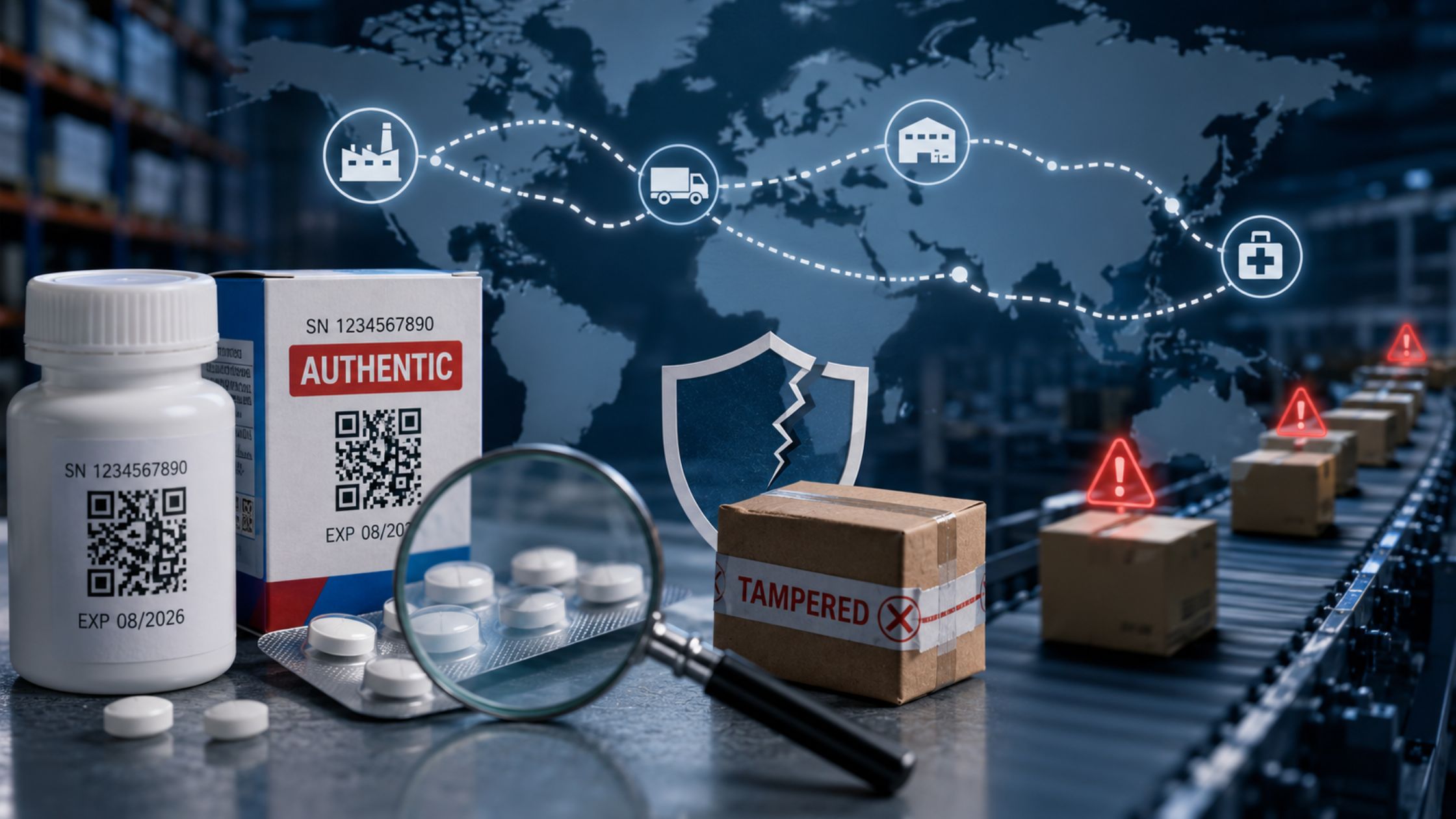
Pharmaceutical distribution can involve manufacturers, importers, distributors, wholesalers, pharmacies, hospitals and increasingly digital marketplaces. Every additional handoff introduces another point at which provenance can become difficult to establish.
WHO has previously noted that substandard and falsified products can enter legitimate supply chains at the distribution level through hospitals, clinics, pharmacies and wholesalers that obtain products from unknown sources or intermediaries without sufficient due diligence. Longer supply chains create more opportunities for weak links.
This changes the central question for pharmaceutical supply-chain security. It is no longer enough to ask whether a medicine was manufactured according to specification. Companies and regulators also need to establish where the product went, who handled it and whether its identity and condition remained intact throughout the journey.
That distinction becomes particularly important as pharmaceutical markets become more cross-border. South Korea, for example, recorded pharmaceutical exports of more than US$10 billion in 2025 for the first time, reflecting the increasing international reach of its pharmaceutical and biopharmaceutical sector. As products move through more markets, maintaining manufacturing quality is only one part of preserving trust.
The digital supply chain is creating new entry points
The expansion of online pharmaceutical commerce has made the problem more complicated. Consumers can increasingly encounter medicines through websites, social-media accounts, messaging channels and online marketplaces rather than conventional pharmacies.
The scale of the illicit digital market was illustrated by INTERPOL’s Operation Pangea XVIII in March 2026. The operation across 90 countries and territories resulted in the seizure of 6.42 million doses of unapproved and counterfeit pharmaceuticals worth US$15.5 million. Authorities also disrupted approximately 5,700 criminal-linked websites, social-media pages, channels and automated bots.
The significance goes beyond the number of products seized. The pharmaceutical supply chain now has a digital layer where unauthorized sellers can reach consumers directly, potentially bypassing traditional distribution controls. Demand also shapes the threat. Counterfeiters have historically targeted everything from inexpensive pain medicines to high-value oncology products, while newer demand for lifestyle and weight-management drugs is creating additional opportunities for illicit sellers. The result is a supply chain that is increasingly difficult to define geographically or operationally.
Technology can trace a product, but cannot guarantee its journey
The pharmaceutical industry has responded with serialization, barcodes, QR codes, RFID, digital verification systems and other track-and-trace technologies. These tools can establish a digital identity for products and provide greater visibility into transactions. But there is an important limitation: digital traceability is not automatically physical traceability.
A database can show that a product was transferred from one party to another. It cannot, by itself, guarantee that the physical package corresponds to that record, that an unauthorized product was not substituted or that an intermediary was legitimate. This is why authentication increasingly needs to be combined with operational controls.
The strongest systems are likely to involve several layers: verified sourcing, authorized distributors, product-level identification, transaction records, anomaly detection and verification at the point of dispensing. Artificial intelligence could also become useful in identifying unusual purchasing, pricing or distribution patterns. But AI is more effective when it has reliable supply-chain data to analyze. Technology cannot compensate for missing visibility at the underlying physical layer.
Fragmented markets reveal the importance of controlling the chain
The challenge is particularly visible in fragmented pharmaceutical markets, where multiple wholesalers and informal channels can separate pharmacies from licensed manufacturers.
Speaking with AsiaTechDaily, Kazi Ashikur Rasul, Co-founder and CEO of PulseTech, described why his company has focused on controlling that chain rather than relying solely on product-level assurances.
“In any fragmented market, counterfeits enter the network through informal channels and unregulated wholesalers. We eliminate this by sourcing directly from licensed manufacturers and do the last mile delivery to retail pharmacies with our own logistics team. This end-to-end control lets us monitor every step of the supply chain and guarantee that only authentic medicines reach pharmacies. We mainly measure the impact through pharmacy retention and repeat purchasing. We currently retain 98% of the pharmacies we serve on a monthly basis, which reflects the trust they place in the reliability and authenticity of our supply. The more these pharmacies rely on us, the more patients get consistent access to authentic medicines. By serving 14,000 pharmacies, we now reach around 8.5 million patients, and that scale, combined with our controlled supply chain, is how we turn authenticity from a claim into a measurable outcome.”
The figures are company-reported, but the underlying principle is broader: authenticity becomes considerably harder to guarantee when a distributor cannot establish who supplied a product and how it moved through the network.
Contamination shows why the problem extends beyond counterfeits
Supply-chain integrity is also about more than fake packaging. In 2025, WHO and the United Nations Office on Drugs and Crime warned about contaminated medicines and pharmaceutical ingredients, including cases in which toxic industrial chemicals were substituted for pharmaceutical-grade ingredients. The organizations documented at least 25 contamination incidents over roughly nine decades that resulted in more than 1,300 deaths. These cases demonstrate that risk can enter at multiple stages, including the sourcing of ingredients and materials before a finished medicine reaches a distributor. That makes pharmaceutical safety a systems problem rather than a single-point manufacturing problem.
The pharmaceutical industry’s traditional quality model has centered on manufacturing standards, testing and regulatory approval. Increasingly, that model needs to be complemented by provenance, distribution visibility and endpoint verification. For Asia’s pharmaceutical markets, this is becoming more consequential as manufacturers expand across borders and consumers increasingly purchase through digital channels. The factory gate, in other words, can no longer be treated as the end of the quality-control process.
A medicine can be perfectly manufactured and still enter a vulnerable distribution network. Conversely, a sophisticated traceability platform is of limited value if the physical chain is not controlled. The next phase of pharmaceutical supply-chain security will therefore be less about building a single technology that identifies counterfeit products and more about connecting technologies, authorized participants and operational controls across the entire journey. The industry’s challenge is no longer simply to make a medicine genuine. It is to prove that it remained genuine from manufacturer to patient.
Quick Takeaways
- Counterfeit medicines are increasingly a supply-chain problem, not just a manufacturing problem.
- Every handoff creates a potential vulnerability, from licensed manufacturers and distributors to wholesalers, pharmacies, and online sellers.
- Digital commerce has expanded the attack surface, giving counterfeiters new ways to reach consumers outside traditional pharmaceutical channels.
- Traceability alone is not enough. Barcodes, serialization, RFID, and digital records can identify products, but they cannot guarantee that the physical product remained authentic throughout distribution.
- Supply-chain control matters as much as product authentication, particularly in fragmented markets where informal wholesalers and unauthorized channels can introduce counterfeit products.
- AI can strengthen pharmaceutical security by detecting unusual purchasing, distribution, and transaction patterns, but its effectiveness depends on reliable underlying supply-chain data.
- The risk extends beyond counterfeit packaging. Contaminated ingredients and substandard medicines demonstrate that vulnerabilities can emerge at multiple stages of the pharmaceutical supply chain.
- Asia’s expanding pharmaceutical trade raises the stakes. As medicines cross more borders and pass through more intermediaries, manufacturers and regulators need greater visibility beyond the factory gate.
- The industry’s goal is shifting from identifying fake medicines to proving provenance, creating an auditable chain of custody from manufacturer to patient.
- PulseTech’s experience illustrates the operational side of the problem: direct sourcing and controlled delivery can reduce dependence on opaque intermediary networks, turning authenticity from a claim into something that can be monitored.
Similar Articles