AsiaTechDaily – Asia's Leading Tech and Startup Media Platform

Beyond Teletherapy: The Rise of Integrated Mental Health Platforms
 by
by

Atomus’ latest partnership with Hyundai Department Store reflects a broader evolution in digital mental healthcare, as providers increasingly combine AI, psychological assessments, enterprise wellness, and hybrid care delivery into integrated platforms designed to support patients beyond individual therapy sessions.
Digital mental health has undergone a significant transformation over the past decade. Early platforms primarily focused on making psychological counseling more accessible through video consultations, appointment booking, or online therapist directories. While these services helped reduce barriers to care, they often addressed only one part of an individual’s mental health journey.
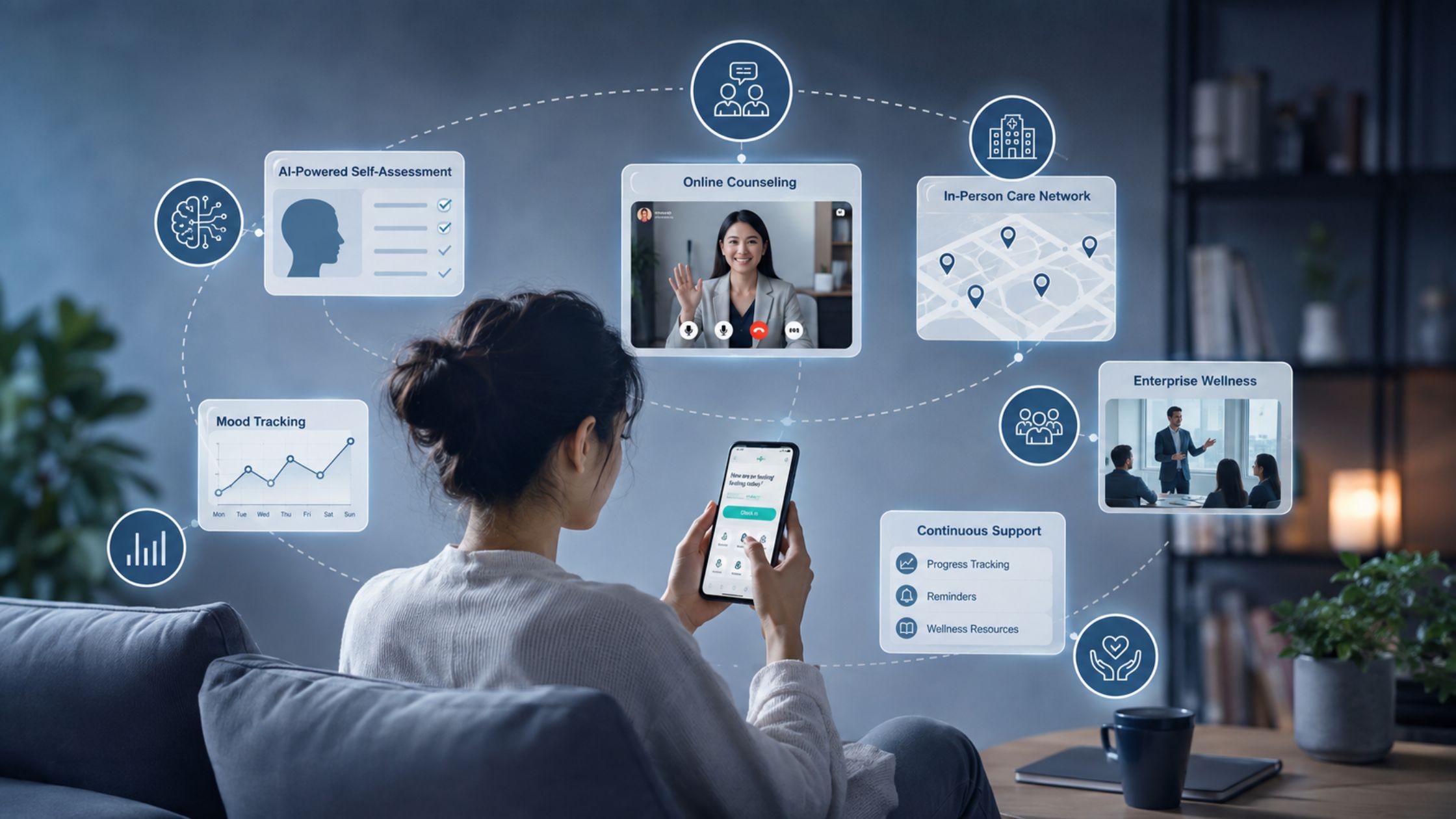
Today, the market is evolving toward more comprehensive care models. Digital mental health providers are increasingly integrating psychological assessments, AI-assisted tools, licensed counselors, in-person clinical services, enterprise wellness programs, and ongoing follow-up into a single ecosystem. Rather than functioning solely as teletherapy providers, these platforms are positioning themselves as long-term mental healthcare infrastructure that supports prevention, intervention, and continuous care.
The shift is reflected in recent developments across South Korea’s digital health sector. Atomus, the operator of the Mind Cafe platform, recently expanded its collaboration with Hyundai Department Store by bringing its services to the retailer’s official online mall, The Hyundai Hi, while also launching a workplace mental health program for Hyundai Department Store employees. The partnership introduces digital psychological assessments, in-person counseling, and specialized wellness programs alongside online services, illustrating how digital mental healthcare is increasingly extending beyond standalone counseling sessions.
From Standalone Therapy to Connected Care
The rapid adoption of teletherapy during the pandemic demonstrated that digital channels could improve access to mental healthcare. However, the industry has gradually recognized that therapy alone often represents only one stage of a much broader care journey.
Individuals seeking mental health support frequently require multiple services over time, including psychological screening, professional assessments, counseling, psychiatric referrals, workplace support, and long-term follow-up. Delivering these services through disconnected providers can create fragmented experiences for both patients and clinicians. As a result, many digital health companies are expanding beyond appointment-based counseling toward integrated care models that connect multiple services within a single platform.
Increasingly, these platforms combine:
- AI-assisted mental wellness tools and psychological assessments.
- Online and in-person counseling.
- Clinical referrals and specialist networks.
- Enterprise mental health programs.
- Continuous follow-up and care coordination.
The objective is not to replace clinicians with technology, but to improve accessibility, continuity, and coordination throughout the care journey.
Artificial intelligence is also assuming a different role within mental healthcare platforms. Rather than acting as a replacement for therapists, AI is increasingly supporting operational functions that improve the overall care experience. Examples include preliminary assessments, appointment coordination, symptom monitoring, personalized wellness content, administrative automation, and matching users with appropriate professionals.
This reflects a broader shift occurring across digital health, where AI is increasingly embedded within healthcare workflows rather than positioned as a standalone clinical solution. Human professionals continue to deliver diagnosis and treatment, while technology helps improve efficiency, accessibility, and continuity between care interactions. Research into human-AI collaboration similarly suggests that AI is most effective when augmenting, rather than replacing, human support in mental health settings.
Enterprise Demand Is Expanding the Scope of Digital Mental Health
Corporate wellbeing has become another important driver of integrated mental healthcare. Organizations increasingly view mental health support as part of broader employee wellbeing initiatives, with many expanding Employee Assistance Programs (EAPs) to include preventive care, psychological assessments, counseling, and organizational wellbeing services. For digital mental health providers, this has created demand for platforms capable of supporting both individual consumers and enterprise clients through a combination of digital services and professional care networks.
Atomus’ latest collaboration with Hyundai Department Store reflects this direction. Beyond making Mind Cafe’s services available through The Hyundai Hi, the partnership extends mental healthcare to employees across Hyundai Department Store branches through psychological assessments, remote counseling, face-to-face consultations, and specialized wellness programs. The company says it currently provides EAP services to more than 700 companies and organizations while operating a platform serving 4.5 million users and a nationwide network of more than 1,600 counseling centers and psychiatric clinics.
Technology Is Helping Scale Human Care
As digital mental health platforms expand, maintaining consistent service quality across large professional networks becomes an increasingly important operational challenge. Unlike traditional software businesses, healthcare platforms depend on licensed professionals delivering highly personalized services. Scaling therefore requires technology that supports governance, operational consistency, and quality assurance alongside clinical expertise.
While conversing with AsiaTechDaily, Kim Kyu-tae, CEO of Atomus, explained how the company approaches this challenge across its nationwide counseling network.
“Mind Cafe’s nationwide network is not simply a directory of counseling providers. Atomus operates a technology-based platform that manages professional qualifications, service processes, customer experience, and counseling quality under standardized operational guidelines.
We review each professional’s qualifications and experience, provide service and ethical guidelines, and continuously monitor customer feedback and service quality. Our platform also supports standardized booking, counseling management, and follow-up processes to ensure a consistent experience across both online and offline services.
At the same time, we maintain close communication with partner clinics and professionals so that they can preserve their clinical expertise while providing services that meet Mind Cafe’s quality standards. This combination of technology, data, and professional networks enables us to scale nationwide without compromising counseling quality.”
The comments highlight an aspect of digital health that often receives less attention than AI itself. As platforms grow, technology increasingly serves not only as a patient-facing interface but also as operational infrastructure that helps coordinate provider networks, standardize service delivery, and support long-term quality management.
Integrated Platforms Are Becoming the Next Phase of Digital Mental Healthcare
The digital mental health industry is gradually moving beyond the idea that online counseling alone defines digital care. Instead, providers are building platforms that connect assessments, AI-assisted support, licensed professionals, enterprise wellness, and physical care networks into more coordinated systems. This reflects changing expectations from both consumers and employers, who increasingly seek continuous support rather than isolated interactions.
For companies such as Atomus, the Hyundai Department Store partnership illustrates how digital mental health services are expanding into both consumer and workplace environments through integrated delivery models. Similar collaborations across the industry suggest that future competition may depend less on offering individual digital services and more on creating platforms capable of coordinating the broader mental healthcare journey.
As digital health continues to mature across Asia, the emphasis is likely to remain on balancing technological innovation with clinical expertise. AI, data, and digital platforms can improve accessibility and operational efficiency, but sustained adoption will ultimately depend on how effectively these technologies support healthcare professionals and deliver consistent, high-quality care across increasingly connected ecosystems.
Quick Takeaways
- Digital mental healthcare is evolving beyond teletherapy. Providers are increasingly combining AI, psychological assessments, licensed counseling, enterprise wellness, and in-person care into integrated mental health platforms.
- Hybrid care models are gaining traction. Rather than relying solely on online counseling, platforms are connecting digital services with physical counseling centers and psychiatric clinics to support more continuous care.
- Enterprise demand is shaping the market. As employers place greater emphasis on workforce wellbeing, digital mental health providers are expanding Employee Assistance Programs (EAPs) that include preventive care, assessments, counseling, and ongoing mental health support.
- AI is supporting care delivery, not replacing clinicians. Across integrated platforms, AI is increasingly used for assessments, care navigation, appointment management, and operational workflows, while licensed professionals continue to provide diagnosis and treatment.
- Operational quality is becoming a key differentiator. As mental health platforms expand their provider networks, maintaining consistent clinical standards, service quality, and patient experience has become an important business and technology challenge.
- The Hyundai Department Store partnership reflects this broader evolution. Mind Cafe’s expansion into The Hyundai Hi and its employee mental health program demonstrates how digital mental health services are increasingly being delivered through integrated consumer and enterprise channels.
- Exclusive insight: While speaking with AsiaTechDaily, Kim Kyu-tae, CEO of Atomus, said the company uses technology, standardized operational processes, and continuous quality monitoring to maintain consistent counseling standards across its nationwide network of more than 1,600 partner clinics, enabling it to scale while preserving clinical quality.
Similar Articles