AsiaTechDaily – Asia's Leading Tech and Startup Media Platform

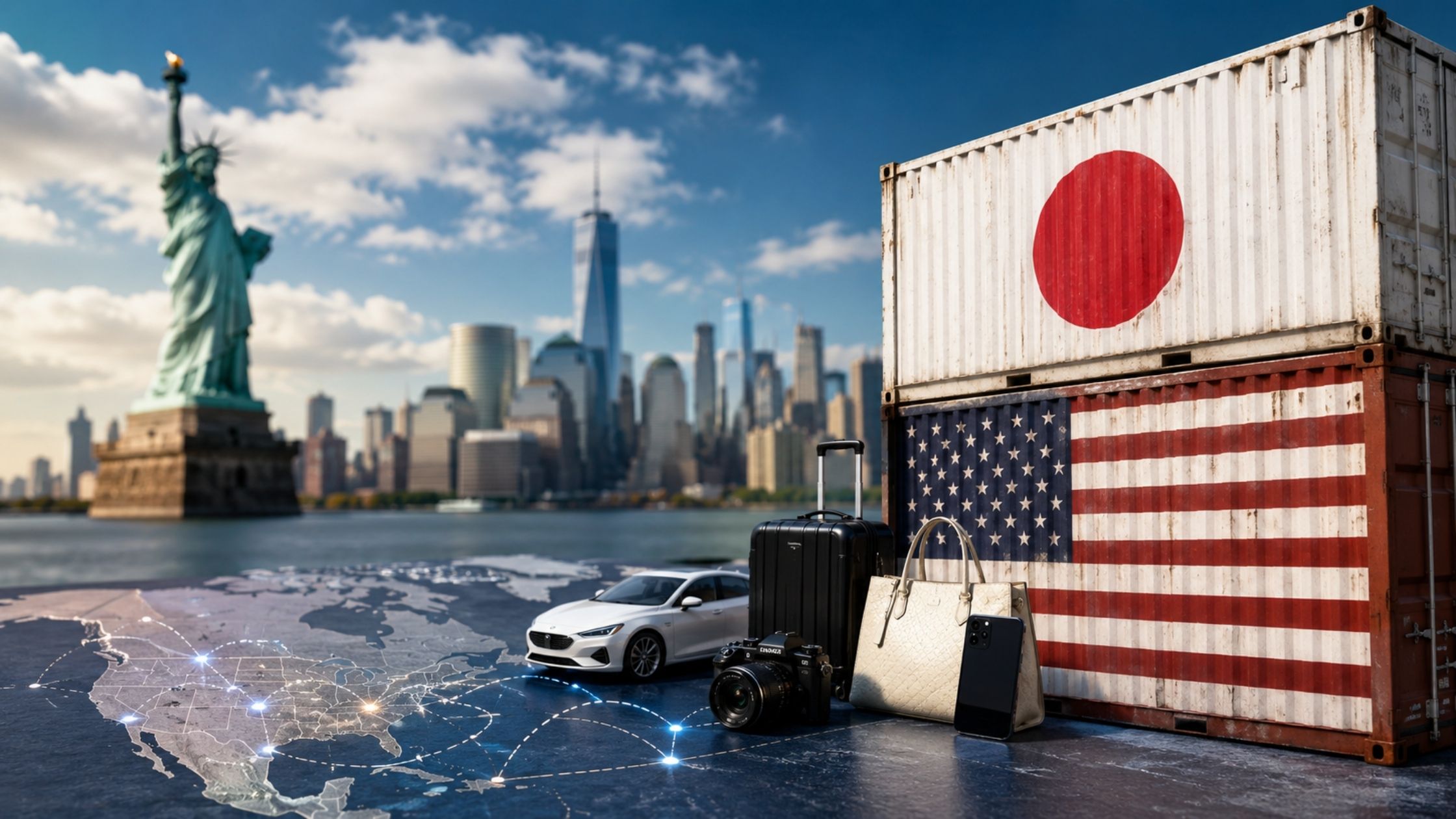
Japan Has a Strong U.S. Presence, but That Does Not Mean Every Japanese Brand Is Visible
 by
by

New research points to a gap between Japanese brands’ strong country-of-origin reputation and their recognition among U.S. consumers, raising questions about how companies can translate established trust into growth in newer categories
Japan’s presence in the U.S. economy is substantial, but its consumer-brand footprint is less evenly distributed. Japanese direct investment in the United States reached $827.1 billion at the end of 2025, the largest position among investor countries when measured by ultimate beneficial ownership, according to the U.S. Bureau of Economic Analysis. Bilateral U.S.-Japan goods and services trade also reached an estimated $322.2 billion in 2025. That economic relationship has helped establish Japanese companies as familiar participants in the U.S. market, particularly in areas such as automotive and electronics. But new research from advertising technology company Nexxen suggests that this broader familiarity does not translate evenly into consumer recognition across categories.
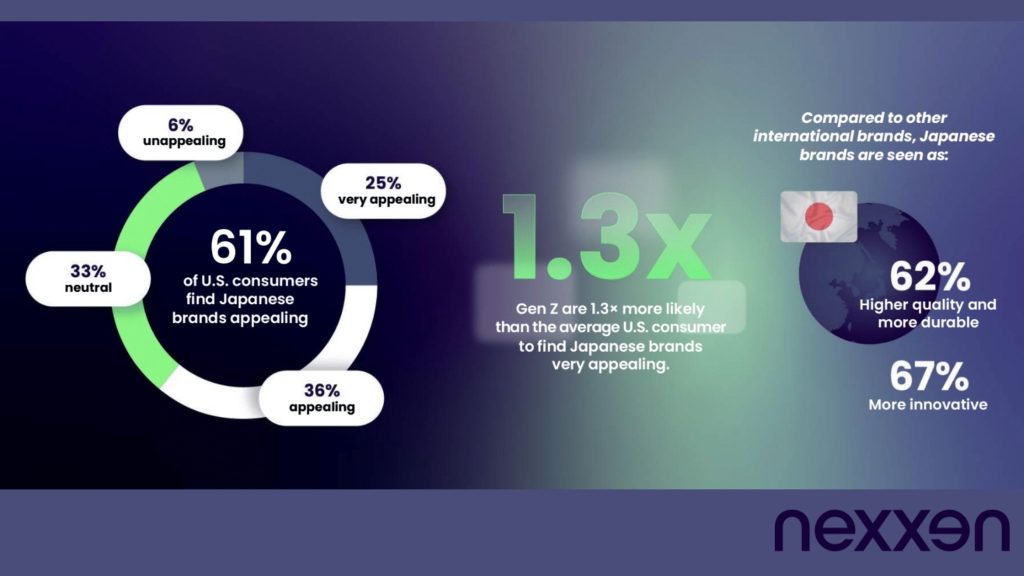
The study, conducted with PureProfile among 1,008 U.S. consumers and 262 Japan-based marketing decision-makers, found that 61% of U.S. consumers consider Japanese brands appealing, while 67% view them as more innovative than other international brands and 62% associate them with higher quality and durability. Yet visibility varies sharply by category. Electronics and automotive recorded recognition levels of 48% and 47%, respectively, compared with 22% for fashion and only 14% for travel. Seventy-three percent of U.S. consumers said they could not identify a Japanese travel brand. The findings point to a distinction that matters for Japanese companies expanding beyond their established categories: positive perceptions of a country or its products do not automatically create recognition for individual brands.
Japan’s economic footprint is larger than its consumer-brand footprint
Japanese companies have spent decades building commercial relationships, manufacturing operations, distribution networks and consumer familiarity in the United States. The country’s investment position illustrates the depth of that relationship. JETRO’s 2026 Japan-U.S. Investment Dynamic report, based on U.S. data, puts Japanese investment in the U.S. at $827 billion at the end of 2025, ahead of Canada at $820 billion and Germany at $706 billion. The BEA similarly ranked Japan first on an ultimate-beneficial-owner basis.
This creates an important distinction between corporate presence and consumer visibility. A Japanese automaker can benefit from decades of dealer networks, advertising, manufacturing investment and household familiarity. An emerging Japanese travel, fashion or consumer brand entering the U.S. cannot assume it inherits the same level of recognition simply because consumers have favorable views of Japan. Nexxen’s research illustrates that gap.
The strongest visibility in the survey is concentrated in electronics and automotive, categories in which Japanese companies have developed long-standing positions in the U.S. The pattern is not necessarily evidence that consumers reject Japanese brands in other categories. Instead, it suggests that consumers have had substantially more opportunities to connect Japanese attributes such as engineering, reliability and quality with specific brands in established sectors.
The distinction is particularly important when Japanese companies move into categories where the country’s commercial identity is less clearly defined. Nexxen’s research found that 61% of U.S. consumers find Japanese brands appealing, yet only 14% identify Japanese brands in travel. Fashion reaches 22%. The gap becomes even more pronounced when consumers are asked to name a specific travel brand, with 73% unable to identify one. As Nexxen’s research suggests, the issue is therefore less about whether consumers have positive associations with Japan and more about whether those associations lead them to a particular company.
Masatsune Shironishi, Vice President, Country Manager for Japan, spoke to AsiaTechDaily on the subject.
“What our research suggests is that trust and recognition aren’t the same thing, and brands can have one without the other. Sixty-one per cent of U.S. consumers say they find Japanese brands appealing, and they consistently associate them with higher quality, durability and innovation. That reputation has been reinforced by categories such as electronics and automotive, which have had decades of sustained, cross-channel presence in the U.S. market.
“Travel and fashion haven’t had that same consistency of exposure, so even though the underlying goodwill toward Japanese brands exists, consumers have relatively few touchpoints connecting those positive perceptions to specific brands. In fact, 73% of U.S. consumers couldn’t name a single Japanese travel brand. That looks less like a quality-perception problem and more like a discovery problem,” he said.
This distinction is important for companies trying to use Japan’s broader country-of-origin reputation as an international growth asset. Country-level trust can lower the barrier to consideration, but it does not eliminate the need for individual brand building.
Localization extends beyond translating the message
The Nexxen research also identifies a gap between what U.S. consumers consider important for local relevance and what Japanese marketers prioritize. For U.S. consumers, product availability and clear English-language communication each received 52%, making them the two most frequently cited factors in determining whether an international brand feels relevant locally. Among Japanese advertisers, however, only 33% identified store and channel availability as a key localization consideration. Pricing and promotions ranked higher, at 48%.
That difference suggests that localization can be misunderstood as primarily a communications exercise. For a consumer, however, a localized brand experience begins before advertising. A product that is difficult to find, unavailable through familiar channels or poorly explained in English may struggle to convert awareness into consideration regardless of how competitive its price is.
This is especially important in fragmented categories such as fashion and travel, where consumers have extensive choice and where discovery often happens across multiple platforms.
Media fragmentation makes discovery harder, but also creates new routes
The research arrives as consumer attention becomes increasingly distributed across traditional television, streaming, mobile and social media. Nexxen’s study argues that Japanese advertisers need to consider how audiences encounter brands across these environments rather than relying on a single channel.
The generational data adds another dimension. Gen Z consumers were 1.3 times more likely to describe Japanese brands as “very appealing.” That suggests younger audiences may already have a favorable starting point, potentially influenced by broader exposure to Japanese entertainment, design, food and culture. The commercial challenge is converting that cultural familiarity into brand-level familiarity.
For companies expanding into the U.S., that requires connecting the audience, category and distribution strategy rather than treating media buying as a separate activity from market entry.
The broader lesson for Asian companies entering the U.S.
The issue extends beyond Japanese companies. Asian businesses entering mature Western markets frequently possess strong products and may benefit from favorable perceptions associated with their home markets. But country-of-origin reputation is only one part of the internationalization equation.
The progression is more complicated: Country reputation → category relevance → brand discovery → recognition → consideration → purchase.
Japanese companies in automotive and electronics have had decades to move through that chain. Companies entering fashion, travel and other categories may have to build those connections much more deliberately. For Asian brands, this also means that localization should encompass more than language or pricing. Availability, distribution, media behavior and sustained exposure can determine whether consumers ever encounter the brand often enough to form a durable association. Japan’s economic relationship with the United States gives its companies a substantial foundation. The country is the largest foreign investor in the U.S. on an ultimate-beneficial-owner basis, while bilateral trade exceeds $320 billion annually. But corporate and economic presence does not guarantee consumer visibility.
Nexxen’s research suggests that Japanese brands have already solved part of the problem. Consumers generally associate them with innovation, quality and durability. The unresolved challenge is translating those country-level perceptions into recognition for individual companies, particularly in categories where Japanese brands have historically had less sustained exposure. For Japanese businesses looking beyond automotive and electronics, the next phase of U.S. expansion may therefore depend less on establishing that Japan produces quality products and more on making individual brands easy to discover, understand and access. In an increasingly fragmented media and retail environment, trust can create an opening. Visibility is what turns that opening into a brand.
Quick Takeaways
- Strong reputation is not translating into broad visibility: 61% of U.S. consumers find Japanese brands appealing, but recognition remains concentrated in established categories.
- Electronics and automotive lead: Japanese brands have 48% visibility in electronics and 47% in automotive, compared with only 22% in fashion and 14% in travel.
- Travel has the biggest discovery gap: 73% of U.S. consumers cannot identify a Japanese travel brand, pointing to a visibility challenge rather than a negative perception of Japanese products.
- Positive country-of-origin perceptions have limits: Consumers may associate Japan with quality, durability and innovation without connecting those attributes to specific brands outside familiar categories.
- Localization priorities are misaligned: 52% of U.S. consumers say product availability and clear English-language communication make international brands feel relevant, while only 33% of Japanese marketers prioritize store and channel availability.
- Gen Z offers a growth opportunity: Gen Z consumers are 1.3x more likely to find Japanese brands “very appealing,” suggesting existing affinity that marketers can convert into brand discovery.
- The broader challenge is media visibility: In a fragmented U.S. media environment, Japanese brands entering newer categories need sustained exposure across the channels where consumers actually discover products and brands.
Similar Articles