AsiaTechDaily – Asia's Leading Tech and Startup Media Platform

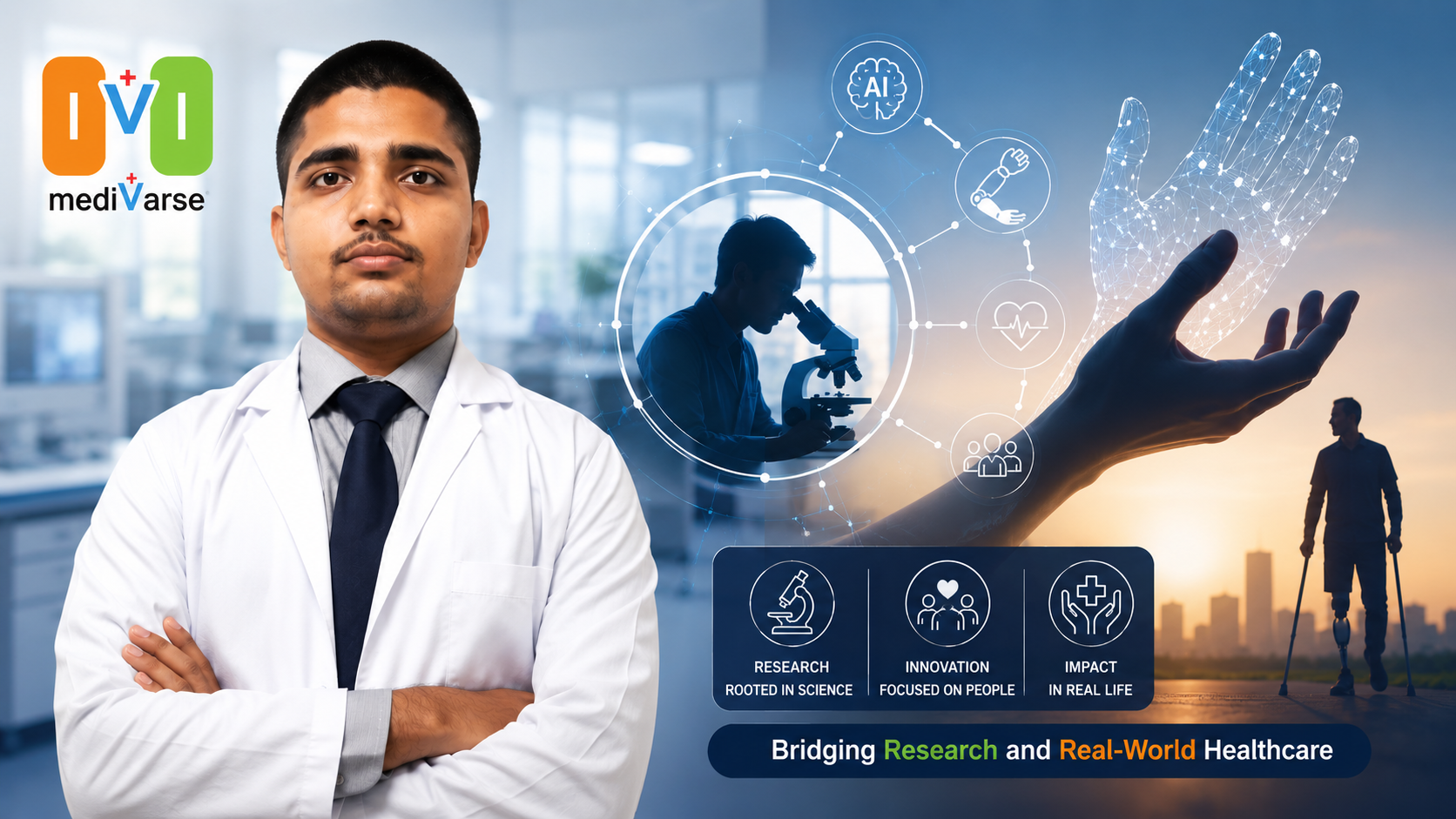
From Research Lab to Real-World Healthcare: How MediVVarse Is Bridging Science and Startup Execution
 by
by

Exclusive: MediVVarse Founder Neeraj Pandey discusses the challenges of commercializing academic research, building AI-powered prosthetics, and why India’s next wave of deep-tech growth will depend on translating science into scalable healthcare solutions.
India has made remarkable progress in building a vibrant innovation ecosystem. Government-backed initiatives, a rapidly growing startup landscape, stronger university incubators, and increasing investment in deep technology have positioned the country as one of Asia’s fastest-growing hubs for healthcare innovation. Yet despite this momentum, one persistent challenge continues to separate promising research from meaningful healthcare impact. Inventing breakthrough technology is only the beginning. Commercializing it is an entirely different challenge.
Unlike software startups that can quickly iterate and scale, medical technologies must navigate years of prototype refinement, clinical validation, regulatory approvals, manufacturing optimization, and market adoption before reaching patients. As a result, many promising healthcare innovations never move beyond university laboratories or research papers.
That commercialization gap is increasingly becoming the defining challenge for India’s emerging medtech ecosystem. MediVVarse Private Limited represents one example of a new generation of startups attempting to bridge that divide. Originating as an academic initiative in 2023 before becoming an incorporated company in 2025, the startup is developing AI-powered prosthetic technologies that combine electromyography (EMG)-based muscle signal recognition with adaptive artificial intelligence. More importantly, its journey reflects how research institutions, incubators, and founders are working together to transform scientific innovation into commercially viable healthcare solutions.
While conversing with AsiaTechDaily, Founder and CEO Neeraj Kumar Pandey of MediVVarse shared how the company’s evolution mirrors a broader shift in India’s deep-tech ecosystem, where success increasingly depends not only on engineering breakthroughs but also on understanding patient needs, building multidisciplinary teams, and navigating the realities of healthcare commercialization.
When Innovation Begins With Patients Instead of Technology
Many deep-tech startups begin by asking what technology can achieve. MediVVarse approached the problem differently. Pandey explained that the company’s direction was shaped not inside a laboratory, but through conversations with amputees, clinicians, and rehabilitation professionals who highlighted a gap between technological advancement and real-world accessibility.
“When I started this journey in 2023, I wasn’t trying to build another robotic hand. I was trying to solve a human problem. During interactions with amputees, rehabilitation professionals, and clinicians, I realized that the biggest challenge wasn’t the lack of advanced technology. It was the lack of technology that people could actually access, afford, and comfortably use every day. The technical breakthrough came when we successfully integrated EMG-based muscle signal recognition with an adaptive AI learning framework and a modular prosthetic architecture. Instead of forcing users to adapt to the device, we began designing a device that learns from the user. But technology alone didn’t convince me to build a company. What convinced me was seeing how many people were excluded from existing solutions because of cost, limited customization, or poor accessibility.”
The industry’s focus is gradually moving away from building the most technologically sophisticated devices toward creating solutions that are affordable, intuitive, and capable of fitting into patients’ everyday lives. For emerging markets across Asia, where affordability remains one of healthcare’s biggest barriers, that distinction could prove just as important as advances in artificial intelligence or robotics.
The Real Challenge Starts After the Research Ends
Moving from academic research to commercial healthcare requires answering questions that extend far beyond scientific feasibility. Can the product be manufactured consistently? Will it meet regulatory requirements? Can clinicians trust it? Will patients continue using it outside controlled testing environments? These questions often determine whether a promising invention becomes a successful business. For MediVVarse, the transition required building technology capable of continuously adapting to individual users rather than relying on standardized programming.
“Human muscles are unique, just like fingerprints. That means every prosthetic should learn from its user rather than relying on generic settings. In our current prototype, the initial EMG calibration typically takes between 10 and 20 minutes under guided supervision. During this session, the system captures baseline muscle activation patterns and creates an individualized motion profile. What excites us even more is continuous learning. The system gradually improves its understanding through daily usage, enabling smoother control and better responsiveness over time. While we are still validating these capabilities through ongoing development, our long-term vision is to make calibration increasingly seamless so that technology feels natural rather than technical.”
Adaptive learning systems are becoming increasingly common across healthcare technologies, from rehabilitation robotics and wearable devices to digital therapeutics. Rather than asking patients to repeatedly adjust to machines, developers are beginning to design intelligent systems that evolve alongside individual users, creating more personalized and effective care experiences.
Why Modern MedTech Requires More Than Engineering
Commercial healthcare innovation is no longer driven by engineering alone. Artificial intelligence, biomedical science, rehabilitation medicine, advanced manufacturing, clinical research, and regulatory expertise now intersect throughout the product development lifecycle. Companies that successfully integrate these disciplines are often better positioned to translate innovation into patient outcomes.
Pandey believes this multidisciplinary foundation distinguishes MediVVarse’s approach.
“Our multidisciplinary background is one of MediVVarse’s greatest strengths. Many robotics companies begin with engineering and later consider healthcare. We approached the problem from the opposite direction. Because our foundation includes pharmaceutical sciences, biomedical research, and rehabilitation, every engineering decision begins with the patient. We think about skin compatibility, long-term comfort, rehabilitation outcomes, emotional well-being, and safety before discussing motors or algorithms. Technology is simply the tool. The patient is always the starting point. We don’t measure success by how advanced a robotic hand looks. We measure success by whether someone can comfortably return to work, embrace a loved one, or regain confidence in daily life.”
That philosophy reflects a broader transformation taking place across global medtech. Healthcare innovation is increasingly being evaluated not by technical specifications alone, but by measurable improvements in quality of life, accessibility, and long-term patient outcomes.
Healthcare Commercialization Demands Patient Capital
Healthcare startups also require a different investment model than conventional technology companies. Clinical validation, regulatory approvals, manufacturing readiness, and product safety extend development timelines significantly beyond those of enterprise software startups. Consequently, grants, incubators, government initiatives, and mission-driven investors often play a critical role during the early stages of commercialization. Pandey believes this longer-term perspective is essential.
“Our immediate focus is to leverage grants, incubators, strategic government programs, CSR initiatives, and mission-aligned funding to accelerate product development while preserving long-term strategic flexibility. As we complete prototype validation, regulatory milestones, and pilot deployments, we plan to engage healthcare-focused venture capital firms and impact investors who understand that meaningful medical innovation takes time. For us, funding is not just about raising capital. It is about finding partners who believe that healthcare innovation should improve lives while remaining accessible to those who need it most.”
His comments echo a broader reality across Asia’s deep-tech landscape. Investors are increasingly recognizing that medtech startups cannot be evaluated using the same timelines or growth expectations as software companies. Scientific innovation requires patient capital, technical mentorship, and long-term partnerships capable of supporting commercialization through multiple stages of development.
The Future of India’s MedTech Ecosystem Will Be Measured by Translation
India has already demonstrated that it can produce world-class engineers, researchers, and scientific discoveries. The next stage of its deep-tech evolution, however, will depend less on generating breakthrough ideas than on consistently translating those ideas into products that improve lives. That transition requires stronger collaboration between universities, incubators, hospitals, regulators, manufacturers, and investors. It also demands founders who understand that successful healthcare innovation extends well beyond technological invention.
MediVVarse’s journey illustrates this shift. Its story is not simply about developing an AI-powered prosthetic. It reflects a broader transformation in how India’s medtech ecosystem is approaching commercialization by placing patients at the center of innovation, embracing multidisciplinary collaboration, and building technologies designed for real-world adoption rather than laboratory validation.
As healthcare increasingly converges with artificial intelligence, robotics, and biomedical science, India’s competitive advantage will not be determined solely by the volume of research it produces. It will depend on how effectively that research is transformed into trusted, affordable, and scalable healthcare solutions. The country’s next breakthrough in medical technology will be measured not by what is invented inside laboratories, but by what ultimately reaches hospitals, rehabilitation centers, and the millions of patients who stand to benefit from it.
Quick Takeaways
- India’s next medtech challenge is commercialization. Transforming academic research into market-ready healthcare solutions remains more difficult than developing the underlying technology.
- AI is making prosthetics more personalized. Adaptive AI combined with EMG-based muscle signal recognition is enabling prosthetic devices to learn from users over time, improving functionality and usability.
- Patient-first innovation is reshaping medical device development. Successful medtech startups are increasingly designing products around clinical and patient needs rather than engineering capabilities alone.
- Deep-tech healthcare requires patient capital. Unlike software startups, medtech companies depend on longer development cycles supported by grants, incubators, strategic partnerships, and investors who understand healthcare commercialization.
- Multidisciplinary collaboration is becoming a competitive advantage. The convergence of AI, biomedical science, rehabilitation, engineering, and manufacturing is driving the next generation of healthcare innovation.
- Research alone is no longer enough. India’s ability to become a global medtech leader will depend on how effectively universities, startups, hospitals, regulators, and investors work together to bring scientific breakthroughs into real-world clinical use.
Similar Articles