AsiaTechDaily – Asia's Leading Tech and Startup Media Platform

Indonesia’s Healthcare Modernization Push Opens Door for Korean AI Healthtech Firms
 by
by

The partnership aims to help Korean healthcare firms navigate Indonesia’s regulatory and commercialization landscape through local hospital networks, PoC support, and compliance coordination.
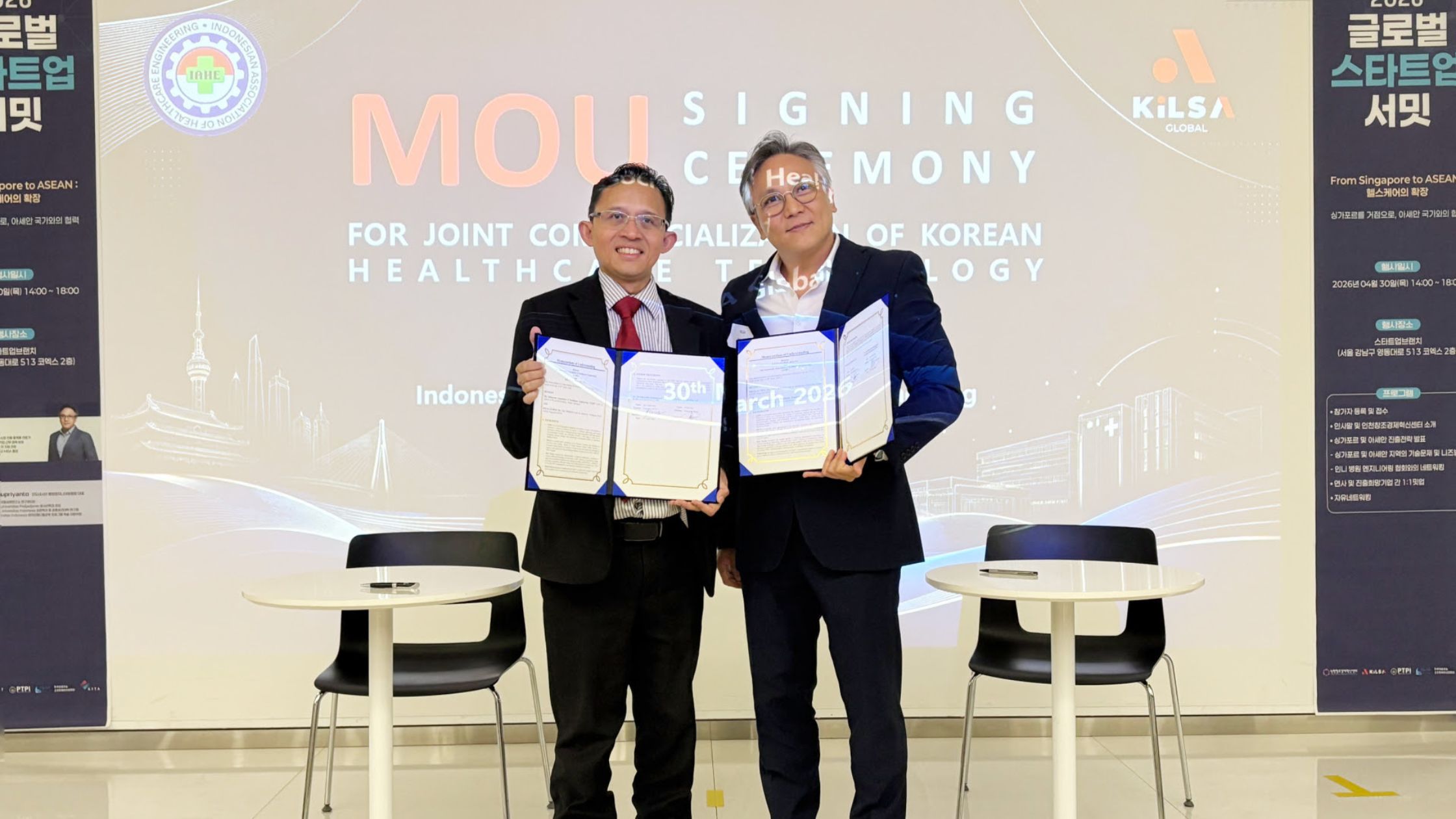
Singapore-headquartered market entry specialist Kilsa Global has signed a memorandum of understanding with IAHE (Indonesian Association of Healthcare Engineering) to support the commercialization of Korean healthcare and medical technology companies in Indonesia. The agreement covers proof-of-concept projects, licensing support, and local partnerships, as Korean firms look to capitalize on Indonesia’s accelerating push to modernize its hospital infrastructure.
The partnership arrives at a moment of significant bilateral momentum. South Korea and Indonesia signed a government-level MOU on April 1, 2026, to expand cooperation across the AI industry, establishing a joint digital development committee and targeting health, education, and digital policy as priority areas. The Kilsa-IAHE agreement operates at the commercial level, translating that bilateral intent into concrete market entry infrastructure for healthcare startups.
Indonesia’s broader context explains the timing. The country has made healthcare a national priority, directly linking it to its “Golden Indonesia 2045” vision of achieving high-income status by its centenary. Among the most tangible expressions of that ambition is the push to develop “SMART” hospitals, a framework centered on safety, reliability, efficiency, and patient-centered care, that is now shaping procurement priorities across the hospital network.
What Indonesian Hospitals Are Actually Asking For
In responses shared directly with AsiaTechDaily, representatives involved in the initiative laid out the technology priorities that Indonesian hospitals are currently pursuing under the SMART hospital transformation.
The highest-priority areas for Korean technology in the IAHE network include AI-based diagnostics and clinical decision support systems, smart hospital command center and operational AI, electronic medical record interoperability and healthcare cybersecurity systems, telehealth and remote patient monitoring, healthcare automation and smart infrastructure systems, and innovative medical devices. Korea, the spokesperson noted, is considered particularly competitive across all of these categories.
The demand profile indicates that Indonesia’s healthcare modernization efforts have moved well beyond basic digitization. Hospitals are no longer seeking standalone software deployments. The focus has shifted toward integrated systems capable of improving workflow efficiency, patient monitoring, diagnostics, and data management simultaneously, creating an opening specifically for Korean companies that combine software capabilities with device manufacturing and embedded AI technologies.
Physical AI Gains Ground at the 2026 Global Startup Summit
One of the more significant trends to emerge from the initiative was the growing interest in what industry participants describe as “Physical AI,” healthcare technologies that combine AI software with hardware-based medical systems.
In responses shared with AsiaTechDaily, the spokesperson described the profile of the 14 Korean startups selected for in-depth consultations at the 2026 Global Startup Summit. The cohort spanned AI-powered diagnostics, digital therapeutics, wearable healthcare platforms, medical imaging, biosignal sensing systems, implant technologies, semiconductors, and smart medical devices.
A notable trend within that group was the strong presence of Physical AI companies, particularly those combining AI software with hardware-based technologies such as imaging devices, biosignal sensing systems, monitoring platforms, wearable devices, and semiconductor technologies. Korea’s advanced manufacturing ecosystem and depth in medical technology continue to underpin its competitiveness in these hardware-driven areas.
At the same time, Software-as-a-Medical-Device (SaMD) platforms are also seeing increased interest, with growing attention toward AI-assisted clinical decision support, remote patient monitoring, workflow optimization, and mental health technologies.
Rather than pointing to a shift toward one category over the other, the consultations reflect a broader convergence. AI-enabled devices and SaMD platforms are increasingly operating as complementary layers within a connected healthcare ecosystem, mirroring a transition playing out across the global hospital sector as institutions move from isolated applications toward integrated digital infrastructure.
Market Entry Remains a Structural Challenge
Despite growing demand, Southeast Asia’s healthcare sector remains difficult terrain for foreign startups. Regulatory requirements, licensing procedures, localization demands, and the complexity of working with both hospital networks and public healthcare systems create timelines that can stretch from 18 to 36 months under conventional approaches.
Under the agreement, Kilsa Global and IAHE said they aim to reduce market entry timelines for Korean healthcare companies by 30% to 50% compared to that standard commercialization cycle. IAHE, which operates a network connected to approximately 3,000 hospitals and healthcare facilities across Indonesia, is positioned to help identify local demand and facilitate institutional connections at scale.
The structure of the partnership also reflects a broader shift in how Korean startups approach overseas expansion. Instead of relying on distributors or consulting-based models, a growing number of companies are seeking operational partners capable of supporting proof-of-concept deployment, licensing, localization, and commercialization execution on the ground.
Philip Park, Managing Director of Kilsa Global, which has been operating as a market entry specialist for Korean and Southeast Asian companies since its founding in Singapore in 2015, said the collaboration is designed to remove the structural friction that typically slows Korean healthcare companies in new markets.
“Through our collaboration with IAHE, we have established a commercialization structure that enables Korean healthcare companies to stably settle into the Indonesian market without trial and error,” Park said.
Eko Supriyanto, chairman of IAHE and professor at the National Institute of Technology Malaysia, framed Indonesia’s current healthcare transformation as a direct pull factor for international technology.
“Indonesia is pursuing a massive healthcare transformation under the ‘Golden Indonesia 2045’ vision, and there is a great need to introduce world-class medical technology, including that from Korea,” Supriyanto said.
Southeast Asia as a Long-Term Commercialization Market
The Kilsa-IAHE agreement reflects a shift in how Korean healthcare companies are beginning to view Southeast Asia, less as an export destination and more as a long-term commercialization and operational growth market. Indonesia, with a population exceeding 270 million and a healthcare system at a genuine inflection point, sits at the center of that repositioning.
As governments across the region continue investing in healthcare digitization, hospital modernization, and AI-enabled infrastructure, demand is growing for technologies that integrate medical devices, software, automation, and data-driven health management into a single operational layer. For Korean healthcare startups, competing in that environment will depend less on technology breadth alone and more on the ability to localize operations, navigate regulatory systems, and build durable institutional relationships within ecosystems that are changing faster than most market entry playbooks anticipated.
About Kilsa Global
Kilsa Global is a Singapore-headquartered global business builder operating across multiple Southeast Asian markets, including Korea, Indonesia, Vietnam, Thailand, and the Philippines. The company supports international market expansion through localization strategy development, commercialization support, and cross-border operational partnerships.
About IAHE
IAHE (Indonesian Association of Healthcare Engineering) is a non-profit healthcare engineering association established under the leadership of Indonesia’s Ministry of Health. The organization is connected to approximately 3,000 hospitals and healthcare facilities across Indonesia and focuses on improving healthcare service quality and supporting SMART hospital development initiatives.
Key Takeaways
- Kilsa Global and IAHE (Indonesian Association of Healthcare Engineering) partnered to support Korean healthcare and AI medical technology companies entering Indonesia’s healthcare market.
- Indonesia’s “Golden Indonesia 2045” vision is accelerating demand for SMART hospital technologies, including AI diagnostics, telehealth, hospital operational AI, healthcare cybersecurity, and EMR interoperability.
- Representatives involved in the initiative told AsiaTechDaily that Korean companies are seen as particularly competitive in healthcare AI, medical hardware, and integrated digital healthcare systems.
- One major trend emerging from the 2026 Global Startup Summit was growing interest in “Physical AI” — healthcare technologies combining AI software with hardware-based medical systems such as imaging devices, wearable platforms, biosignal sensing, and semiconductor-enabled healthcare solutions.
- Interest in Software-as-a-Medical-Device (SaMD) platforms is also increasing, particularly in clinical decision support, remote patient monitoring, workflow optimization, and digital mental health.
- The discussions reflected a broader shift toward integrated healthcare ecosystems where AI-enabled devices and software platforms increasingly operate together within hospitals and clinical environments.
- The partnership also highlights how Korean healthcare startups are increasingly viewing Southeast Asia as a long-term commercialization and operational growth market rather than simply an export destination.
Similar Articles