AsiaTechDaily – Asia's Leading Tech and Startup Media Platform

From Capital to Clarity: Urska Vracun on Building Startups That Actually Matter
 by
by

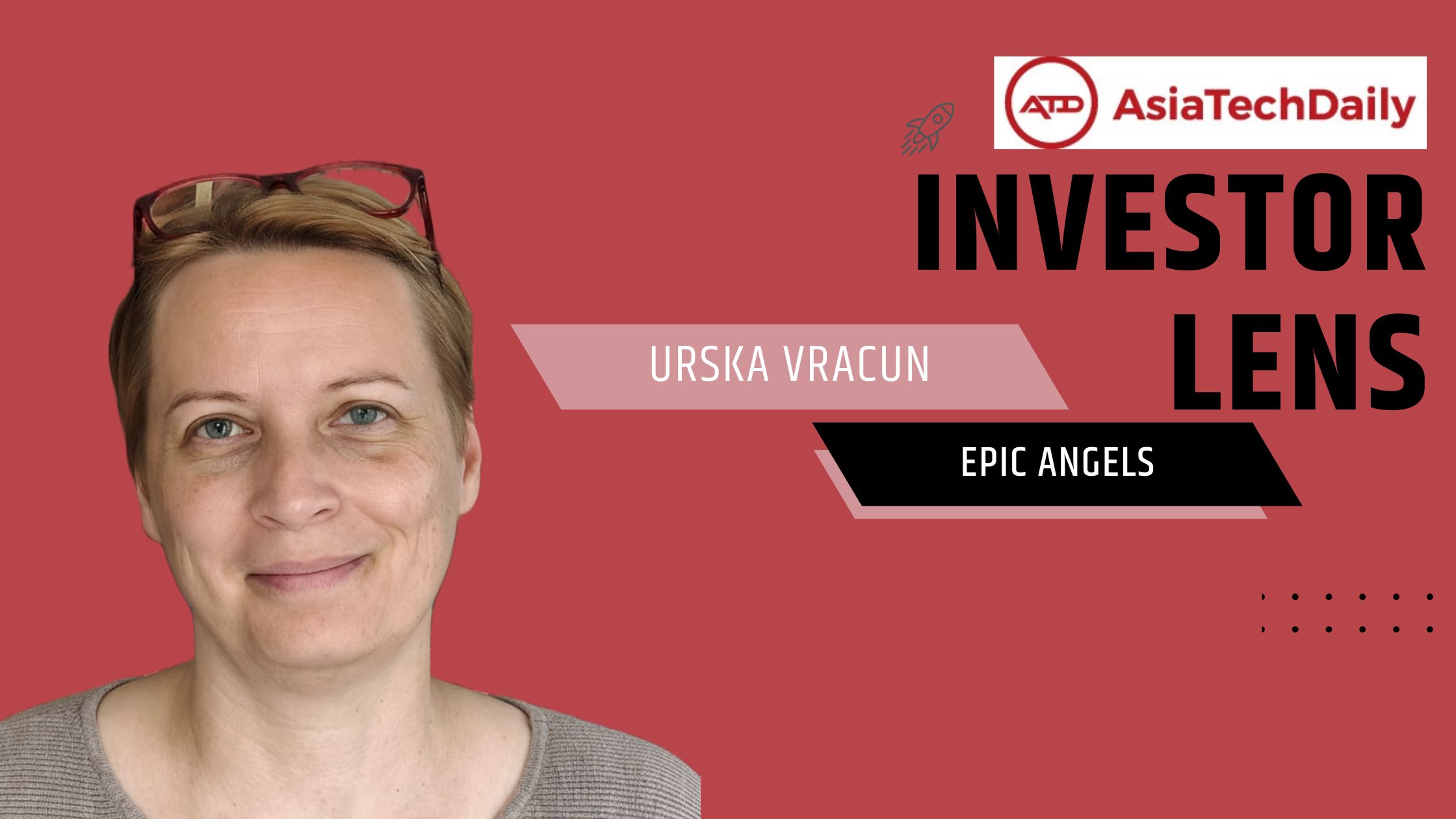
An exclusive AsiaTechDaily interview with Urska Vracun on AI saturation, founder blind spots, and what truly drives early-stage success
In 2026, artificial intelligence has become less of a differentiator and more of a default. Global venture capital is increasingly concentrated in AI, with estimates suggesting that over half of all funding now flows into AI-led startups, as investors double down on what is widely seen as the defining technology cycle of the decade. At the same time, the number of companies positioning themselves as “AI-first” has surged—turning what was once a competitive edge into a baseline expectation.
But as the market converges around the same narrative, a more uncomfortable question is beginning to surface: If everyone is building with AI, what actually sets a startup apart?
For Urska Vracun, the answer lies not in the technology itself, but in how founders define and solve real problems. In an exclusive interview with AsiaTechDaily, Vracun—an angel investor, startup advisor, and member of Epic Angels—offers a grounded perspective shaped by years of working closely with early-stage founders across Europe and Asia. Her experience spans both sides of the table, from advising startups on growth and market expansion to backing them with capital.
“I see 98% of startups today, their model is mostly AI-based. There is no differentiation anymore,” she says. “I am still really looking for a startup that is solving a core problem that isn’t based solely on AI. Because, yes, AI is a perfect tool—it’s a great tool—but it’s not the core of a solution. If you ask me, it’s just infrastructure.”
Her observation cuts through one of the defining contradictions of today’s startup ecosystem: even as access to powerful technology expands, true differentiation is becoming harder—not easier—to achieve. That gap between perception and reality becomes most visible in how founders approach their own challenges.
The Problem Founders Think They Have—and the One They Actually Do
One of the most consistent patterns Vracun observes is that founders often misdiagnose their own challenges.
“Many startup founders believe their main challenge is funding, or getting access to new markets, or increasing visibility,” she says. “But when you actually spend time with them, you realize that their challenges are quite different from what they think they are.”
What emerges instead are deeper structural gaps—ones that no amount of capital can easily fix.
“In many cases, it comes down to positioning. They don’t clearly understand how they fit into the market. Often, there is no real customer validation. And then there is the team—sometimes what they need most is a strong team that can support them when things get difficult. Another major gap is communication. Founders often struggle to explain their idea clearly to investors.”
This insight points to a broader issue in the startup ecosystem: the tendency to focus on external signals of success—funding rounds, growth metrics, expansion—while overlooking the internal coherence of the business itself. In that sense, what Vracun is describing is not just a founder problem, but a systemic one. The ecosystem often places greater emphasis on visibility and narrative, sometimes at the expense of validation.
What Investors Actually Back
When it comes to investment decisions, Vracun’s criteria are grounded in fundamentals—though not always in the way founders expect.
“One of the most important aspects is the founding team,” she explains. “Not necessarily because they have extensive experience, but because they have grit. They need to be determined, resilient, able to withstand pressure, and capable of building a strong team around them.
The product or solution has to be validated to a certain extent, depending on the stage. If it’s just an idea in the founder’s head, even if it sounds great, that’s not enough. There has to be some proof that it works in practice.”
But beyond team and validation, there is a more subtle trait that often determines long-term success: openness.
“You can see quite quickly, after a few conversations, how open a founder is to feedback. They don’t have to agree with everything—that’s not the point. But they need to be open enough to listen, to consider other perspectives, and to build something together with others.”
In many ways, this has shown how early-stage investing is evolving—from evaluating ideas to evaluating adaptability.
The AI Illusion: When Tools Replace Thinking
Nowhere is this tension between perception and reality more visible than in the current wave of AI-driven startups. Vracun is careful not to dismiss AI itself—she acknowledges its transformative potential—but she is deeply skeptical of how it is being used as a positioning tool.
“Of course AI is incredibly powerful—it has huge potential, and it’s going to transform many industries,” she says. “But what I see today is that almost every startup positions itself as AI-based. I would say 98% of startups today have some kind of AI angle.”
Her concern is not technological—it is strategic.
“I am still really looking for startups that are solving real problems—whether it’s something related to an aging population or femtech—areas that are underrepresented but have long-term potential. What I find challenging is when AI becomes the core of the narrative, instead of the problem being solved.
AI is a perfect tool—it’s a great tool. But it’s not the core of a solution. If you ask me, it’s just infrastructure. And I think in five years, we might look back and realize that we spent too much time focusing on it, and not enough time exploring other approaches, because we assumed it would solve everything.”
This framing—AI as infrastructure rather than differentiation—cuts to the heart of a broader shift underway in the ecosystem. As foundational technologies become more accessible, the competitive advantage moves away from access to tools, and toward how those tools are applied within real-world contexts.
Two Ecosystems, Two Speeds
Vracun’s cross-regional experience also highlights a growing divergence in how startup ecosystems evolve. Asia, she notes, is defined by speed.
“What stands out in Asia is how fast everything moves. Innovation cycles are short, engineering cycles are short, and the pace at which new startups emerge is incredible. Over the past few years, funding has also increased significantly, which creates more opportunities for founders.”
Europe, by contrast, operates at a different tempo.
“It’s more conservative when it comes to venture capital. There is a stronger focus on deep technology and quality, even at early stages. But the pace of innovation is slower—you don’t see the same level of rapid iteration.”
Rather than viewing this as a limitation, Vracun sees it as a complementary dynamic.
“In an ideal scenario, you would combine both—the speed of innovation in Asia with the depth and quality of technology in Europe. That combination would be incredibly powerful.”
This observation reflects a broader reality: innovation is no longer defined by a single geography, but by the interplay of different ecosystems, each optimizing for different strengths.
Rethinking Regulation and Flexibility
Another area where perception diverges from reality is regulation.
“There is often an assumption that Asian markets are more rigid or harder to navigate,” Vracun notes. “But in my experience, I would actually say the opposite.”
She elaborates, “European regulations are much more rigid. Not necessarily rigid in a negative sense, but there are many regulations, and they are very strict. They are also implemented very quickly across the European Union. In contrast, Asian regulatory environments tend to be more flexible—less rigid in how they are applied.”
This distinction is particularly relevant for early-stage startups, where the ability to test and iterate quickly can significantly influence product development and market fit.
A Return to What Actually Matters
Taken together, Vracun’s observations point to a broader shift in how early-stage success is being defined. As access to AI tools, capital, and global markets continues to expand, the traditional barriers to building startups are becoming less pronounced. In parallel, however, the expectations around differentiation and execution are rising. What once set companies apart—access to technology or funding—now increasingly serves as a baseline rather than an advantage.
In this environment, the emphasis is gradually moving toward fundamentals. Clear problem definition, early validation, and the ability to build and retain strong teams are becoming more central to how investors assess long-term potential.
Vracun’s view of AI as “infrastructure” reflects this shift. Rather than diminishing its importance, it places the technology within a broader context—one where its value depends on how effectively it is applied to real-world use cases. A similar pattern can be seen across regions. Differences in speed, capital availability, and regulatory approaches continue to shape how startups are built, but they do not fundamentally change what determines sustainability.
For founders, this suggests a recalibration rather than a reset. The tools available today remain powerful, but their impact is increasingly tied to how they are used—particularly in addressing clearly defined problems and building solutions that extend beyond initial momentum. In that sense, the current phase of the startup ecosystem appears less about the emergence of new advantages, and more about the refinement of existing ones.
As access continues to expand, what ultimately differentiates startups may not be what they build with—but how clearly they understand why they are building it.
Quick Takeaways
- AI is becoming a baseline, not a differentiator — as more startups adopt it, true differentiation is shifting elsewhere
- Founders often misidentify their biggest challenges, focusing on funding and visibility instead of positioning and validation
- Investors prioritize team resilience, product validation, and coachability over early hype
- The current ecosystem increasingly rewards narrative—but sustains fundamentals
- Asia and Europe reflect different startup strengths: speed and capital vs depth and quality
- Regulatory flexibility and ecosystem dynamics influence how quickly startups can iterate and scale
- Long-term success is increasingly tied to how clearly a problem is defined and executed, not just the tools used
Similar Articles