AsiaTechDaily – Asia's Leading Tech and Startup Media Platform


The Great Regulatory Inversion: Why Asia Is Emerging as the More Agile Innovation Environment
 by
by

As Europe tightens rulebooks, Asia’s collaborative regulatory models are reshaping where and how startups scale
A quiet but consequential shift is unfolding in the global innovation landscape. For decades, Europe has been seen as a standard-setter in regulation, shaping global norms across privacy, competition, and digital governance. Asia, by contrast, has often been characterized as fragmented or uneven in its regulatory approach.
In 2026, that dynamic is beginning to invert. Across sectors such as AI, fintech, and digital infrastructure, a growing number of founders and investors are reassessing where innovation moves fastest—and increasingly, the answer points toward Asia. This “regulatory inversion” is not about deregulation versus control, but about how regulation is designed, implemented, and integrated into the innovation lifecycle.
At the heart of this shift are two distinct regulatory philosophies. In Europe, the prevailing model is rulebook-driven. Frameworks such as the EU AI Act emphasize comprehensive, risk-based compliance from the outset, with clearly defined categories, obligations, and penalties. This approach prioritizes consumer protection, legal clarity, and standardization across markets.
However, that clarity comes with trade-offs. For early-stage companies, compliance requirements are often front-loaded—requiring legal, operational, and technical alignment before products can scale. In fast-moving sectors, this can slow iteration cycles and increase the cost of experimentation.
Asia, meanwhile, is increasingly embracing a more adaptive model—one that positions regulators not only as enforcers, but as participants in the innovation process. Rather than prescribing rigid frameworks upfront, several Asian markets are adopting a “test-and-learn” approach, where standards evolve alongside the technology itself. This reflects a broader shift in the role of regulation—from static rule-setting to dynamic governance embedded within the innovation lifecycle .
The Mechanics of Agility
Asia’s perceived regulatory agility is not incidental. It is supported by a set of structural mechanisms that reduce friction for startups and accelerate time-to-market. One of the most prominent is the use of regulatory sandboxes. In markets such as Singapore, startups in fintech and AI can test products in controlled environments under regulatory supervision. This allows companies to validate use cases, refine compliance requirements, and iterate quickly—without the burden of full regulatory approval from day one.
Equally important is the role of industry in shaping governance. In several Asian ecosystems, governments set high-level objectives while working closely with private-sector stakeholders to define technical standards and implementation frameworks. This reduces the risk of premature or misaligned regulation, particularly in emerging technologies.
A third factor is the growing emphasis on regional interoperability. Efforts to align regulatory standards across Asian markets are gradually lowering barriers to cross-border expansion, enabling startups to scale beyond domestic markets more efficiently .
Together, these mechanisms create an environment where compliance is iterative rather than obstructive—allowing innovation and regulation to evolve in parallel.
Europe’s Trade-Off: Trust at the Cost of Speed
None of this suggests that Europe’s model is flawed. On the contrary, its emphasis on safety, accountability, and consumer protection has established a high-trust environment that remains attractive for mature industries and large enterprises.
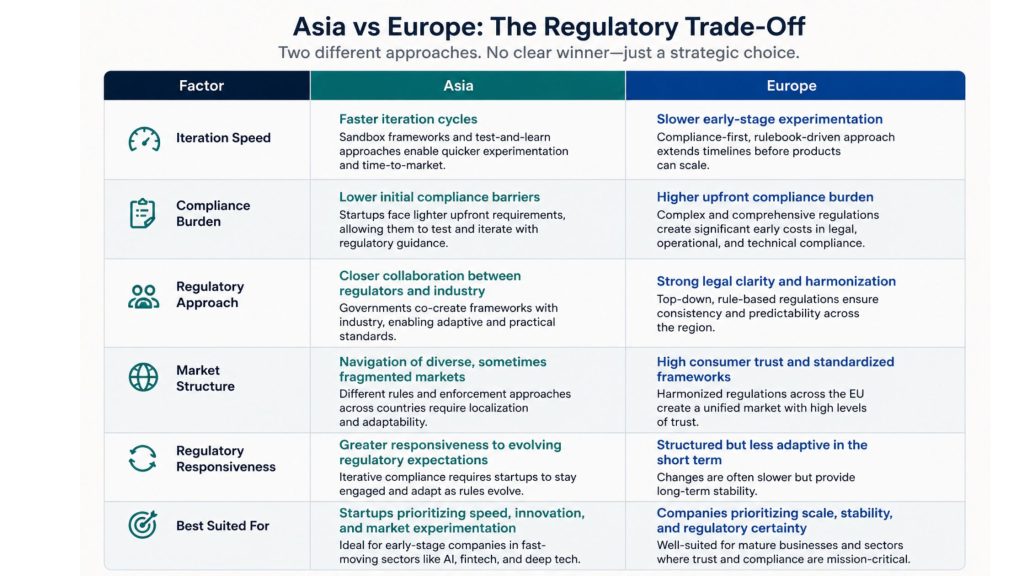
But for early-stage innovation, the trade-offs are becoming more visible. A compliance-first approach, while reducing long-term risk, can increase short-term friction. Startups must navigate complex legal frameworks before achieving product-market fit, and the cost of misalignment can be significant. In contrast, Asia’s approach shifts some of that burden later in the lifecycle—allowing experimentation to precede standardization. The result is a divergence not in regulatory intent, but in regulatory sequencing.
Investor Perspective: Where Founders Feel the Difference
For investors and founders, these differences are not abstract—they directly influence where companies are built and scaled.
Urska Vracun, angel investor and member of Epic Angels, challenges the perception that Asia is the more rigid regulatory environment. Speaking to AsiaTechDaily, she noted:
“I would say European regulations are much more rigid than those in Asia. Maybe not rigid in the sense of being restrictive, but we have a lot of regulations in the European Union—and they are very strict. They’re also implemented very quickly. In contrast, Asian regulatory environments tend to be more flexible, perhaps less rigid or strict in how they are applied.”
Her perspective reflects a broader recalibration among investors. Flexibility, in this context, does not imply weaker oversight—it points to a more adaptive, context-driven approach to regulation. For founders, this translates into a practical advantage: the ability to test, iterate, and refine products before navigating full compliance requirements.
Toward Convergence, Not Competition
What makes this moment significant is that regulation is no longer a neutral backdrop. It is becoming an active variable in competitive positioning. Where a company is built—and under which regulatory regime—can influence everything from product design to go-to-market timelines and capital efficiency.
In that sense, regulation is evolving from a constraint into a strategic lever. The notion of a “regulatory inversion” should not be read as a zero-sum shift. Both regions are responding to the same underlying challenge: how to govern rapidly evolving technologies without stifling innovation. Europe may move toward more flexible, iterative frameworks in specific sectors, while Asian markets may introduce greater standardization as ecosystems mature.
The long-term opportunity lies not in choosing between speed and safety, but in aligning the two. For now, however, the balance has shifted. In an era where innovation cycles are measured in months rather than years, the ability to integrate regulation into the process—not impose it externally—may prove to be the defining advantage.
Quick Takeaways
- A “regulatory inversion” is emerging, with Asia enabling faster innovation cycles than Europe
- Europe’s compliance-first model prioritizes trust but slows early-stage iteration
- Asia’s collaborative, sandbox-driven approach allows for faster experimentation
- Investors are increasingly viewing regulatory flexibility as a strategic advantage
- The future likely lies in hybrid models balancing agility with accountability