AsiaTechDaily – Asia's Leading Tech and Startup Media Platform


Techsauce Global Summit 2026 Puts Southeast Asia’s Digital Economy at a Strategic Crossroads
 by
by

The Bangkok summit brought together participants from 60 countries, including more than 1,000 C-suite executives and 500 investors, as AI, digital infrastructure, shifting supply chains and emerging health technologies reshape the region’s growth agenda.
Techsauce Global Summit 2026, held August 26-28 at Bangkok’s Queen Sirikit National Convention Center, brought together technology companies, investors, corporate leaders and policymakers from 60 countries under the theme “The Race to the NEXT…”. More than 1,000 C-suite executives and 500 investors participated, while the summit facilitated more than 1,500 business-matching meetings.
The scale of investment and participation points to a broader shift in Southeast Asia. The region is increasingly competing not only for technology adoption and manufacturing capacity, but also for digital infrastructure, capital, talent and strategic industries.
From manufacturing base to technology hub
Techsauce CEO and Co-founder Oranuch Lerdsuwankij argued that geopolitical fragmentation and changing supply chains are creating an opening for Southeast Asia to assume a broader economic role.
“With global supply chains and emerging technologies shifting, Southeast Asia has a rare window to become a global hub for innovation and capital, moving beyond its traditional role as a manufacturing base,” Lerdsuwankij said. “The ‘NEXT’ is all about seizing this opportunity. Southeast Asia is ready to help shape the new global order, and our mission at Techsauce is to unite the entire ecosystem to turn these macro shifts into concrete partnerships.”
The investment data provides some evidence of the structural changes behind that argument. Thailand’s first-half investment applications were concentrated in digital infrastructure, while electronics and electrical equipment attracted another 120.23 billion baht. Foreign investment applications accounted for 1.368 trillion baht of the total.
Thailand is also attempting to ensure that the data-center boom translates into wider economic capabilities. In September, Prime Minister Anutin Charnvirakul said the country should not focus merely on attracting data centers, but also on technology transfer, human-resource development, related industries and a broader digital ecosystem. That distinction matters because infrastructure investment alone does not necessarily create a technology ecosystem. The longer-term question is whether data centers, cloud infrastructure and AI investment generate domestic capabilities and wider productivity gains.
AI was central to the summit, but the discussion increasingly moved beyond individual applications toward how companies should reorganize around the technology. In his keynote on AI-native enterprises, AI investor and researcher Dr. Kai-Fu Lee argued that falling AI costs are changing the economics of software and knowledge work. According to Techsauce’s account of his presentation, comparable AI capabilities have become approximately 175 times less expensive over two years, while agentic AI can increasingly write code, use tools and execute multi-step workflows.

Lee’s argument was that companies cannot necessarily capture those gains simply by adding more AI tools. His proposed model combines multi-agent systems with clearly accountable individuals who own outcomes, while people continue to contribute judgment, creativity, vision and trust.
Thailand is simultaneously building the infrastructure needed for wider AI adoption. The government has identified AI data centers, cloud infrastructure and AI applications as priorities, while a new national big-data plan aims to address fragmented data, shortages of AI personnel, data connectivity, cybersecurity and privacy constraints.
This makes AI adoption an organizational and infrastructure issue as much as a software issue. Businesses need access to computing and data, but they also need the skills, governance and operating models to convert those resources into measurable outcomes.
Healthspan expands the technology agenda
The summit also highlighted the emerging Healthspan Economy, showing how Thailand is seeking to connect technology with sectors beyond digital services. Public Health Minister Pattana Promphat outlined an ambition to position Thailand as a regional longevity hub using AI and genomics to support preventive and personalized healthcare. The discussion aligns with a broader government push to develop Thailand as a medical and wellness hub, including advanced medical technologies, AI and genomics.
Thailand’s health authorities have increasingly framed healthspan around prevention, personalized care and technologies such as AI-assisted diagnosis and real-time health monitoring.
The opportunity, however, depends on translating these technologies into clinical and commercial applications. That requires infrastructure, research, regulation, clinical evidence and partnerships across healthcare institutions and technology companies.
Capital, policy and cross-border collaboration
The summit’s more than 1,500 business-matching meetings placed capital and commercial partnerships alongside technology discussions. Startups, investors, corporate decision-makers and public-sector representatives participated in an ecosystem designed to connect technology with potential customers, investors and partners.
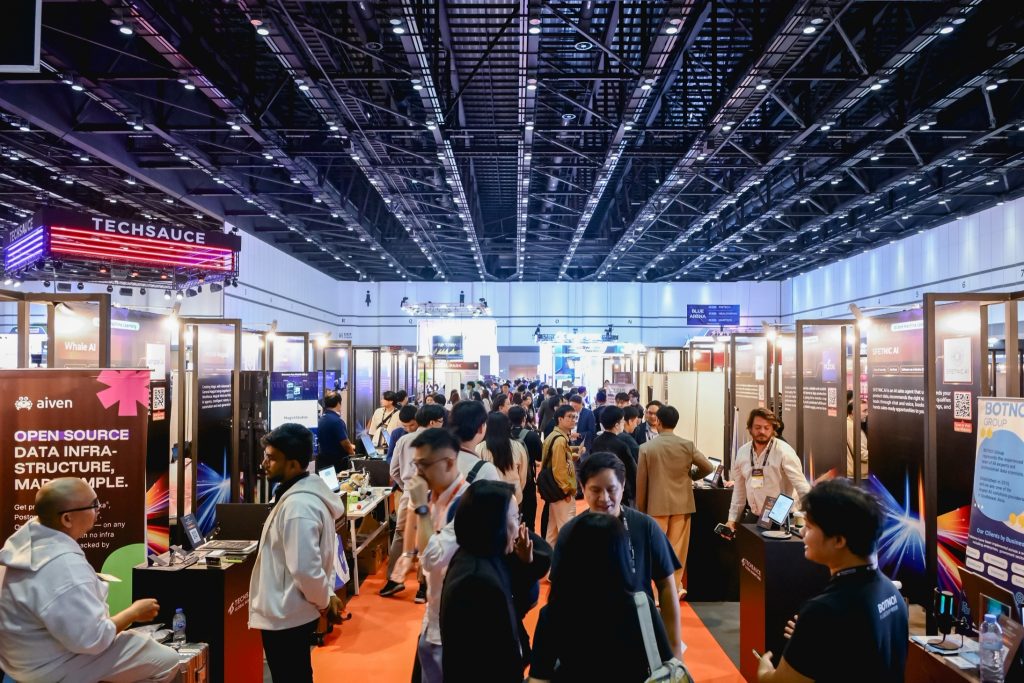
That ecosystem approach also reflects the summit’s stated ambition of positioning Thailand as a “Tech Gateway of Southeast Asia.” The government is pursuing a similar direction through investments in digital infrastructure and policies designed to expand AI adoption across businesses and public services.
In closing remarks, Professor Dr. Yodchanan Wongsawat, Deputy Prime Minister and Minister of Higher Education, Science, Research and Innovation, described Techsauce as a platform with national significance and said the government was prepared to translate insights from the summit into policy.
The summit’s significance ultimately extends beyond its attendance figures. Thailand is attracting substantial capital into digital infrastructure while simultaneously trying to develop AI capabilities, advanced industries, healthcare technologies and stronger links between startups and international markets. The harder test will be whether that investment translates into locally developed capabilities, higher productivity, technology transfer and companies able to scale across Southeast Asia. Techsauce Global Summit 2026 captured that transition at an important moment: the region is no longer simply deciding which technologies to adopt, but increasingly competing over where the infrastructure, capital and talent behind the next technology cycle will be built.
Quick Takeaways
- Techsauce Global Summit 2026 brought together participants from 60 countries, including more than 1,000 C-suite executives and 500 investors.
- More than 1,500 business-matching meetings connected startups, investors, corporations and potential partners across Southeast Asia.
- Thailand’s digital sector attracted 1.115 trillion baht (about US$33 billion) in investment applications in the first half of 2026, highlighting strong demand for data centers, cloud and digital infrastructure.
- AI adoption is shifting from standalone tools to organizational transformation, with businesses being pushed to rethink workflows, talent and accountability around AI.
- Thailand is positioning itself beyond a manufacturing base by targeting AI, digital infrastructure, advanced industries, healthcare and regional technology collaboration.
- The emerging Healthspan Economy is expanding the technology agenda into AI, genomics, preventive healthcare and personalized medicine.
- The broader challenge is turning investment in infrastructure and AI into technology transfer, skilled talent, local capabilities and scalable businesses across Southeast Asia.
Similar Articles