AsiaTechDaily – Asia's Leading Tech and Startup Media Platform


Spirit AI Raises $280M to Scale “Dirty Data” Robotics — Is China Betting Big on Embodied AI?
 by
by

Backed by state capital, industrial giants and top VCs, the Beijing startup is building a “universal robotic brain” trained on messy real-world data rather than curated lab datasets.
China-based embodied AI startup Spirit AI has raised nearly 2 billion yuan (about US$280 million) across two recent funding rounds, pushing its valuation beyond 10 billion yuan (approximately US$1.4 billion), according to local media reports. The financing drew a mix of venture firms, industrial groups and state-linked funds, including Yunfeng Capital, HongShan, Chaos Investment, Synstellation Capital and TCL Capital. Regional government-backed funds from Chongqing and Hangzhou also participated, alongside existing investors such as ShunWei Capital, Prosperity7 and Fortune Capital.
The capital will be used to scale deployment of the company’s embodied AI foundation models, expand its data pipelines to more than one million hours by 2026, and accelerate integration of robotic agents into industrial environments.
Founded in February 2024, Spirit AI develops vision-language-action (VLA) foundation models for robotics. Its ambition is to create what it calls a “universal robotic brain” — a general-purpose intelligence layer capable of handling complex physical tasks in real-world environments.
The company’s proprietary AI model drives Moz1, a force-sensitive humanoid robot equipped with 26 degrees of freedom, built to handle intricate manipulation work in industrial settings. Earlier this year, Spirit AI released its Spirit v1.5 model as open source, stating that it showed strong ability to perform unfamiliar tasks without additional task-specific training.
In January 2026, Spirit v1.5 reportedly topped the RoboChallenge global leaderboard, signalling performance comparable to leading embodied AI models internationally.
The “Dirty Data” Strategy
Unlike many robotics teams that rely on carefully curated datasets, Spirit AI is pursuing what co-founder and chief scientist Dr. Yang Gao describes as a “dirty data” strategy.
“Dirty data is the key to scaling VLA models,” Gao said, arguing that real-world variability is essential for developing robots with general reasoning ability.
Instead of scripted training scenarios, the company gathers diverse human video and wearable sensor data. It has already collected more than 200,000 hours of interaction data and plans to exceed one million hours by 2026.
Spirit AI claims its proprietary wearable devices reduce data acquisition costs by around 90% compared with traditional teleoperation-based data collection.
This approach aligns with a broader industry shift toward scaling laws in embodied AI — similar to how large language models improved through exposure to vast and diverse data rather than carefully filtered corpora.
Company Overview and Technology Focus
Spirit AI has moved beyond research into early industrial deployment. Its humanoid agents are operating on production lines at CATL’s Zhongzhou battery facility, where they handle flexible wire harnesses — a task traditionally difficult for robots due to material unpredictability. The company said the system achieves success rates above 99%, matching skilled human workers in precision and cycle time.
Moz robots have also been introduced in JD.com retail environments for customer interaction and product demonstration.
The company’s shareholder base includes industrial and technology players such as CATL, JD.com, Huawei, Xiaomi and TCL. These relationships provide real-world testing environments and ongoing data flows — an advantage in a field where deployment data is critical.
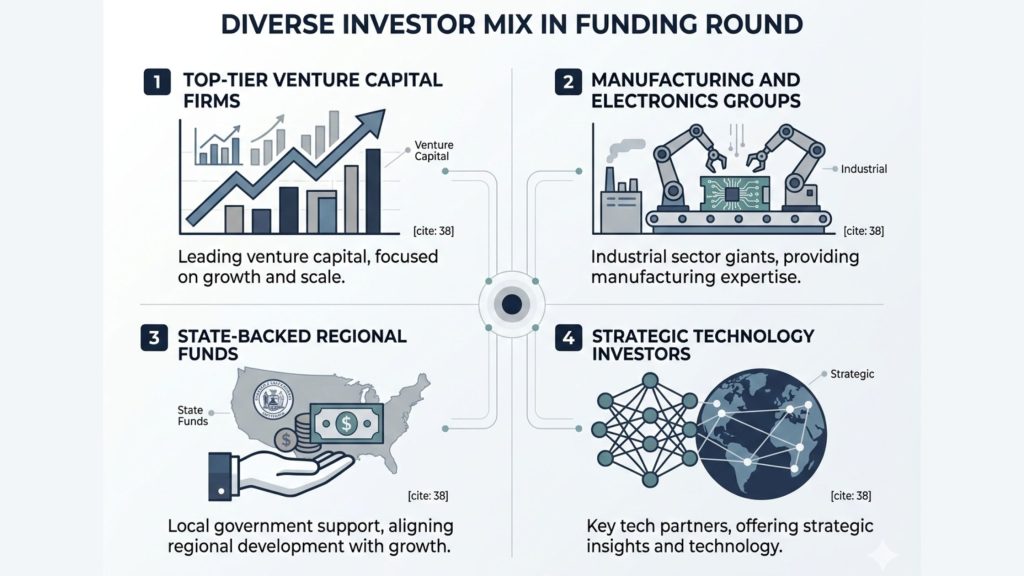
This coalition suggests that Spirit AI is not being positioned purely as a startup, but as part of a broader industrial push into embodied AI.
China’s policy environment increasingly emphasizes robotics, automation and AI-driven manufacturing as part of industrial upgrading strategies. Embodied AI — particularly in factory settings — fits squarely within that agenda.
The Global Embodied AI Race
Spirit AI enters a competitive global landscape. International peers such as Google DeepMind and Physical Intelligence are also pursuing large-scale embodied AI systems trained on diverse multimodal data.
However, embodied AI differs from software-only generative AI in key ways:
- It requires hardware integration
- It depends heavily on real-world deployment data
- It faces physical safety and reliability constraints
- Scaling is more capital intensive
Unlike consumer-facing AI applications, robotics deployment demands operational proof in real industrial environments.
Spirit AI’s emphasis on industrial validation — particularly in battery manufacturing — signals an effort to differentiate itself from lab-centric competitors.
Risks and Realism
Despite strong early funding and industrial backing, several challenges remain.
Embodied AI is still in its early stages globally. Questions persist around:
- Long-term reliability outside controlled environments
- Cost efficiency at scale
- Hardware durability
- Return on investment for manufacturers
Moreover, competition is intensifying, both within China and internationally, as capital flows into robotics startups that promise general-purpose agents.
The next phase will test whether Spirit AI can move from pilot deployments to widespread industrial adoption.
What This Signals for China’s AI Strategy
The $280 million raise underscores a broader shift in China’s AI ecosystem. While generative AI dominated headlines in 2023 and 2024, attention is increasingly turning toward physical AI — systems that can act in the real world rather than generate text or images.
Spirit AI’s funding coalition — spanning venture firms, state funds and industrial giants — suggests a coordinated effort to strengthen domestic capabilities in robotics and automation.
If large language models transformed digital workflows, embodied AI could reshape manufacturing, logistics and retail operations.
But scaling from prototype to workforce integration remains a complex challenge.
Spirit AI’s $280 million raise positions it among China’s most well-funded embodied AI startups. Its “dirty data” thesis — prioritizing messy real-world inputs over curated training sets — reflects a growing belief that general-purpose robotics will require exposure to complexity rather than perfection.
The company has secured industrial partnerships and early deployment sites. It has built a large data pipeline and attracted state and strategic capital.
The real test, however, lies ahead: turning experimental embodied models into reliable, scalable systems that deliver measurable productivity gains in factories and beyond.
In a global race to bring AI into the physical world, Spirit AI is betting that scale — not cleanliness — will define the next frontier.
Quick Takeaways
- $280M raised, $1.4B valuation: Spirit AI secured nearly 2 billion yuan across two rounds, with backing from venture firms, industrial groups and state-linked funds.
- Focus on embodied AI: The company builds vision-language-action (VLA) foundation models designed to power general-purpose robots in real-world environments.
- “Dirty data” approach: Instead of curated datasets, Spirit AI trains models on large volumes of unstructured human video and wearable sensor data to improve real-world generalisation.
- Industrial validation underway: Its Moz humanoid robots are deployed on CATL production lines and in JD.com retail settings.
- Scale is the next test: The company aims to exceed 1 million hours of interaction data by 2026, but long-term commercial adoption and reliability remain key challenges.
Similar Articles