AsiaTechDaily – Asia's Leading Tech and Startup Media Platform

Singapore’s Acti Raises $5.3M to Bring AI Agents Directly to the Smartphone Keyboard
 by
by

The seed funding will support the Singapore startup’s vision of embedding AI into the keyboard, enabling users to execute tasks, build no-code AI skills, and carry contextual assistance across apps without switching between standalone AI tools.
Singapore-based startup Acti has raised $5.3 million in seed funding, led by BITKRAFT Ventures, to develop what it describes as the world’s first “agentic keyboard.” The company aims to transform the smartphone keyboard from a text input tool into an AI-powered interface capable of executing tasks across multiple applications. The funding will support engineering and AI hiring, strengthen Acti’s on-device intelligence, and expand its Skill ecosystem and developer community as the company seeks to establish a new interaction model for mobile AI.
The rapid adoption of generative AI has largely centered around dedicated applications such as chatbots and AI assistants, where users typically leave their existing workflow, enter prompts, and manually transfer responses back into their conversations or documents. Acti is attempting to simplify that experience by embedding AI directly into the keyboard, one of the most frequently used interfaces on smartphones.
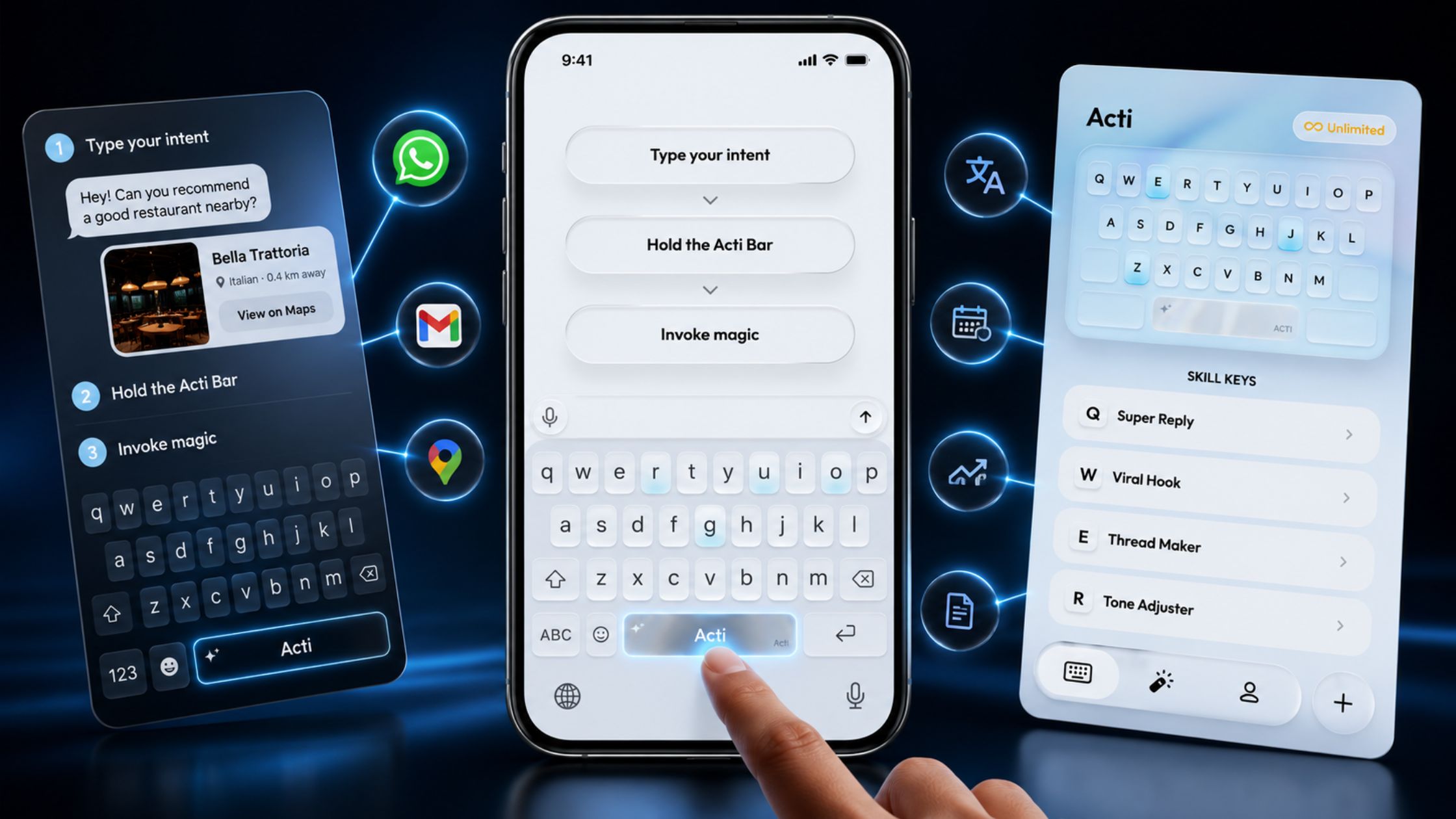
Instead of opening separate AI applications, users can activate predefined “Skill Keys” through a long press while typing. These customizable shortcuts can perform actions such as translating messages, generating meeting links, retrieving live information, or completing repetitive workflows without leaving the current application.
The company says users can build these AI-powered Skills using natural language rather than code through its Skill Builder. Skills can remain private or be shared through the company’s Skill Hub, creating a community-driven ecosystem where users contribute reusable workflows. According to Acti, early access users created more than 1,000 Skills within the first two weeks of the platform’s launch.
The startup argues that placing AI directly inside the keyboard reduces friction by allowing users to invoke AI precisely where digital intent originates, whether in messaging applications, email, social media platforms, or productivity software.
Building a User-Owned Context Layer
Beyond the keyboard itself, Acti is positioning its platform around a broader concept: creating a user-owned context layer that functions across applications rather than remaining confined to individual software ecosystems.
The idea reflects a growing debate within the AI industry over how personal context should be managed as AI assistants become increasingly integrated into everyday digital experiences. Today, much of a user’s behavioral data and preferences remain fragmented across individual applications and platforms.
While conversing with AsiaTechDaily, Young Wang, Founder and CEO of Acti, said the company sees its approach as complementary to platform-level AI assistants rather than directly competing with them.
“We believe platform assistants and Acti can coexist because they operate at different layers. Platform AI assistants are naturally tied to the operating system and their own ecosystems. Acti starts from the keyboard, the surface where user intent appears across almost every app. Before people send a message, search, schedule, or share something, they often express that intent through text.
Our goal is not to replace platform assistants, but to build a user-owned context and action layer that works wherever the user is typing, across WhatsApp, Telegram, X, Gmail, Notion, and more. As AI becomes more personal, users should be able to carry their context across apps and control what is remembered, used, or kept private. The operating system may own the device layer, but Acti aims to own the intent layer.”
The company’s strategy reflects an emerging trend in consumer AI, where developers are increasingly exploring ways to make AI more ambient and accessible within existing workflows rather than requiring users to engage with separate AI interfaces.
Competition Is Shifting Toward AI Interfaces
The funding comes at a time when major technology companies are rapidly expanding AI capabilities across their software ecosystems. Apple has introduced Apple Intelligence across its devices, Google continues to integrate Gemini throughout Android and Workspace, while Microsoft has embedded Copilot across Windows and Microsoft 365. Rather than remaining standalone products, AI assistants are increasingly becoming integrated into operating systems, productivity applications, browsers, and communication tools.
Startups are looking for opportunities beyond building foundation models themselves. Instead, companies such as Acti are focusing on interaction layers that determine how users access AI during everyday digital activities. The keyboard represents one such opportunity because it serves as a common interface across virtually every mobile application, regardless of platform or developer.
Whether this approach becomes a lasting interaction model will depend not only on AI performance but also on user adoption and the willingness of developers to build around shared ecosystems rather than proprietary platforms.
Acti’s founding team brings significant experience in consumer software and AI products. Founder and CEO Young Wang previously spent nearly a decade at Baidu International, where he helped grow Facemoji Keyboard to more than 300 million daily active users. Chief Technology Officer Mike Sun previously served as the founding technical lead behind Yike Album, Baidu’s cloud photo platform that scaled to more than 10 million daily active users. Chief Strategy Officer Junbo Yang joined the company from HashKey Capital, where he led more than 30 consumer-focused investments. The company is headquartered in Singapore and has launched Acti on both iOS and Android.
The first wave of generative AI transformed how users search for information, generate content, and automate individual tasks. The next phase may be defined less by the capabilities of AI models themselves and more by how naturally those capabilities integrate into everyday digital experiences.
For startups such as Acti, the opportunity lies not in building another chatbot, but in reducing the friction between user intent and AI execution. If successful, the keyboard could evolve from a simple input tool into an intelligent interaction layer that connects users with AI across applications.
The success of that vision will ultimately depend on whether consumers adopt new interaction habits. As AI becomes increasingly embedded into mobile operating systems and productivity platforms, the competition is likely to extend beyond model performance toward whichever interface can deliver contextual assistance with the least disruption to existing workflows.
Quick Takeaways
- Singapore-based Acti has raised $5.3 million in seed funding, led by BITKRAFT Ventures, to develop an AI-powered keyboard designed to bring AI agents directly into users’ everyday mobile workflows.
- The startup aims to reduce friction in AI interactions by embedding AI into the keyboard, allowing users to trigger tasks, retrieve information, and execute custom workflows without switching to standalone AI applications.
- Acti is building a user-owned context layer that works across apps such as messaging, email, and productivity platforms, enabling users to carry their AI context while maintaining greater control over their data.
- The platform’s no-code Skill ecosystem is central to its strategy. Users can create, customize, and share AI-powered “Skills,” with more than 1,000 Skills reportedly built by early access users within the first two weeks.
- The funding reflects a broader shift in consumer AI as startups increasingly focus on embedding AI into existing interfaces and workflows, positioning interaction design and contextual assistance as the next frontier beyond standalone chatbots.
Similar Articles