AsiaTechDaily – Asia's Leading Tech and Startup Media Platform


Saudi VC Builds Its Own AI Brain to Guide Capital Allocation
 by
by

Saudi Venture Capital Company launches “Aian” to strengthen transparency, forecasting, and market-making as the Kingdom’s private capital ecosystem scales under Vision 2030.
Saudi Arabia’s private capital market is expanding rapidly — but scale brings complexity. To address this, Saudi Venture Capital Company (SVC) has launched Aian, a proprietary artificial intelligence platform designed to improve decision-making across the Kingdom’s venture and private equity ecosystem.
Developed in-house using Saudi expertise, Aian is positioned as a market intelligence engine that transforms SVC’s internal data and institutional knowledge into structured insights. The goal is clear: move from reactive capital deployment to predictive, data-driven market making.
SVC was established as a government-backed investor with a mandate to stimulate private capital formation in Saudi Arabia. Unlike traditional VCs, its role extends beyond backing startups. It also works to crowd in private investors and reduce structural gaps in the ecosystem.
With Aian, SVC is formalizing that mandate. The platform consolidates SVC’s proprietary portfolio data with selected external market sources, creating what the firm describes as a dynamic view of capital flows. Instead of relying solely on periodic reports, Aian continuously validates and updates market activity.
This reflects a broader shift in emerging markets: access to funding is no longer the only constraint. Access to reliable, consistent data is increasingly critical.
Why Data Is Becoming Strategic Infrastructure
Nora Alsarhan, Deputy CEO and Chief Investment Officer at SVC, said that as the Saudi market matures, transparency and data integrity are becoming as important as capital itself.
“As Saudi Arabia’s private capital market scales, clarity, transparency, and data integrity become as critical as capital itself,” Alsarhan said. “With Aian, we are building the data backbone of the ecosystem, allowing us to act with precision and ensure capital formation is guided by insight, not assumption.”
She added that market making is not limited to writing cheques. It also involves shaping the conditions under which capital flows efficiently. According to her, the next phase of development will be driven by intelligence and analytics alongside investment activity.
In practical terms, SVC is positioning Aian as part of national financial infrastructure rather than just an internal analytics tool.
Addressing a Structural Gap in Emerging Markets
Athary Almubarak, Chief Strategy Officer at SVC, emphasized that fragmented information remains a structural challenge in private capital markets.
“In private capital markets, access to capital is rarely the binding constraint. Access to reliable insight increasingly is,” Almubarak said.
She noted that inconsistent disclosures and scattered institutional knowledge directly affect allocation efficiency and the ability to attract private investors at scale. For development-focused institutions, this can slow ecosystem growth. By centralizing validated market intelligence, SVC aims to reduce those frictions.
According to SVC, Aian includes:
- Customizable dashboards with real-time market updates
- Predictive analytics that forecast potential funding rounds and estimated ticket sizes
- Benchmarking tools that compare sectors, peers, and interventions
These features enable SVC to identify funding gaps, recalibrate allocation strategies, and design targeted ecosystem programs.
More importantly, the platform produces what the company describes as a “living” representation of the market — tracking how capital is actually deployed over time rather than relying on static snapshots.
The Vision 2030 Context
The launch of Aian aligns with Saudi Arabia’s broader Vision 2030, which aims to diversify the economy and strengthen non-oil sectors, including technology and entrepreneurship.
Over the past few years, Saudi Arabia has emerged as one of the region’s most active venture markets. Government-backed entities have played a significant role in anchoring early-stage funding and building investor confidence.
By introducing a structured intelligence layer, SVC is signaling that the next stage of growth will focus on quality, efficiency, and capital productivity — not just volume.
Regional Context: How SVC’s Approach Compares
The development is notable beyond Saudi Arabia. Across emerging ecosystems in Asia and the Middle East, government-backed investors often struggle with:
- Limited transparency
- Data fragmentation
- Inefficient capital deployment
If Aian successfully improves allocation discipline and transparency, it could offer a replicable model for other state-linked investment platforms. The key question will be measurable impact: whether predictive insights translate into better returns, stronger co-investment flows, and faster scaling startups.
SVC’s move also fits into a broader regional pattern, where state-linked investment institutions are expanding their analytical capabilities.
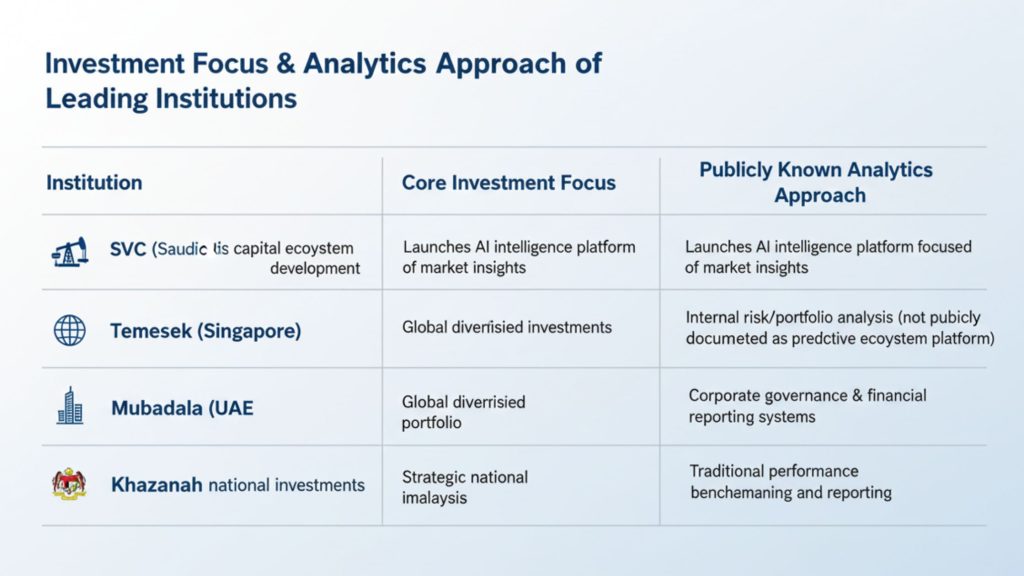
In Singapore, Temasek has long integrated internal research and scenario modeling into its portfolio strategy. In Abu Dhabi, Mubadala Investment Company operates with centralized data systems supporting cross-sector capital deployment. Malaysia’s Khazanah Nasional has similarly strengthened performance benchmarking and portfolio analytics in recent years.
What distinguishes SVC’s approach is its focus on private capital ecosystem development rather than global multi-asset investment management. While sovereign wealth funds primarily manage diversified international portfolios, SVC’s mandate is concentrated on domestic venture and private equity market formation.
By institutionalizing predictive analytics at the ecosystem level, Saudi Arabia appears to be formalizing intelligence infrastructure relatively early in its market development cycle. In contrast, many Asian emerging markets introduced similar tools after their venture ecosystems had matured further.
Whether this early institutionalization leads to stronger capital efficiency or greater ecosystem coordination remains to be seen. But the launch of Aian signals that Saudi Arabia views data infrastructure as a strategic pillar of private capital development — not simply an operational enhancement.
Predictive Capital Allocation: How Reliable Can AI Forecasting Be?
One of Aian’s most ambitious features is its predictive capability. According to SVC, the platform can anticipate potential funding rounds and estimate likely ticket sizes by analyzing historical deployment patterns and current market signals.
However, forecasting in private markets remains inherently complex.
Unlike public markets, venture and private equity transactions are not fully transparent. Deal sizes are sometimes undisclosed, valuations can vary widely, and reporting timelines are inconsistent. Early-stage ecosystems, in particular, are influenced by founder networks, sentiment shifts, and macroeconomic cycles that are difficult to model precisely.
Predictive analytics can improve visibility and reduce blind spots, especially when built on proprietary portfolio data. But their accuracy ultimately depends on the depth, consistency, and coverage of the underlying dataset. In emerging markets, where institutional records are still developing, models may face structural limitations.
For SVC, the value of Aian may therefore lie less in precise forecasts and more in directional intelligence — identifying sector momentum, capital gaps, and funding cycles earlier than traditional reporting methods allow.
If effectively implemented, such tools could improve allocation discipline and reduce capital mispricing. The real test will be whether predictive insights translate into measurable improvements in co-investment flows, fund performance, and ecosystem depth over time.
SVC’s move suggests that the future of venture ecosystems may rely as much on analytics infrastructure as on capital pools. As markets mature, investors will need clearer visibility into sector trends, funding gaps, and performance benchmarks.
By building its own AI-driven intelligence platform, SVC is attempting to institutionalize that visibility. Whether Aian becomes a quiet internal tool or a defining feature of Saudi Arabia’s private capital architecture will depend on execution. But the message is clear: in fast-scaling markets, data is no longer optional — it is foundational.
Quick Takeaways
- AI enters Saudi’s VC infrastructure: Saudi Venture Capital Company has launched Aian, an in-house AI platform aimed at improving visibility into private capital flows and sector trends.
- From capital deployment to market design: SVC is positioning itself not only as an investor, but as a market maker shaping how capital is allocated across the ecosystem.
- Predictive ambition: Aian includes forecasting tools that estimate potential funding rounds and ticket sizes — though predictive accuracy in opaque private markets remains to be tested.
- Data as strategic asset: The platform reflects a shift from capital scarcity to information scarcity as Saudi Arabia’s venture market matures.
- Vision 2030 alignment: The initiative supports broader national goals under Vision 2030, reinforcing Saudi Arabia’s push to become a regional private capital hub.
- Regional signal: Compared with other state-linked investors in Asia and the Gulf, SVC is explicitly institutionalizing ecosystem-level intelligence at an early stage of market development.
Similar Articles