AsiaTechDaily – Asia's Leading Tech and Startup Media Platform

Sarawak’s AI Moment? Hartamodal Bets on NEUON to Scale Industrial Intelligence Across Malaysia
 by
by

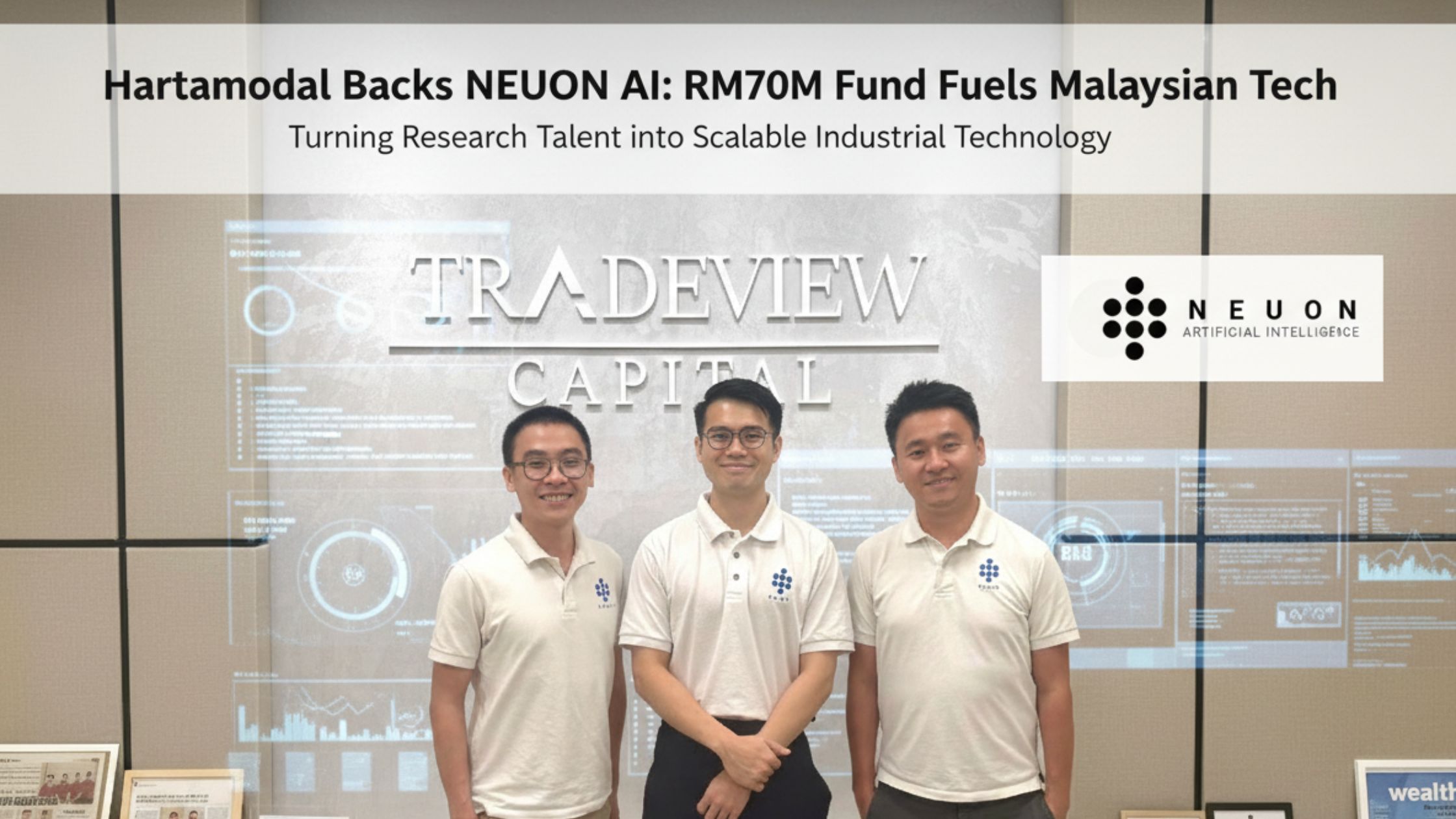
With its maiden RM70 million Dana Impian fund, Hartamodal is backing NEUON AI’s commercially deployed platforms — signaling a broader push to turn Malaysian research talent into scalable industrial technology.
When Hartamodal Sdn Bhd, the venture capital arm of Tradeview Capital, announced its strategic investment in NEUON AI Sdn Bhd, the move went beyond a typical early-stage funding deal. It marked the fund’s entry into Sarawak’s emerging startup ecosystem and underscored a growing investor focus on applied, industry-ready artificial intelligence.
The investment is made under Hartamodal’s RM70 million (approximately $18 million) Dana Impian fund, which is designed to accelerate the commercialisation of industrial AI solutions in Malaysia. To date, the firm has deployed roughly $4 million across three technology startups.
Unlike many AI startups that remain in pilot stages, NEUON AI has already built and deployed commercial systems across government and enterprise environments — a factor that likely shaped the fund’s decision.
Founded in 2018 by Sarawakian technologists Dr Chai Kok Chin, Marcus Chai Koh Kiong, and Dr Chang Yang Loong, NEUON AI was built on strong academic foundations in artificial intelligence research. But its strategy has been practical from the start: convert deep research into deployable infrastructure tools.
Tan Cheng Wen, executive director of Hartamodal, said the founding team has shown an ability to translate complex AI research into scalable, real-world applications.
“KC and the team excel at translating highly sophisticated academic AI research into real-world, high-impact solutions for the everyday economy at scale,” Tan said.
“Their proprietary applications in road asset management, forestry preservation, and sports science clearly demonstrate this capability.”
That ability to commercialise — not just innovate — is increasingly critical in Malaysia’s venture ecosystem, where investors are becoming more selective about revenue visibility and implementation track records.
ROADPLUS: A Flagship with Public Sector Validation
At the center of NEUON AI’s portfolio is ROADPLUS, a computer vision-powered road asset management platform currently deployed by agencies including Jabatan Kerja Raya Sarawak.
The system automates road inspection and monitoring using AI-based image analysis, improving maintenance planning and reducing manual survey work.
Its recognitions include:
- “Best Commercialisation Project” at MYHackathon 2020
- World Summit Award 2025 for digital innovation
Such awards, while symbolic, indicate validation from both local and international platforms — particularly important for public-sector-focused AI providers.
Beyond road infrastructure, NEUON AI has delivered solutions for Sarawak Forestry Corporation and Institut Sukan Negara. The company is also a graduate of the Digital Village Accelerator programme run by Sarawak Digital Economy Corporation, which supports early-stage digital ventures in the state.
Why This Deal Matters
Hartamodal’s backing of NEUON AI Sdn Bhd has shown a deeper structural shifts within Malaysia’s startup and venture ecosystem. The deal is not just about one company raising capital — it signals how regional innovation, applied AI, and institutional funding are beginning to align.
1. Rise of Regional Innovation Hubs
For years, Malaysia’s startup activity has been concentrated in Klang Valley. However, Sarawak is steadily emerging as a serious digital economy node, supported by state-led initiatives and ecosystem builders such as Sarawak Digital Economy Corporation.
Sarawak’s strategy has been deliberate:
- Build local technical talent
- Support startups through accelerators
- Anchor innovation around real industry problems
NEUON AI is an example of that model working. Instead of relocating to Kuala Lumpur or Singapore, the company scaled from Sarawak while securing government deployments. This suggests that regional hubs can now produce commercially viable deep-tech companies, not just early-stage experiments.
For investors like Hartamodal Sdn Bhd, entering Sarawak’s ecosystem early offers access to less crowded deal flow and founders solving problems tied to local industries such as infrastructure, forestry, and agriculture.
In short, innovation in Malaysia is decentralising — and capital is starting to follow.
2. Shift Toward Applied AI
Globally, the AI boom has created a wave of startups focused on generative tools and experimental applications. But investors are increasingly cautious about models that lack clear monetisation pathways.
NEUON AI represents a different category: applied AI embedded into operational systems.
Its ROADPLUS platform, deployed by agencies including Jabatan Kerja Raya Sarawak, addresses a specific and measurable problem — road inspection and maintenance efficiency. Similarly, its projects with Sarawak Forestry Corporation and Institut Sukan Negara focus on defined sector use cases.
This reflects a broader investment shift:
- From hype-driven AI experimentation
- To sector-specific, revenue-generating deployments
- From consumer-facing tools
- To enterprise and government infrastructure systems
Applied AI, particularly in public sector and industrial settings, tends to offer longer contracts and recurring revenue — characteristics that appeal to disciplined venture funds.
3. Institutional Capital Entering Industrial Tech
The RM70 million Dana Impian fund marks structured, institutional capital entering Malaysia’s industrial technology segment.
Historically, much of Malaysia’s venture activity has centered around fintech, e-commerce, or consumer platforms. Industrial and deep-tech startups often relied on grants or corporate partnerships rather than formal VC backing.
Hartamodal’s approach signals a maturation of the market:
- A licensed VC deploying a dedicated fund
- Focus on commercialisation, not just research
- Emphasis on nationwide adoption across critical sectors
By supporting companies digitising infrastructure, healthcare, and agriculture, the fund is effectively betting on productivity gains rather than user growth metrics.
This is significant because industrial AI adoption requires patient capital. Deployment cycles are longer, integration is complex, and government procurement processes can be slow. Institutional investors willing to take that view may help bridge the long-standing gap between Malaysian research capability and scalable commercial execution.
Dr Chai Kok Chin, co-founder and CEO of NEUON AI, described the investment as a turning point for the company.
“Securing institutional venture capital backing from Hartamodal represents a pivotal milestone in our growth,” he said.
“With Hartamodal’s long-term investment approach aligned with our mission, we are accelerating the delivery of home-grown AI solutions for critical sectors across Malaysia.”
Looking Beyond Malaysia
NEUON AI is also testing cross-border opportunities. The company has signed a memorandum of understanding with Runjian Co., Ltd., a Shenzhen-listed digital operations services provider, to explore: (1) Automated harvesting systems for black pepper crops (2) Satellite-based navigation systems for oil palm plantations.
If commercialised, these applications would place Malaysian-developed AI tools into regional agri-tech and plantation markets — sectors that remain central to Southeast Asia’s economy.
The NEUON AI deal follows Hartamodal’s earlier backing of healthtech platform Connect & Heal in June 2025. Together, the investments suggest that Dana Impian is focused on startups digitising foundational sectors such as infrastructure, healthcare, agriculture, and public services.
Rather than chasing high-growth consumer apps, the fund appears positioned around what could be described as “infrastructure AI” — technologies embedded into national systems.
Under Dana Impian, Hartamodal aims to accelerate nationwide industrial AI adoption while supporting scalable, industry-ready innovation. The challenge now will be execution: turning pilot deployments into repeatable revenue streams across states and, potentially, across borders.
A Test Case for Malaysian Industrial AI
For Malaysia’s venture ecosystem, the investment in NEUON AI represents more than capital injection. It is a test case for whether locally developed AI — grounded in research but proven in deployment — can scale beyond isolated contracts into national infrastructure layers.
If NEUON AI succeeds in expanding ROADPLUS and its sector-specific tools, it could demonstrate that Malaysia’s AI ambitions are not confined to labs or policy frameworks, but embedded in operational systems that shape roads, forests, farms, and public institutions.
For Hartamodal, the bet is clear: the next phase of Malaysian tech growth may not come from flashy consumer platforms — but from quiet, embedded intelligence powering the everyday economy.
Quick Takeaways
- Strategic Sarawak Entry: Hartamodal Sdn Bhd’s investment marks its formal entry into Sarawak’s growing startup ecosystem, signaling rising investor confidence beyond Klang Valley.
- Applied, Not Experimental AI: NEUON AI Sdn Bhd stands out for commercially deployed AI systems, particularly in public sector and industrial use cases.
- Flagship Public Deployment: Its ROADPLUS platform is already used by Jabatan Kerja Raya Sarawak, demonstrating real-world adoption rather than pilot-stage testing.
- Institutional Capital for Industrial Tech: The RM70 million Dana Impian fund reflects structured VC backing for infrastructure and sector-focused AI, not consumer apps.
- Early Regional Expansion Signals: NEUON AI’s MoU with Runjian Co., Ltd. suggests ambitions beyond Malaysia, particularly in agriculture and plantation tech.
- Part of a Broader Fund Strategy: The deal follows Hartamodal’s earlier investment in Connect & Heal, reinforcing its focus on startups digitising core industries.