AsiaTechDaily – Asia's Leading Tech and Startup Media Platform

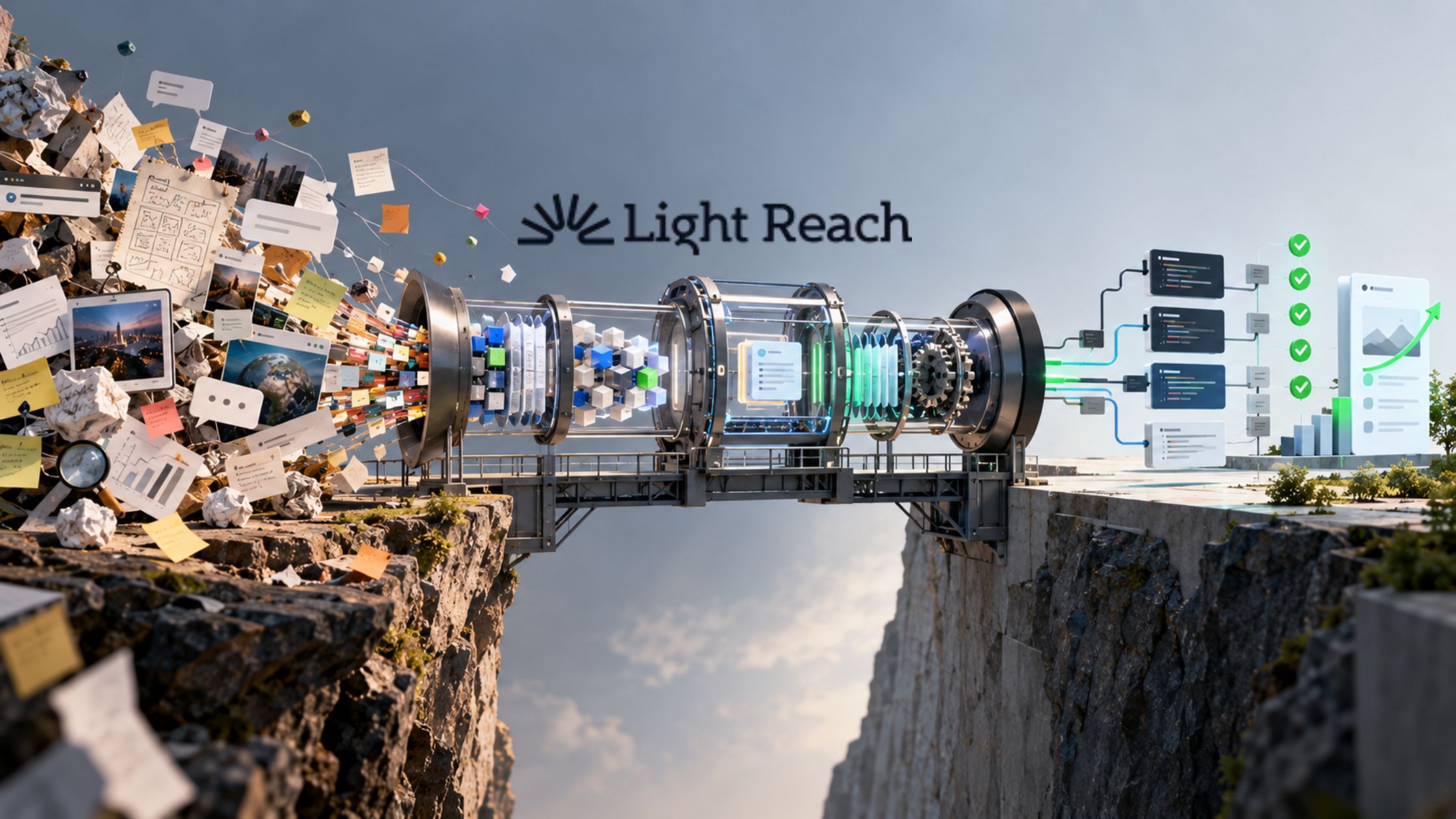
Light Reach Is Building an AI Execution Layer for the Product Development Loop
 by
by

The Manila-based startup is connecting customer and market signals to product decisions and governed AI-assisted engineering as software development moves from AI-assisted coding toward agentic execution.
AI coding agents are rapidly changing the economics of software development. A 2026 JetBrains survey of more than 15,000 professional developers found that 90% were using AI coding agents at work at least weekly, while 68% were using them daily. Developers in East Asia, including South Korea, China and Japan, were among the heaviest users, with roughly one-third generating more than 80% of their code through agents.
As code generation becomes increasingly automated, however, the next challenge is moving beyond the question of how to build software to how product decisions become executable work. That is the space Light Reach, a Manila-based startup founded in 2023, is targeting with an AI-native system that connects customer conversations and market evidence to product decisions, engineering execution and measurable outcomes.
Light Reach’s current platform is built around a simple premise: information gathered during product development should not become detached from the engineering work it eventually informs. Its workflow uses Crawl to preserve evidence from external sources and customer conversations, Signal to rank opportunities based on factors including evidence strength, impact, urgency and actionability, and Compress to turn approved work into controlled engineering execution. The company describes the resulting process as a loop from evidence to shipped outcome.
That positioning puts Light Reach in an emerging category between product intelligence and AI coding agents. Instead of treating coding as an isolated task, the company is attempting to connect the reasoning that precedes a feature with the engineering work that follows it.
Building an Execution Layer Around AI Agents
Compress is central to that strategy. The system takes an approved objective and repository context, selects an approved model, runs the task in a private cloud workspace with controlled tools, and returns changed files, tool activity, tests, token usage and cost for review before anything is committed. The distinction matters as organizations move toward agentic development. McKinsey’s 2026 research of 334 product and engineering leaders found that only 25% of director-level and above respondents reported meaningful or top AI acceleration, while 30% said team productivity had fallen. Its research found that the organizations seeing stronger results were redesigning end-to-end workflows, roles, verification and measurement rather than simply adding AI tools to existing processes.
Light Reach’s approach reflects that broader shift. The product is not designed around giving an agent unrestricted access to a repository. It emphasizes context, boundaries, verification and human approval. Light Reach is still in the pilot phase and is initially targeting startups, solo founders and startup product managers. Jonathan Tweneboah, founder and CEO of Light Reach, said while conversing with AsiaTechDaily:
“We’re currently in the pilot phase of our product development and more targeted at startups, solo founders and product managers at startups. These people are already excited when they see high leverage engineering work queued up for them. They rarely need external motivation to execute on these tasks.”
The choice gives Light Reach a relatively direct environment in which to test its thesis. Smaller teams typically have fewer organizational layers between customer feedback, product decisions and engineering. The company’s initial opportunity is therefore less about persuading teams to use AI and more about determining whether AI can reliably carry approved product intent through execution.
The Economics of Agentic Execution
Light Reach is also addressing the economics behind AI-powered development. Compress handles model selection and context preparation rather than requiring teams to manage those decisions separately for every task. The company has also positioned model routing and prompt compression as ways to control inference costs. That becomes increasingly relevant as agents take on longer and more complex tasks. When AI executes more work, model selection, context size, token consumption and verification become part of the economics of software engineering.
Light Reach’s public evaluations also show how early this category remains. Its September 26 development results reported 14 of 14 investigated task-relevance cases passing and 24 of 24 engineering-enrichment readiness decisions judged correct. A separate DeepSWE evaluation recorded 64 of 113 tasks passing, or 56.6%. The company explicitly says these are development evaluations, not customer success rates, and that the DeepSWE result is not a competitor leaderboard comparison.
That distinction is important. Successfully generating code is only one part of the product-development loop. The larger test is whether a system can consistently preserve the original product intent, execute safely, produce verifiable work and ultimately demonstrate that the shipped change improved the intended outcome.
Light Reach’s longer-term proposition is therefore less about replacing the developer and more about connecting the layers around development. The emerging loop looks increasingly like: evidence → prioritization → product decision → AI execution → verification → outcome → new evidence
As AI makes individual engineering tasks faster, companies may increasingly compete on how effectively they redesign this entire loop. Light Reach is still early in proving that model in production. But its approach reflects a broader transition in software: the next generation of AI development may be defined not only by models that can write code, but by systems that can reliably carry product intent from evidence to execution and back to measurable learning.
Quick Takeaways
- Light Reach is building an AI execution layer for product teams, connecting customer conversations and market signals to product decisions and engineering work. (Light Reach)
- Its workflow is essentially evidence → decision → approved execution → verification → measured outcome, rather than simply using AI to generate code. (Light Reach)
- Compress is the execution component. It selects an approved model, prepares context, runs the task in an isolated workspace, and returns code, tests, tool activity, token usage and cost for human review. (Light Reach Compress)
- The company is initially targeting startups, solo founders and product managers, where high-leverage engineering work can have a direct connection to growth.
- Its broader thesis is that AI coding is becoming increasingly accessible, so the harder problem is deciding what should be built and reliably carrying that decision into execution.
- Light Reach’s latest public evaluations show 14/14 task-relevance cases and 24/24 engineering-readiness decisions passing, but these are synthetic development evaluations, not customer success rates. (Light Reach)
- The company itself acknowledges that end-to-end voice-to-PR success, independent plan accuracy and human correction time are not yet measured. A September 27 live workflow check also failed before implementation approval. (Light Reach)
- The key story: Light Reach is betting that the next layer of AI-native software development will not just be better coding agents, but systems that connect product intent, evidence, execution and measurable business outcomes.
Similar Articles