AsiaTechDaily – Asia's Leading Tech and Startup Media Platform

Konnect Takes Top Spot at KSGC 2025 as Korea Targets Inbound Innovation
 by
by

As overseas founders compete in Seoul, Korea sharpens its inbound approach to innovation, talent, and market access
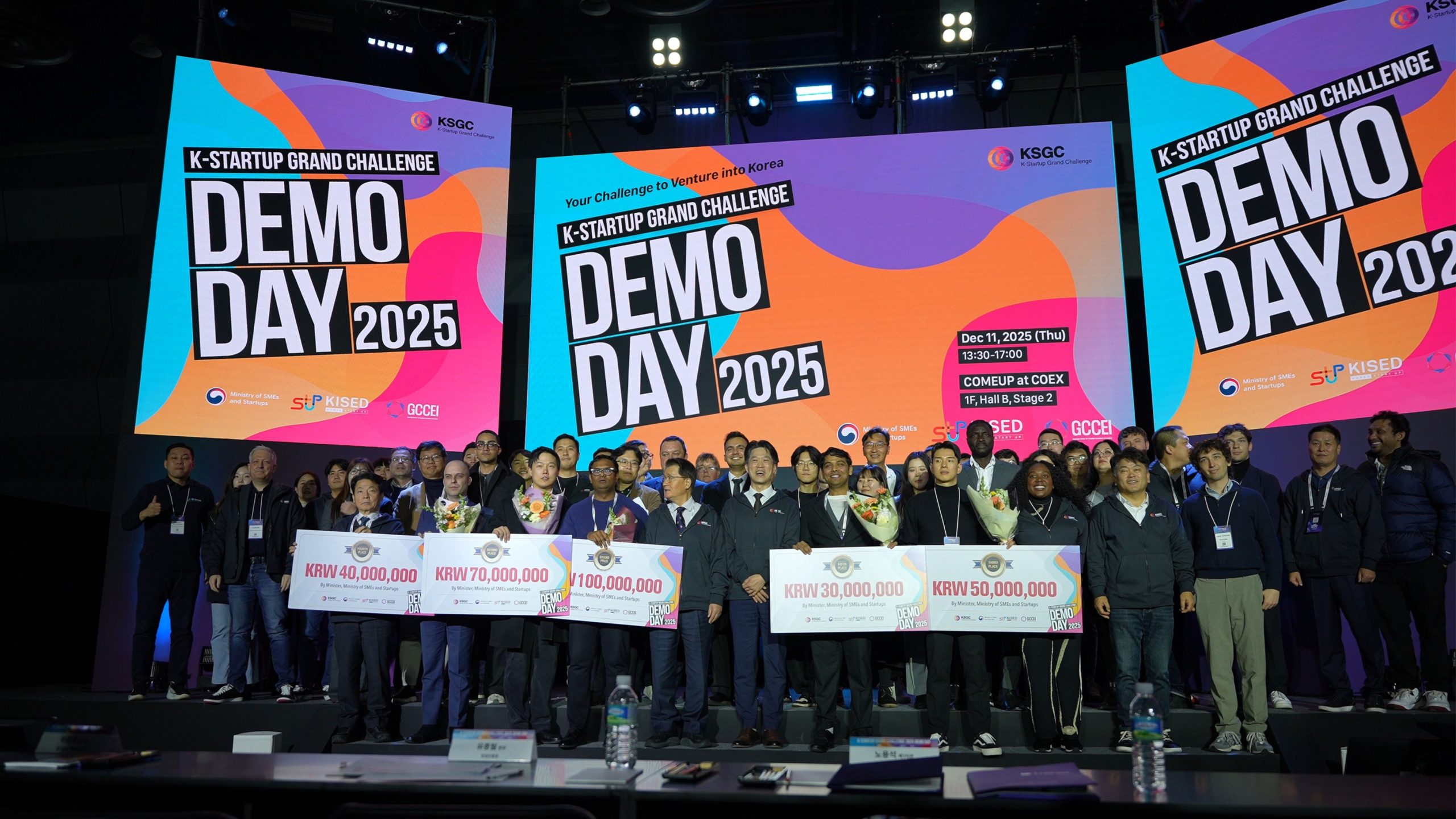
The K-Startup Grand Challenge (KSGC) 2025 Demo Day, held on December 11 at COEX in Seoul, marked the conclusion of this year’s inbound startup programme aimed at overseas founders. While the event followed the familiar format of live pitches and awards, its significance extended beyond the stage.
Now in its 10th year, KSGC has evolved into one of Korea’s most structured efforts to attract foreign startups into its domestic innovation ecosystem. Unlike short-term accelerators or showcase-driven competitions, the programme is designed to address a more fundamental challenge: how to help global founders enter, operate, and remain competitive in the Korean market.
The 2025 Demo Day took place as part of COMEUP 2025, Korea’s flagship startup festival, bringing together policymakers, investors, large companies, and startup operators in one venue. This integration is intentional. It positions inbound startups not as visitors, but as potential long-term participants in Korea’s technology and business landscape.
Global interest is rising:
This year’s KSGC attracted 2,626 applications from 97 countries, the largest applicant pool in the programme’s history. The number itself is notable, but more telling is how selective the programme has become.
From the initial pool:
- 80 teams advanced to Phase 1
- 40 teams were selected for Phase 2 and invited to Korea
- 8 startups reached the final Demo Day pitch stage
The filtering process reflects a shift in priorities. KSGC is no longer optimised for volume or geographic diversity alone. Instead, it increasingly favours startups that show clear relevance to Korea’s market, the ability to localise their business models, and readiness to engage with Korean corporates or institutions.
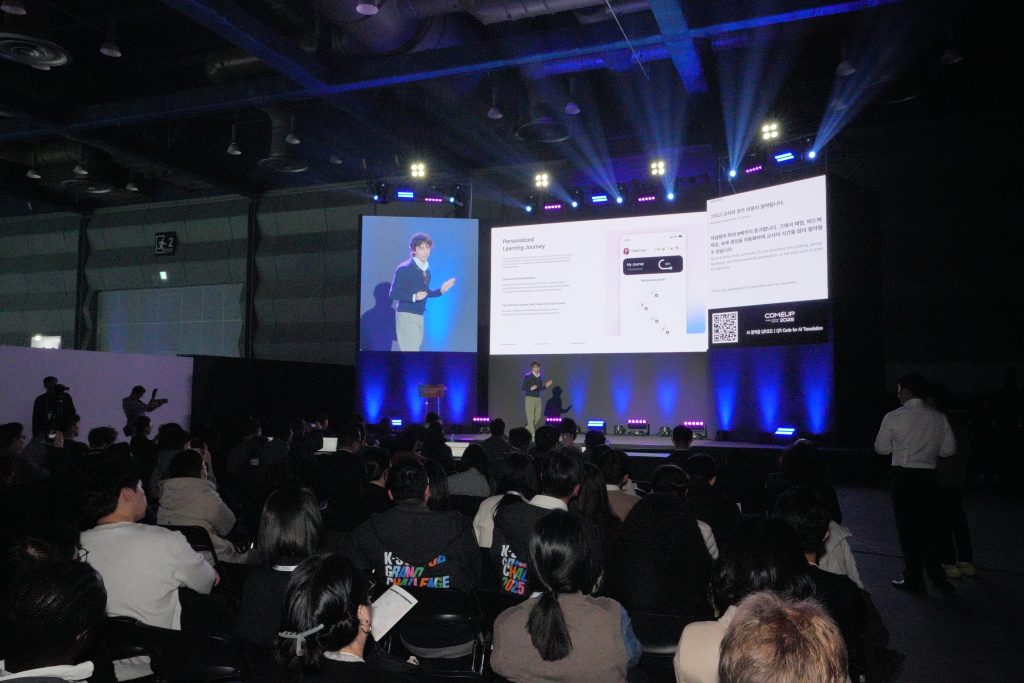
For many global founders, Korea is a difficult market to enter. Regulatory complexity, language barriers, and tightly integrated domestic platforms often slow adoption. KSGC’s selection process now functions as an early test of whether a startup can realistically navigate these constraints.
Why Konnect won: solving a local problem with national implications
The Grand Prize went to Konnect, which received KRW 100 million (approximately US$66,700). The startup is developing a platform that addresses authentication and payment challenges faced by foreign residents and visitors in Korea.
This problem is widely acknowledged but rarely solved at scale. Many digital services in Korea rely on national ID systems, domestic banking rails, or local verification processes that are efficient for citizens but difficult for foreigners to access. As Korea seeks to expand tourism, attract global talent, and internationalise its economy, these frictions become more visible.
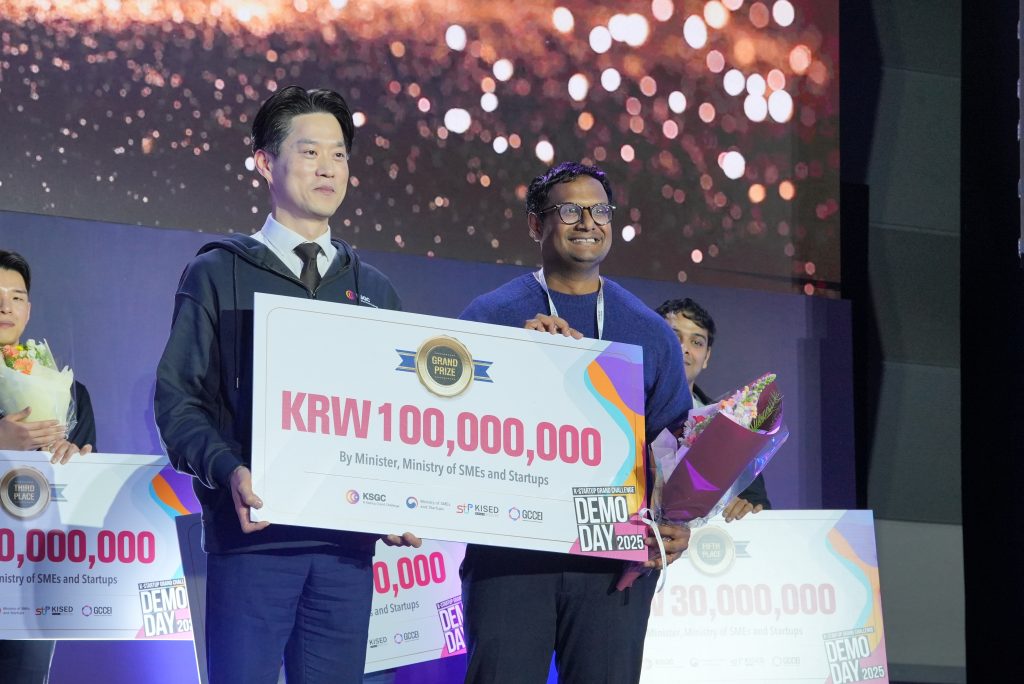
Konnect’s approach positions it not just as a fintech or identity startup, but as a bridge between Korea’s digital infrastructure and its growing international population. The company plans to expand its service into an integrated lifestyle platform, covering payments, authentication, settlement, and convenience services in one interface.
From a policy perspective, Konnect’s win signals what KSGC values most: startups that address practical gaps in Korea’s domestic system, rather than exporting generic global solutions into the market.
Second and third place point to automation and asset efficiency
Second place was awarded to MaimHaim (USA), which received KRW 70 million for its unmanned operations solution using IMU sensors and Zero UI technology. The company focuses on enabling automated services in physical spaces without relying on traditional user interfaces.
This aligns closely with broader trends in Korea, where automation is increasingly used to address labour shortages in retail, logistics, and facilities management. Solutions that reduce the need for manual input or staffing are particularly relevant in dense urban environments and high-traffic venues.
Pierrot Company (Canada) took third place, receiving KRW 50 million for its data-driven IT asset circulation platform. The company focuses on managing, recovering, and redistributing IT devices more efficiently across global markets.
Its selection highlights another structural issue: as enterprises refresh hardware more frequently, managing device lifecycles, resale value, and sustainability has become a non-trivial operational challenge. Korea’s role as a technology manufacturing and trading hub makes this problem especially relevant.
Together, the top three winners illustrate a clear pattern. KSGC is prioritising startups that address operational efficiency, infrastructure gaps, and system-level challenges, rather than consumer novelty.
Government backing signals long-term intent, not one-off support
The presence of Vice Minister Roh Yong-seok of the Ministry of SMEs and Startups (MSS) at Demo Day reinforced the government’s continued involvement in the programme. His remarks emphasised sustained policy support for global startups seeking to grow in Korea.
This matters because inbound startup programmes often fail not due to lack of interest, but due to lack of follow-through. Visas, incorporation, compliance, and early-stage partnerships are where many foreign founders stall.
KSGC attempts to address this by embedding startups into a multi-agency support structure, rather than treating them as temporary guests. The programme’s longevity—now a decade old—suggests that inbound entrepreneurship is no longer an experiment, but a permanent pillar of Korea’s innovation policy.
Phase 3 is where ambition meets execution
Beyond prize money, the 20 startups selected for Phase 3 will receive three months of follow-up support, including office space in Pangyo, business matching with major Korean conglomerates, and tailored investor relations opportunities.
This phase is critical. Many startup competitions end at Demo Day, offering visibility but limited commercial traction. Phase 3 is designed to test whether startups can move from pitching to partnerships, and from introductions to revenue-generating pilots.
Pangyo, often described as Korea’s Silicon Valley, plays a strategic role here. Locating startups close to major tech firms, R&D centres, and venture investors increases the likelihood of ongoing engagement beyond the programme’s formal timeline.
What the Top 20 says about Korea’s inbound priorities
The Phase 3 cohort spans AI, healthtech, cybersecurity, robotics, climate tech, and digital infrastructure. While diverse on the surface, the group shares a common thread: each startup operates at the intersection of technology and real-world systems.
Several startups focus on healthcare and diagnostics, such as Acurion, Patientory, and BION, reflecting Korea’s interest in AI-enabled medical solutions and ageing-related technologies. Others, including GROUNDUP.AI, Predulive Labs, and Peris.ai, target industrial reliability, compliance, and cybersecurity—areas tied closely to Korea’s manufacturing and infrastructure base.
Robotics and automation are also prominent, with companies like IDOLL Robotics and MaimHaim addressing both emotional interaction and operational efficiency. Climate and sustainability themes appear through startups such as Protein Kapital and RIFFAI, aligning with Korea’s broader environmental goals.
Rather than betting on a single sector, KSGC’s 2025 cohort reflects a strategy of importing capabilities that complement Korea’s existing strengths, while filling gaps where domestic startups may be less active.
KSGC 2025 Phase 3 Startups (Top 20 Teams) (Announced at Demo Day) *Alphabetical Order
- 3TGDS: Travel Trust Tickets enabling instant redemption across global travel & lifestyle services
- Acurion: AI detecting genomic markers for precise, efficient cancer diagnosis
- ArbaLabs: Securing AI at the edge for aerospace & critical infrastructure with sovereign trusted tech
- AvoLabs: AI-driven B2B EdTech tools delivering personalized learning and automation
- BION: LEO™ Gluten Sensor helping manage gluten intolerance with simple food-allergy detection
- Digital Human Corporation: Human-centric AI with KAi, an empathetic digital companion for elderly support
- GROUNDUP.AI: AI asset management using sensors and agents to predict equipment failures early
- IDOLL Robotics: Emotionally intelligent robot that sees, feels, and grows with users
- InsightMatches: AI SaaS platform automating and accelerating global research and innovation matching
- Konnect: Super-app for foreigners integrating search, bookings, payments, and verification
- MaimHaim: AI geofencing that auto-activates location-based services at venues and facilities
- Markopolo AI: AI automation platform personalizing engagement via SMS, email, push, WhatsApp, and more
- Niio: Platform turning any screen into a digital art canvas streaming curated global art
- Patientory: Web3 health platform enabling secure management and sharing of personal medical data
- Peris.ai: AI orchestration platform detecting and responding to cyber threats in real time
- Pierrot Company: IT device subscription and IT recovery service
- Predulive Labs: AI infrastructure analytics detecting defects and compliance issues in real time
- Protein Kapital: Sustainable alternative protein & bio-fertilizer produced using insects and food waste
- RIFFAI: AI sensing technology monitoring environmental changes and pollution
- Smart Contract: Automated smart contract workflows simplifying document and identity processes
Why COMEUP matters in this equation
Holding Demo Day within COMEUP 2025 was not incidental. COMEUP functions as Korea’s primary convening platform for startups, investors, corporates, and public institutions.
For inbound startups, this setting offers something rare: density of decision-makers. Instead of navigating Korea’s ecosystem one meeting at a time, founders are exposed to multiple stakeholders over a short period.
This increases the chances of follow-up conversations, pilot discussions, and cross-border partnerships—outcomes that are far more valuable than stage time alone.
KSGC as infrastructure, not an event
K-Startup Grand Challenge 2025 was not defined by its winners alone. It reflected how Korea is treating inbound startups as infrastructure for future growth, rather than short-term publicity.

By combining policy backing, market-entry support, corporate access, and investor exposure, KSGC functions as a structured gateway into Korea and, by extension, parts of Asia.
Whether this model produces long-term economic impact will depend on what happens after Demo Day. But the scale of participation, the maturity of the selection process, and the depth of post-programme support suggest that Korea is no longer experimenting with inbound innovation—it is institutionalising it.
Similar Articles