AsiaTechDaily – Asia's Leading Tech and Startup Media Platform

From $4.3B to $12B? Moonshot AI Tests Investor Appetite in China’s AI Boom
 by
by

Fresh $700M round, global revenue crossover, and rising IPO comps push Beijing’s AI contender into China’s decacorn race
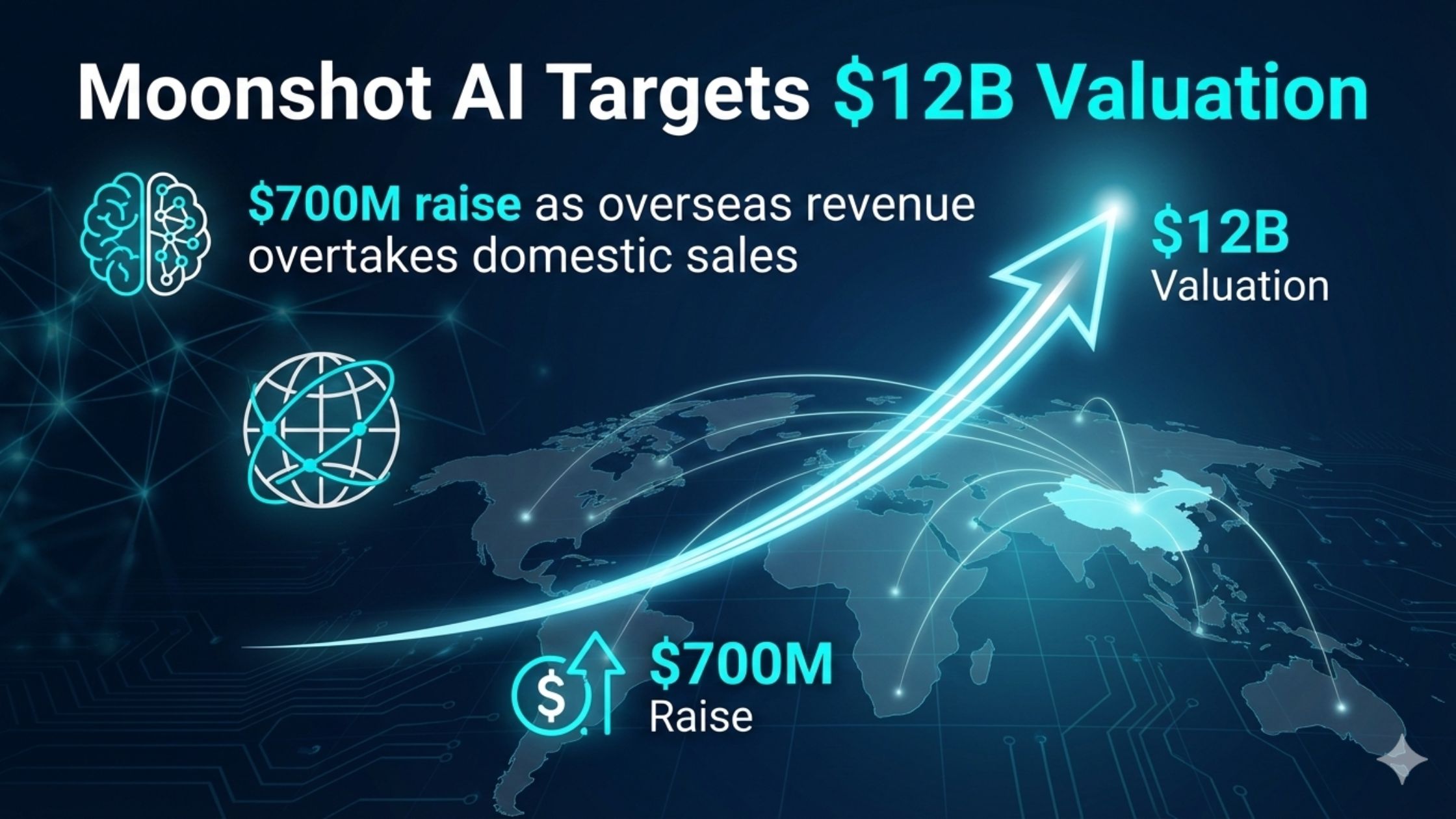
China’s generative AI race is entering a new phase — and Moonshot AI wants to be at the centre of it. The Beijing-based startup behind the Kimi large language models has raised at least US$700 million in a new funding round that could value the company at up to US$12 billion. The raise comes barely a month after its previous round, when it secured US$500 million at a valuation of about US$4.3 billion. If completed at target pricing, the latest round would nearly triple its valuation in under two months.
The financing was led by a group of existing backers, including 5Y Capital, Andon Hong Kong, Tencent Holdings and Alibaba Group Holding, according to a person familiar with the discussions. Additional participation came from Cathay Capital and Gaorong Ventures. The round remains ongoing, and it is still unclear whether Moonshot will ultimately secure the full valuation it is seeking.
One of the most notable developments behind the valuation jump is Moonshot’s overseas performance. Following the release of its flagship Kimi K2.5 model in January, overseas revenue reportedly surpassed domestic revenue for the first time. Paid users outside China grew roughly fourfold after the launch, according to a source.
This marks a critical milestone. Many Chinese AI startups have struggled to monetise internationally due to regulatory, geopolitical and distribution barriers. Moonshot’s ability to grow paid overseas users suggests that its models are gaining traction beyond the domestic market — a key signal for global investors.
The company also launched “Kimi Claw,” a global service that allows users to access the open-source AI agent OpenClaw via its platform. The move indicates an effort to build ecosystem stickiness rather than rely solely on chatbot subscriptions.
Model Performance and Competitive Position
Moonshot’s Kimi K2.5 has been ranked among the strongest open models globally by benchmarking firm Artificial Analysis. On developer platform OpenRouter, the model is reported to rank among the most-used large language models, ahead of several international competitors in usage metrics. However, performance leadership is tightly contested.
Beijing-based Zhipu AI and Shanghai-based MiniMax have both seen market capitalisations surge beyond US$29 billion following their Hong Kong IPOs earlier this year. Those listings collectively raised more than US$1 billion and triggered a re-rating across China’s AI sector. At a proposed US$12 billion valuation, Moonshot would still trail those rivals significantly — but it would firmly enter decacorn territory.
Moonshot, founded in 2023 by Yang Zhilin, a former Tsinghua University researcher with experience at Meta and Google, is considered one of China’s “Six Little Tigers” — a group of leading generative AI startups competing to build foundational models.
Industry sources describe investor competition in the latest round as “extremely fierce,” driven partly by fear of missing out after Zhipu and MiniMax’s IPO-driven valuation spikes. Cathay Capital, which had previously stated caution around LLM investments, reportedly joined the round — signalling how sentiment has shifted.
Still, valuation momentum may not guarantee long-term advantage. China’s AI leaders face intense competition not only from peers but from tech giants such as Alibaba, Tencent and ByteDance, which are investing aggressively in computing infrastructure, model development and consumer AI distribution.
Capital, Scale and the Cost of Survival
Moonshot reportedly holds more than 10 billion yuan (US$1.4 billion) in cash and is not rushing toward an IPO. That liquidity provides runway in what remains a capital-intensive race.
Analysts note that sustaining leadership in foundation models requires:
- Heavy annual spending on computing infrastructure
- Continuous model iteration and training
- Enterprise monetisation pathways
- Global distribution strategy
Some industry executives estimate that only companies capable of investing billions of yuan annually in model R&D will survive the consolidation phase.
This raises a key question: Is Moonshot’s valuation growth driven by fundamentals — such as overseas monetisation — or by sector-wide repricing after recent IPOs?
What This Means for Asia’s AI Market
Moonshot’s fundraising reflects broader shifts across Asia’s AI ecosystem — particularly in valuations, monetisation benchmarks and competitive structure.
Valuations Are Being Repriced
Recent Hong Kong IPOs of Zhipu AI and MiniMax have reset expectations for Chinese large language model companies. Public market gains have pushed private valuations higher, with investors now pricing leading AI firms as future infrastructure platforms rather than early-stage experiments.
Moonshot’s US$12 billion target sits within this re-rating cycle. Whether those valuations hold will depend on revenue growth and global competitiveness, not momentum alone.
Overseas Revenue Is Becoming a Key Signal
For much of the past year, China’s AI race focused on domestic adoption. Now, overseas monetisation is emerging as a credibility test. International revenue suggests product competitiveness, distribution strength and resilience beyond local market dynamics.
In previous Asian tech waves — from SaaS to gaming — companies that scaled globally commanded stronger long-term valuations. Moonshot’s revenue crossover therefore carries strategic weight.
Infrastructure and Consolidation Will Shape the Next Phase
AI leadership in Asia depends not only on model quality, but also on sustained spending on compute, cloud infrastructure and R&D. Export restrictions and capital intensity make this a structural challenge.
At the same time, consolidation is likely. China’s crowded LLM field may narrow as only well-capitalised players sustain multi-billion yuan annual investments.
Taken together, Moonshot’s raise signals a market moving from rapid experimentation toward capital concentration and global competition. The next phase will be defined less by funding headlines and more by durable revenue, infrastructure resilience and international scale.
China’s AI Race Enters a Global Phase
Beyond the numbers, Moonshot’s overseas revenue crossover may signal a broader shift. For the past year, China’s AI race has largely focused on domestic market share. Now, international adoption is becoming a new benchmark of competitiveness.
If Moonshot can convert usage growth into sustainable enterprise revenue, it could differentiate itself in a crowded field. If not, the company may find itself squeezed between better-capitalised tech giants and publicly listed rivals with deeper funding pools.
For now, the message from investors is clear: China’s AI decacorn race is accelerating.
Whether Moonshot’s US$12 billion target reflects durable growth — or peak-cycle optimism — will depend less on funding momentum and more on its ability to scale revenue, manage costs and defend its model performance in an increasingly crowded global arena.
Quick Takeaways
- Moonshot AI raised at least US$700M in a round targeting up to US$12B valuation
- Overseas revenue surpassed domestic income after Kimi K2.5 launch
- Investors include Alibaba, Tencent, 5Y Capital, Cathay Capital and others
- Valuation still trails IPO peers Zhipu AI and MiniMax
- Long-term sustainability depends on R&D spending, monetisation and global traction
Similar Articles