AsiaTechDaily – Asia's Leading Tech and Startup Media Platform

Beyond Automation: How Predictive AI Is Changing Supply Chain Decision-Making
 by
by

As supply chains become more complex and customer expectations continue to rise, artificial intelligence is evolving beyond automating repetitive tasks. Increasingly, predictive AI is helping logistics operators anticipate disruptions, optimize resources, and make faster operational decisions before problems affect the business.
Global supply chains have entered a period where speed alone is no longer enough. Businesses are operating in an environment shaped by volatile demand, geopolitical uncertainty, labor shortages, climate-related disruptions, and increasingly demanding customer expectations. At the same time, the rapid growth of e-commerce has compressed fulfillment windows from days to hours, forcing logistics operators to make thousands of operational decisions in real time.
This shift is redefining the role of artificial intelligence across supply chain operations. For years, AI adoption in logistics centered primarily on automation. Warehouse management systems streamlined inventory tracking, automated workflows reduced manual tasks, and robotics improved picking and sorting efficiency. While these technologies increased productivity, they largely helped organizations execute existing processes more efficiently.
Today, the focus is changing. The next phase of AI adoption is centered on prediction rather than automation. Instead of simply responding to operational events, AI is increasingly being used to identify emerging patterns, forecast disruptions, recommend corrective actions, and enable managers to make decisions before problems escalate.
This evolution represents a fundamental shift in supply chain management. Competitive advantage is no longer determined solely by how efficiently companies execute operations, but increasingly by how accurately they can anticipate what happens next.
From Automation to Operational Intelligence
The digital transformation of supply chains has progressed through several distinct phases. The first generation of warehouse technologies digitized inventory records and replaced paper-based processes. The second focused on automation, introducing robotics, conveyor systems, and warehouse management software that increased throughput and reduced manual intervention.
More recently, organizations have invested heavily in visibility. Connected sensors, cloud platforms, and Internet of Things technologies have provided managers with real-time information about inventory levels, equipment performance, and shipment status.
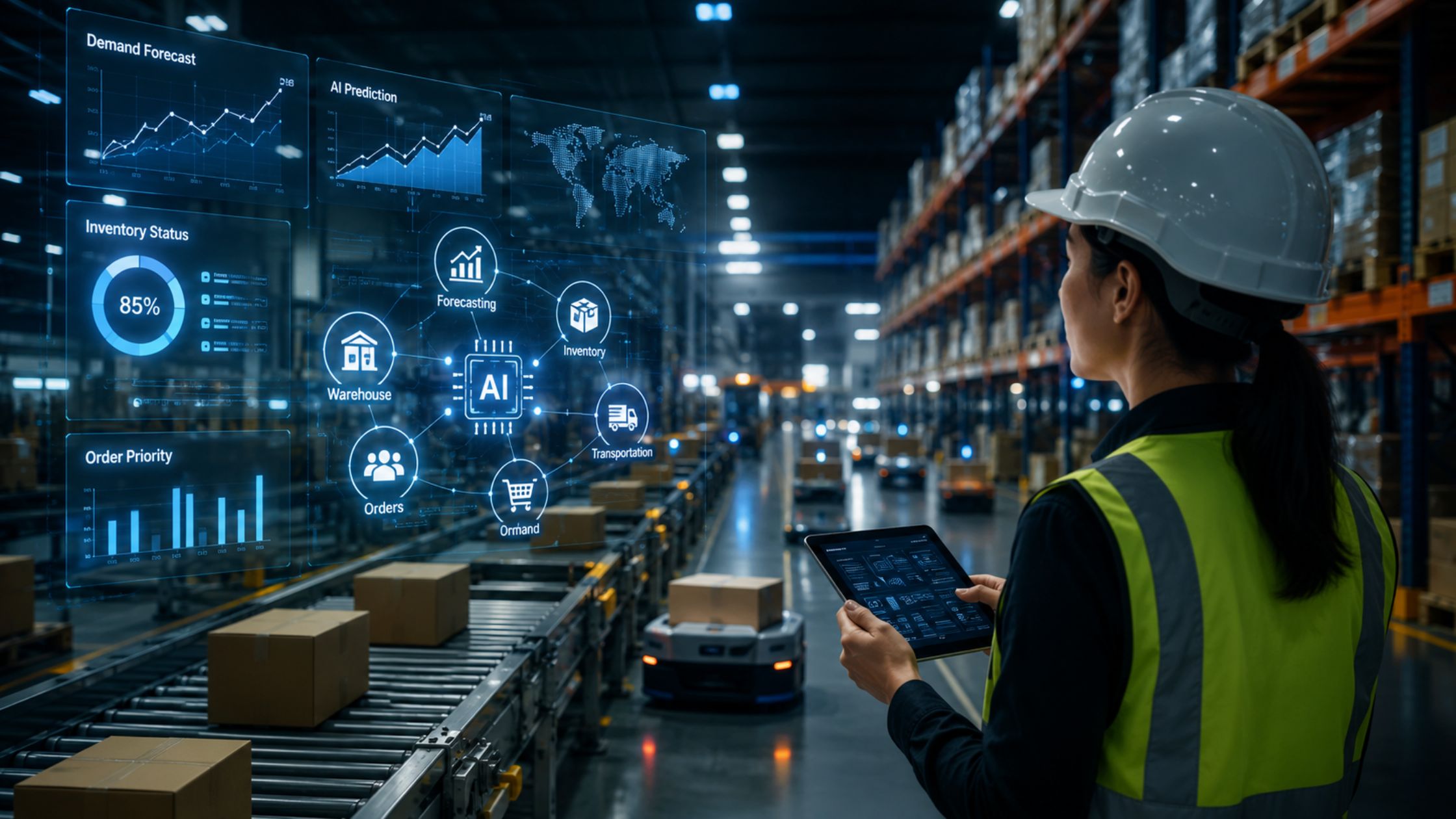
Predictive AI builds upon this digital foundation. Rather than simply displaying operational data through dashboards, AI systems are increasingly capable of interpreting that information, identifying hidden relationships, forecasting future conditions, and recommending actions before operational performance deteriorates. This transforms AI from a reporting tool into an operational intelligence platform. The distinction is significant. Traditional warehouse systems explain what has already happened. Predictive AI helps organizations understand what is likely to happen next and what actions should be taken before customer service or operational efficiency is affected.
Why Prediction Is Becoming the New Competitive Advantage
Modern supply chains generate enormous volumes of operational data every second. Order volumes, inventory movements, labor productivity, transportation schedules, weather conditions, and customer purchasing patterns all influence daily operations. The challenge is no longer collecting data. The challenge is making timely decisions based on that data. Predictive AI enables organizations to analyze these continuously changing variables simultaneously, allowing managers to identify emerging demand shifts, anticipate warehouse congestion, optimize inventory positioning, and allocate labor before operational bottlenecks occur.
Instead of reacting after delays begin affecting customer orders, logistics teams can intervene proactively. This capability is becoming particularly valuable as businesses seek to improve resilience while maintaining increasingly demanding service-level agreements. Rather than optimizing individual warehouse activities, predictive AI supports decisions across interconnected supply chain operations, allowing organizations to coordinate inventory planning, fulfillment, transportation, and workforce allocation more effectively.
South Korea’s Dawn Delivery Model Illustrates the Shift
Few markets demonstrate the need for predictive decision-making more clearly than South Korea. The country’s highly competitive e-commerce sector has transformed consumer expectations through “Dawn Delivery” services, where orders placed late at night arrive before customers wake up the following morning. Meeting these commitments requires warehouses to receive, process, pick, pack, and dispatch thousands of orders within exceptionally compressed timeframes. Under these conditions, reacting to operational disruptions is often no longer sufficient. Warehouse managers must anticipate them.
While conversing with AsiaTechDaily, José Luis Santiago, Director of Mecalux Software Solutions, explained how predictive AI is enabling this transition.
“South Korea’s ‘Dawn Delivery’ model requires extremely precise, high-speed warehouse operations. Easy AI helps logistics managers move from reactive decision-making to predictive execution by analyzing operational data in real time and identifying patterns that can anticipate demand, workload peaks, and order-preparation needs.
Instead of waiting for bottlenecks to appear, warehouse teams can use AI-driven insights to optimize picking strategies, prioritize urgent orders, allocate resources more efficiently, and reduce response times. This predictive approach is especially valuable in high-pressure environments where every minute counts and service-level commitments are extremely demanding.”
His observations reflect a broader transformation taking place across global logistics networks. Artificial intelligence is increasingly being deployed not simply to automate warehouse activities, but to improve the quality and speed of operational decision-making itself.
One of the most significant changes in enterprise AI adoption is the evolving relationship between humans and intelligent systems. Early discussions surrounding AI often focused on replacing manual work through automation. In logistics, this typically meant robots performing repetitive physical tasks or software automating administrative processes.
Predictive AI introduces a different model. Rather than replacing warehouse managers, AI increasingly functions as a decision-support system that continuously monitors operations, evaluates multiple variables simultaneously, and recommends actions based on changing business conditions. Managers remain responsible for strategic decisions, exception handling, and balancing competing operational priorities.
AI contributes by identifying risks earlier than human operators could reasonably detect and by presenting recommendations before disruptions affect performance. This collaborative approach reflects a broader trend across enterprise AI adoption, where organizations are increasingly using AI to augment human expertise rather than replace it.
Why Asia Is Well Positioned for Predictive Supply Chains
Asia’s logistics ecosystem provides particularly favorable conditions for predictive AI adoption. The region combines dense urban populations, rapidly growing digital commerce, sophisticated manufacturing networks, and increasingly demanding consumer expectations. Markets including South Korea, Japan, Singapore, and China continue to push fulfillment standards toward same-day and even sub-day delivery, placing unprecedented pressure on warehouse operations and distribution networks.
In this environment, predictive capabilities offer several operational advantages:
- Forecasting demand fluctuations before they affect inventory availability.
- Identifying warehouse bottlenecks before fulfillment performance declines.
- Optimizing labor allocation during changing order volumes.
- Prioritizing urgent orders while maintaining overall operational efficiency.
- Supporting managers with continuous, AI-driven operational recommendations.
These capabilities help organizations reduce delays while improving resource utilization across increasingly complex supply chain networks.
Prediction Will Define the Next Phase of Supply Chain Innovation
Automation transformed warehouses by reducing manual work and increasing operational efficiency. Predictive AI is beginning to reshape something even more fundamental: how decisions are made. Instead of waiting for disruptions to occur, organizations are increasingly investing in technologies capable of forecasting operational risks, identifying emerging opportunities, and recommending actions before customer experience is affected.
The implications extend well beyond warehouse management. As AI continues to mature, predictive intelligence is expected to influence procurement, manufacturing, transportation, inventory management, and demand planning, creating supply chains that continuously adapt to changing business conditions rather than responding after disruptions occur.
For Asia’s logistics industry, where speed, efficiency, and reliability have become critical competitive differentiators, this shift may prove to be one of the most significant developments in the next generation of supply chain technology. The future of logistics will not be defined solely by faster automation or larger fulfillment centers. It will increasingly be defined by organizations that can transform operational data into timely, intelligent decisions. In that transition, predictive AI is emerging not simply as another technology tool, but as the operational intelligence layer that enables supply chains to become more resilient, responsive, and strategically agile.
Quick Takeaways
- Supply chain AI is evolving beyond automation. Businesses are increasingly using predictive AI to anticipate disruptions, forecast demand, and optimize operations before problems arise.
- Predictive decision-making is becoming a competitive advantage. AI enables logistics teams to identify bottlenecks, allocate resources more efficiently, and improve fulfillment speed through real-time operational insights.
- South Korea’s “Dawn Delivery” model highlights the need for predictive logistics. Ultra-fast fulfillment windows require warehouses to anticipate demand and workload peaks rather than react to operational challenges.
- AI is augmenting, not replacing, warehouse managers. Predictive systems act as decision-support tools, helping human operators make faster and more informed operational decisions.
- Asia’s fast-growing e-commerce sector is accelerating adoption. As consumer expectations for faster deliveries continue to rise, predictive AI is becoming an essential capability for building more resilient and responsive supply chains.
Similar Articles