AsiaTechDaily – Asia's Leading Tech and Startup Media Platform

AsiaStartupExpo Q3 Brings Early-Stage Startups and Investors Together to Explore What Makes a Business Investable
 by
by

The latest AsiaStartupExpo edition brought founders working across AI, cybersecurity, HealthTech, data, workforce technology, and consumer platforms together with investors for discussions around market opportunity, traction, differentiation, and long-term scalability.
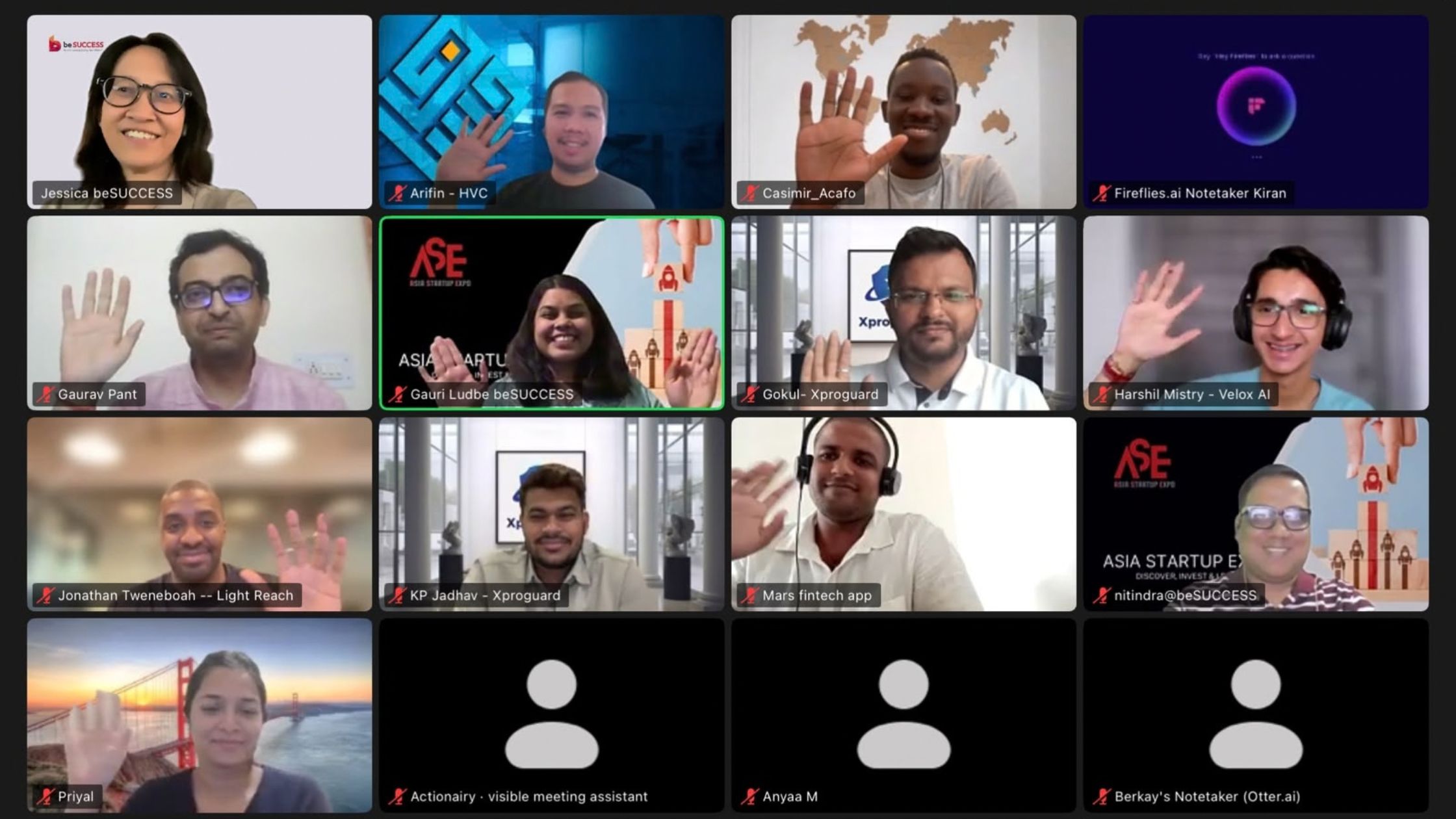
AsiaStartupExpo Q3 2026 brought together early-stage founders and investors on September 23 for a virtual showcase focused on one of the most important questions facing startups in today’s funding environment: what makes a business investable beyond the strength of its technology or the popularity of its sector? Hosted by beSUCCESS in collaboration with AsiaTechDaily, KoreaTechDesk, and IndiaTechDesk, AsiaStartupExpo provides early-stage companies with an opportunity to present their businesses directly to investors and receive feedback on their products, markets, business models, and growth strategies.
The Q3 edition featured startups working across growth engineering, beauty and consumer transparency, career technology, cybersecurity, data analytics, AI diagnostics, freelance marketplaces, and voice AI.
Looking Beyond the Hype Around Emerging Technologies
The event opened with an investor panel titled “Hot Sector or Real Opportunity? How Investors Separate Trends from Investable Businesses.” The discussion featured Tommy Khuong from Capital JDI, Gaurav Pant, Mochamad Arifin Zainul from Hasan VC, and Priyal Mehta, who explored how investors assess companies operating in sectors attracting significant attention.
For founders, being part of a high-growth category can create visibility, but sector momentum alone does not establish a sustainable business. The discussion therefore focused on the signals investors use to distinguish genuine market opportunities from businesses benefiting primarily from a popular technology or investment narrative.
Market demand, customer validation, traction, business models, differentiation, and defensibility emerged as important considerations when assessing early-stage companies. The panel also examined the challenge of evaluating startups when founders have limited historical data.
AI was another important part of the conversation. As AI tools reduce the time and resources required to develop software products, the technology itself can become easier to replicate. This increases the importance of other sources of competitive advantage, including proprietary data, customer relationships, workflow integration, domain expertise, and distribution.
Startups Bring Diverse Technology and Business Models to the Showcase
Following the investor discussion, founders presented their businesses and engaged directly with the panel on questions around market opportunity, customer needs, product differentiation, business models, and scalability. The diversity of the cohort also highlighted how the investment case can differ significantly across sectors. While enterprise startups need to demonstrate clear customer value and a path to recurring revenue, consumer-facing businesses need to establish strong customer demand and differentiation. HealthTech companies face additional considerations around validation and adoption, while AI startups increasingly need to demonstrate defensibility as the cost of developing AI-enabled products continues to fall.
The participating startups represented a range of technology and industry applications, from AI and enterprise software to healthcare, cybersecurity, beauty technology, and workforce solutions. The founders included:
LightReach
Singapore-based LightReach, founded by Jonathan Tweneboah, is developing an AI-powered growth engineering platform that helps companies turn customer conversations, market signals, and product data into prioritized growth opportunities and measurable experiments.
The platform connects market intelligence with product and growth execution, allowing companies to capture signals, prioritize opportunities, and measure outcomes without building a large dedicated cross-functional growth team.
Bare Halal
Morocco-based Bare Halal, founded by Ilham Lahreche, focuses on ingredient intelligence for beauty and personal care products.
The platform helps consumers interpret complex ingredient lists and understand factors including ingredient origins, halal considerations, and potential safety risks. Its approach addresses growing demand for greater transparency around cosmetic and personal care products.
Acafo
Acafo, founded by Casimir Agossou, focuses on helping international talent navigate employment opportunities in South Korea.
The platform provides tools around job preparation, resume analysis, Korean-standard resume creation, translation, skill discovery, job matching, and career coaching. Its focus is on the challenges international professionals face when navigating Korea’s employment market.
Xproguard
Xproguard, part of the cybersecurity ecosystem developed by Xprobyte and founded by KP Jadhav, focuses on digital security for consumers.
Xprobyte’s broader product ecosystem also includes Xproshield for enterprise security and XproAI for developers, giving the company a multi-segment approach to cybersecurity across individual users, businesses, and software developers.
Imperial Tech
Founded by Berkay Başeski, Imperial Tech focuses on data analytics and visualization.
The company is developing tools to help users organize, analyze, and present data in a more accessible format, addressing the needs of businesses and other organizations working with increasingly complex datasets.
Cortex AI
Cortex AI, founded by Assylzhan Abdullayev, is developing AI-driven healthcare tools for donor-recipient compatibility assessment and medical decision support.
Its approach combines biomathematics and CKD-EPI metrics to calculate a compatibility index and generate medical explanations, risk hypotheses, and transplant recommendations. The company is targeting healthcare providers including hospitals, clinics, and telemedicine platforms.
TaskLi
TaskLi, the flagship product of LiNis, founded by Radhouane Alaadeen K, is an AI-powered freelancer marketplace.
The platform uses AI matching to connect users with taskers for everyday services and other work opportunities. LiNis is developing the platform for both individual users and potential enterprise applications.
VeloxAI
VeloxAI, founded by Harshil Mistry, is developing AI-powered voice agents for enterprise customer service and contact centers.
The planned platform is designed to handle customer interactions without complex integration or coding, with a focus on automating voice-based customer support. The company is also exploring a usage-based model for enterprise adoption.
What the Investor Conversations Revealed
The diversity of the startups also highlighted how investment considerations vary depending on the market and business model. For enterprise-focused companies, questions around measurable customer value, recurring revenue, adoption, and scalability remain central to the investment case. For startups addressing specialized consumer or regional markets, a clearly defined customer problem and focused initial market can provide an entry point, but founders also need to demonstrate how that opportunity can expand.
A strong technology can help a startup enter a market, but investors ultimately need to understand whether there is a meaningful customer problem, a sufficiently large and accessible market, a sustainable business model, and a reason the company can maintain its position as competition increases.
Creating a More Direct Founder-Investor Conversation
One of the central elements of AsiaStartupExpo is the interaction that follows each pitch. Rather than limiting the session to presentations, founders engage directly with investors on questions around their market, customers, traction, business model, differentiation, and growth plans.
For early-stage companies, these conversations provide an opportunity to test their fundraising narrative against the questions investors are likely to ask beyond the pitch deck. The Q3 edition reinforced the value of this direct exchange. Across different sectors and business models, the discussions consistently returned to fundamentals: understanding the customer, proving demand, building differentiation, and demonstrating how an early-stage product can develop into a scalable business.
As startup funding becomes increasingly focused on business fundamentals, these conversations can play an important role in helping founders understand how investors assess opportunities and what evidence is needed to move from an initial pitch to a deeper investment discussion. AsiaStartupExpo Q3 2026 highlighted that while technology trends can create new markets and accelerate innovation, the foundations of an investable startup remain closely tied to customer demand, business model strength, differentiation, and the ability to build a scalable company.
Quick Takeaways
- Investor focus is shifting beyond sector hype toward customer demand, traction, business fundamentals, and scalability.
- AI alone is not a moat. As AI makes products easier to build and replicate, startups need stronger sources of differentiation and defensibility.
- Early traction needs context. Pilots, partnerships, and initial users matter, but investors also look for evidence that demand is repeatable and commercially sustainable.
- A focused market entry can strengthen the investment case. Startups need to balance a clear initial customer segment with a credible path to a larger market.
- Asia’s market diversity creates both challenges and opportunities, particularly around regulation, customer behavior, and cross-border expansion.
- Direct investor-founder discussions add value beyond the pitch deck, helping founders understand how investors assess their business and what evidence can strengthen their fundraising case.
Similar Articles