AsiaTechDaily – Asia's Leading Tech and Startup Media Platform

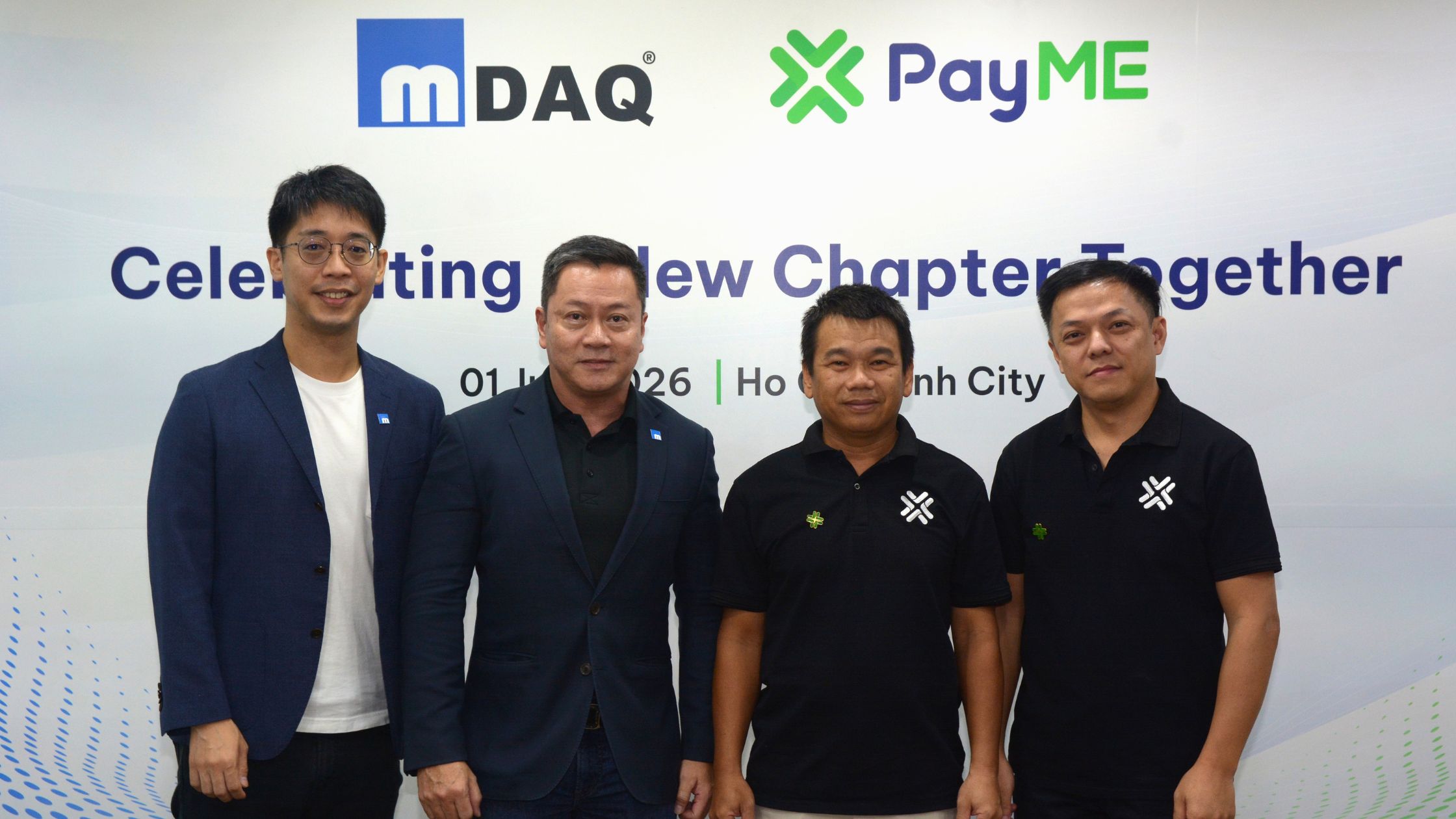
Singapore’s M-DAQ Expands Into Vietnam to Strengthen ASEAN Cross-Border Payments Network
 by
Byungho Lim
by
Byungho Lim

The strategic integration with Vietnam’s METech gives M-DAQ regulated local payment infrastructure in one of Southeast Asia’s fastest-growing digital economies, advancing its ambition to build a unified ASEAN Payments Hub.
Singapore-headquartered M-DAQ Global, a fintech group specializing in foreign exchange (FX) and cross-border payment solutions, has signed definitive agreements for a strategic integration with METech, the majority shareholder of Vietnam-based licensed payment service provider PayME. The move gives M-DAQ its own regulated payments infrastructure in Vietnam, enabling the company to process local collections and payments directly in Vietnamese Dong (VND) while reducing its dependence on third-party payment providers.
The integration marks another milestone in M-DAQ’s strategy to build a unified ASEAN Payments Hub, following earlier expansions through EasyPay in Malaysia and Wallex in Indonesia.
Vietnam has emerged as one of Southeast Asia’s most dynamic digital economies, making it an increasingly important market for cross-border financial services. According to a recent report, Vietnam’s digital economy reached US$72.1 billion in 2025, accounting for more than 14% of the country’s GDP, with the government targeting an increase to 30% by 2030. The country’s domestic e-commerce market also reached US$31 billion in 2025, placing Vietnam among ASEAN’s three largest digital economies, while its cross-border business-to-consumer e-commerce market is projected to grow to US$13.39 billion by 2031.
As digital trade expands, payment infrastructure capable of supporting local collections, foreign exchange, and cross-border settlements is becoming increasingly critical for businesses operating across the region.
Through the integration, M-DAQ gains direct access to Vietnam’s regulated payment rails, allowing it to process local collections and payouts in Vietnamese Dong rather than relying on intermediary financial institutions. The company said this will enable faster settlement, lower operational friction, and greater control over one of ASEAN’s most important trade corridors.
Building a Unified ASEAN Payments Hub
The Vietnam expansion builds on M-DAQ’s broader regional strategy of establishing licensed payment infrastructure across Southeast Asia. With METech joining the group, M-DAQ now holds five regulated licenses, including operations across four key ASEAN markets. The integration combines METech’s local regulatory expertise, banking relationships, and payment infrastructure with M-DAQ’s regional FX, collection, and payout capabilities.
While conversing with AsiaTechDaily, Tan Choon Seng, Group CEO of M-DAQ Global, said the integration represents another important step toward creating an interconnected regional payments ecosystem.
“This integration significantly deepens our ASEAN footprint, building directly on our prior strategic expansions through EasyPay in Malaysia and Wallex in Indonesia. By securing our own regulated payments infrastructure in Vietnam, we now have direct access to local collection and payout rails natively in Vietnamese Dong (VND).
With Vietnam serving as a critical node in our regional payments network, this milestone moves us closer to our ultimate vision of a unified, interoperable payments hub that accelerates seamless cross-border transactions across ASEAN. We will continue to expand our regulatory footprint regionally and globally, but our immediate priority remains the successful integration of METech and delivering maximum value to our customers.”
The company’s long-term objective reflects a broader shift within ASEAN fintech, where payment providers are increasingly seeking to create integrated regional networks capable of supporting businesses operating across multiple jurisdictions.
Why Licensed Local Infrastructure Matters
Historically, many fintech companies entering new markets have relied heavily on local banking partners or third-party payment providers to access domestic payment systems. While this approach enables relatively quick market entry, it can introduce additional operational complexity, settlement delays, and dependency on external infrastructure. Increasingly, fintech firms are instead pursuing regulated local licenses and infrastructure to gain greater control over payment flows.
Tan explained that direct ownership of regulated infrastructure provides significant operational advantages.
“From our perspective, integrating regulated local infrastructure instead of relying heavily on third parties provides vital strategic control over key cross-border payment corridors, like VND flows. Instead of navigating multiple banking or payment partners, we can offer fintechs and banks a faster go-to-market with a single connectivity layer that provides access to six markets, while leveraging our deep understanding of local regulations and market-specific restrictions. By reducing reliance on traditional third-party setups, we significantly reduce operational friction, enabling faster settlements and more efficient transaction flows for businesses.
This strategy also grants us direct access to METech’s established network of local merchants, SMEs, and ecosystem partners. Ultimately, combining this locally embedded infrastructure with our proprietary technology gives us superior scalability, allowing us to support complex cross-border use cases more effectively than traditional financial institutions.”
His comments underscore a growing trend across Southeast Asia’s fintech sector, where infrastructure ownership is becoming an increasingly important competitive differentiator as payment volumes and cross-border commerce continue to grow.
Strengthening Regional Payment Connectivity
METech contributes more than regulatory access to the partnership. As the majority shareholder of PayME, the company has spent years building payment infrastructure within Vietnam, offering services including online payment gateways, QR code payments, digital wallets, and salary advance solutions. Its established relationships with domestic financial institutions and merchants provide M-DAQ with an embedded presence in Vietnam’s financial ecosystem while expanding its reach into one of the region’s fastest-growing economies.
Commenting on the integration, Lê Hoàng Gia, Founder of METech, said combining local infrastructure with regional connectivity creates opportunities beyond Vietnam.
“We have established a deeply entrenched presence within Vietnam’s financial ecosystem over the past decade, developing substantial expertise by serving the local business community. With this integration with M-DAQ, we are keen to extend our expertise to businesses beyond Vietnam, combining local infrastructure with regional reach to unlock new growth opportunities across ASEAN. Together, we are setting a new standard for how cross-border payments can be executed with speed, reliability, and transparency.”
Meanwhile, Tan Choon Seng noted that Vietnam represents a natural extension of M-DAQ’s ASEAN-focused strategy.
“Vietnam is one of ASEAN’s most dynamic growth markets and a key pillar for the region’s digital transformation. We are proud to mark M-DAQ’s first direct presence in the country through this integration, advancing our ASEAN-focused strategy. This positions us well to unlock new opportunities across the region, strengthen connectivity between markets, and drive the next phase of scalable cross-border payments.”
The integration reflects a broader evolution taking place across Southeast Asia’s financial technology landscape. As cross-border trade, digital commerce, and regional business expansion continue to accelerate, fintech companies are increasingly moving beyond customer-facing payment services toward building the regulated infrastructure that powers regional financial connectivity. Ownership of licensed local payment rails is becoming as strategically important as payment applications themselves, enabling providers to deliver faster settlement, greater transparency, and improved regulatory compliance across multiple markets.
For M-DAQ, Vietnam represents another building block in its vision of an interconnected ASEAN payments ecosystem. More broadly, the transaction illustrates how regional fintech competition is increasingly shifting from expanding into new markets to owning the infrastructure that enables seamless movement of money across them.
Quick Takeaways
- Singapore-based M-DAQ Global has expanded into Vietnam through a strategic integration with METech, giving the fintech company its own regulated payment infrastructure and direct access to Vietnamese Dong (VND) collection and payout capabilities.
- The move advances M-DAQ’s vision of building a unified ASEAN Payments Hub, strengthening its licensed payments network across key regional markets following previous expansions in Malaysia and Indonesia.
- Vietnam’s rapidly growing digital economy provides a significant growth opportunity. With a digital economy valued at US$72.1 billion in 2025 and a domestic e-commerce market worth US$31 billion, demand for efficient cross-border payment infrastructure is expected to continue rising.
- The integration reflects a broader shift in ASEAN fintech, where companies are increasingly investing in regulated local payment infrastructure instead of relying solely on third-party banking and payment partners to improve settlement speed, scalability, and regulatory compliance.
- As cross-border commerce accelerates across Southeast Asia, payment infrastructure is becoming a strategic competitive advantage. Fintech providers are increasingly focusing on owning licensed local payment rails to enable faster, more transparent, and seamless regional transactions for businesses operating across multiple ASEAN markets.