AsiaTechDaily – Asia's Leading Tech and Startup Media Platform

Epic Angels Invests in Enaxiom’s $1.8M Round Targeting Data Center Cooling
 by
by

The oversubscribed round comes as water availability begins to shape how and where AI data centers are built.
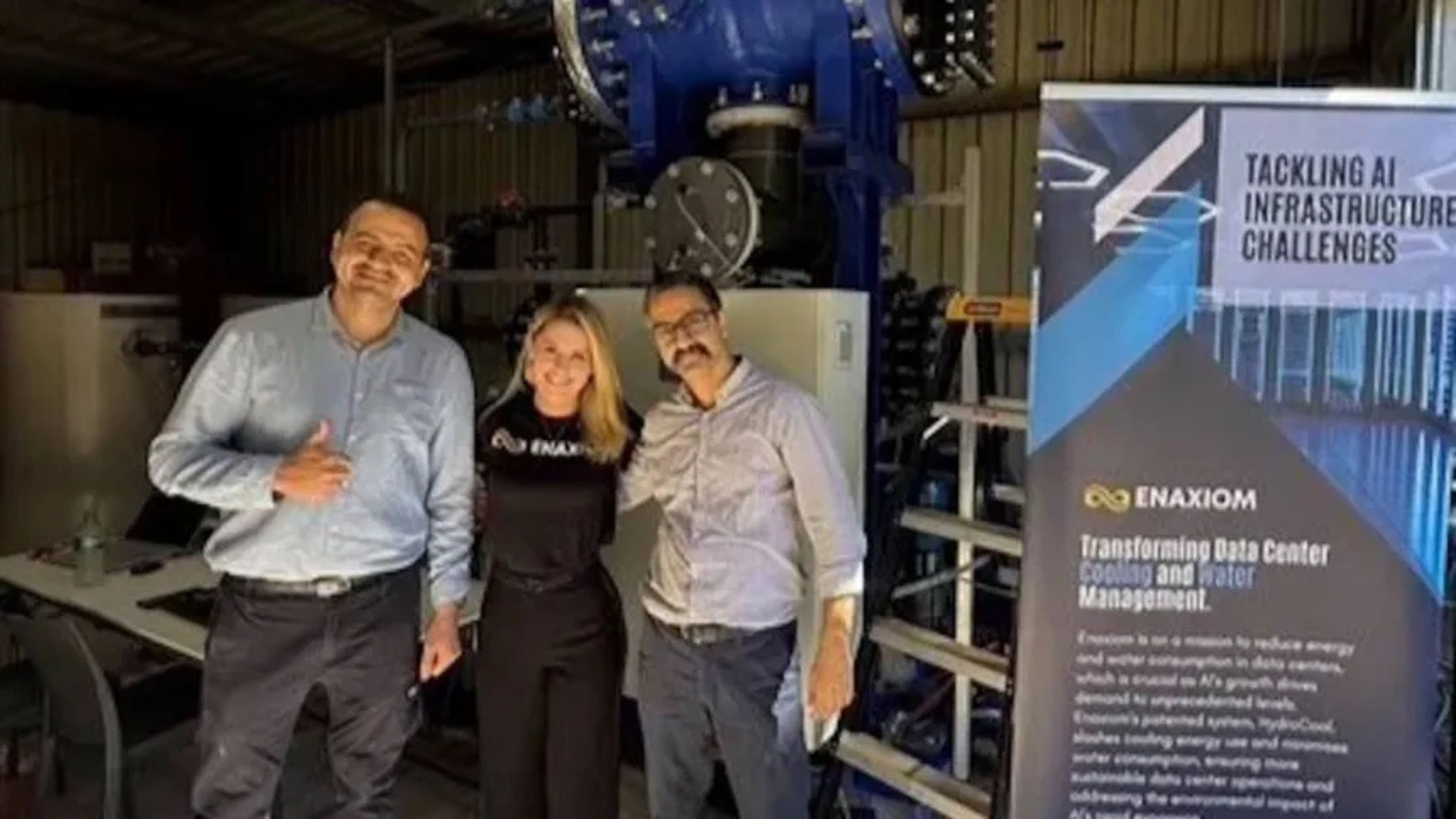
Enaxiom, an Australian deep tech startup developing cooling systems for AI data centers, has closed an oversubscribed $1.8 million seed round, bringing its total funding to US$2.7 million (A$3.7 million). The round included Epic Angels, the largest global all-female investment collective, with participation from Antler and BlackNova. The company will use the capital to support commercial deployment of its technology, expand its team, and accelerate entry into the US market.
The investment arrives as water availability moves from a peripheral concern to a concrete operational constraint for data center operators. U.S. data centers directly consumed 17.4 billion gallons of water in 2023, a figure projected to reach between 38 and 73 billion gallons by 2028, driven largely by the cooling demands of AI infrastructure. Yet water has remained a secondary consideration in most conversations about sustainable data center development, sitting in the shadow of energy and carbon emissions. Enaxiom is among a small group of startups building specifically around that gap.
The rapid expansion of AI infrastructure has drawn sustained attention to energy consumption, but water usage is emerging as an additional and less-discussed constraint. Data centers rely on cooling systems to manage the heat generated by high-performance computing hardware, and many of these systems require substantial volumes of treated water.
Google reported using 6.4 billion gallons of water worldwide in 2023, with 95% attributed to its data centers. In regions where water availability is limited or contested, this is beginning to influence how and where facilities can be built. A study by the Houston Advanced Research Center and the University of Houston found that data centers in Texas alone will use 49 billion gallons of water in 2025, rising to as much as 399 billion gallons by 2030.
For Maaike Doyer, founding partner of Epic Angels, the investment in Enaxiom reflects a view that the industry is approaching a reckoning it has not adequately prepared for.
“We invest now to change the problems of the future. That’s the whole point. Right now, everyone is talking about electricity. Water will be next if we are not careful, and the issues are accumulating fast. Enaxiom already has a working pilot. This is not a bet on a concept, it’s a bet on a team that has done the hard work. Now is the time to double down, not wait,” Doyer told AsiaTechDaily.
Targeting the Heat Rejection Layer
Enaxiom is focusing on a specific part of the cooling process known as heat rejection, where a significant share of both energy use and water consumption is concentrated. Rather than redesigning entire cooling systems, the company’s approach is to integrate into existing liquid cooling architectures, including direct-to-chip and immersion systems.
HydroCool is described as the world’s first regenerative cooling system, built around a closed-loop process that uses non-potable water sources, including wastewater streams, and is designed to recover water as part of the cooling cycle. The goal is to reduce dependence on clean water inputs while improving overall resource efficiency. The technology is the result of over a decade of research and development.
Tia Collings, CEO and Co-Founder of Enaxiom, framed the focus on heat rejection as addressing one of the more overlooked bottlenecks in cooling infrastructure.
“We’re building cooling infrastructure that tackles this at the heat rejection layer, one of the most overlooked but critical parts of a data centre cooling system,” Collings said.
The system has been tested through a 40kW pilot with independent engineering validation, and the company is now moving toward commercial-scale deployment.
Scaling Through Standardisation
One of the central challenges for infrastructure startups is the transition from pilot systems to large-scale deployment. This typically involves engineering complexity alongside significant manufacturing and integration constraints. Enaxiom’s approach is to standardise its system into repeatable modules rather than designing bespoke configurations for each deployment.
“Our approach to scaling is fundamentally modular, which changes the nature of that leap. Rather than redesigning the system for each scale, we’re building a standardised module, effectively a Lego block, that can be repeated to reach megawatt and multi-megawatt deployments. That means whether we’re delivering 1MW or 10MW, we’re manufacturing and deploying the same core unit, just in multiples. This has two major advantages. First, from a data centre perspective, it naturally enables redundancy, which is critical for Tier III and Tier IV facilities where uptime is non-negotiable. Second, from a manufacturing standpoint, it allows us to lock in our supply chain and optimise around a single design, which significantly improves speed, cost, and reliability as we scale,” Collings told AsiaTechDaily.
Bijan Rahimi, CTO and Co-Founder of Enaxiom, described the modular design as a deliberate strategy to maintain performance consistency across different deployment sizes.
“We’re not scaling by building bigger systems. We’re scaling by repeating a proven unit. That modular approach means we can move faster, maintain performance consistency, and meet the redundancy requirements of modern data centres without reinventing the system at each stage,” Rahimi noted.
Why the US Is a Priority Market
Enaxiom is initially focusing on the United States, which combines high data center density with growing resource constraints. A significant portion of new infrastructure is being developed in regions already facing water stress, creating additional pressure on cooling strategies.
“The US stands out both for its scale and for the urgency of the problem we’re solving. It represents one of the largest concentrations of data centre infrastructure globally, but more importantly, a significant portion of that infrastructure is being built in water-stressed regions. That creates a growing tension between the expansion of AI workloads and the availability of sustainable water and energy resources. What makes the US particularly compelling is the overlap between rapid data centre growth and water scarcity. That’s exactly where our technology is designed to operate, reducing water use while enabling high-performance cooling,” Collings told AsiaTechDaily.
Gartner forecasts that electricity demand from AI-enabled data centers will surge by 160%, potentially limiting 40% of these facilities due to grid constraints by 2027. Water availability is becoming an equally concrete limiting factor, particularly in states like Texas, Nevada, and Virginia, where data center concentration is highest and environmental scrutiny is increasing.
The company also pointed to customer demand, access to capital, and policy support as additional drivers for entering the US market ahead of other geographies.
A Constraint That Is No Longer Secondary
The expansion of AI infrastructure is often framed as a race for compute and energy. On the ground, however, constraints are already shifting. Water availability is beginning to influence permitting, site selection, and long-term viability in ways that are harder to ignore, particularly where data center growth directly overlaps with resource stress.
For operators, this introduces a new layer of complexity. Scaling AI capacity is no longer just about securing power and hardware. It increasingly requires ensuring that supporting infrastructure can operate within environmental and regulatory limits. Cooling, once treated as a secondary design consideration, is becoming a central one.
For startups like Enaxiom, this shift creates both an opportunity and a test. The question is no longer whether the problem is real, but whether alternative cooling approaches can be deployed at scale, integrated into existing systems, and adopted quickly enough to keep pace with demand. The answer, in large part, will depend on whether the industry treats water with the same urgency it has applied to energy.
About Enaxiom
Enaxiom is an Australia-based deep tech company focused on addressing the water and energy demands of data center cooling. Founded in Sydney in 2023 by Tia Collings (CEO) and Bijan Rahimi (CTO), the company develops systems targeting the heat rejection layer of cooling infrastructure, where a significant share of water consumption and energy use occurs. Its HydroCool technology is designed to integrate with existing liquid cooling methods, uses non-potable water sources, and enables water recovery as part of the process. Enaxiom is currently progressing from pilot-stage validation to commercial deployment.
About Epic Angels
Epic Angels is a global investment collective focused on early-stage startups across Asia Pacific and Latin America. The network comprises over 850 female investors and invests in sectors including technology, climate, and consumer platforms. In addition to capital, Epic Angels provides portfolio companies with access to mentorship, networks, and market entry support.
About Antler
Antler is a global early-stage venture capital firm that invests in startups from inception through early growth stages. The firm operates across multiple geographies and focuses on building companies from the ground up, often working with founders prior to product development.
About BlackNova
BlackNova is a venture capital firm that invests in early-stage technology companies, with a focus on sectors including deep tech and infrastructure. The firm participates in seed and early growth rounds, supporting startups through capital and strategic guidance.
Quick Takeaways
- Enaxiom has raised a total of US$2.7 million (A$3.7 million) in funding, with the latest oversubscribed seed round led by Epic Angels, alongside Antler and BlackNova
- The company is developing HydroCool, described as the world’s first regenerative cooling system, targeting water usage in AI data centers at the heat rejection layer
- HydroCool uses non-potable water sources and is designed to recover water during the cooling cycle, reducing dependence on clean water inputs
- The technology has been tested through a 40kW pilot with independent engineering validation and is now moving toward commercial-scale deployment
- Enaxiom is adopting a modular scaling approach, standardising its system into repeatable units to simplify manufacturing and integration
- The company is prioritising the US market, citing the overlap between high data center density and increasing water scarcity
- U.S. data centers consumed 17.4 billion gallons of water in 2023, a figure projected to rise to between 38 and 73 billion gallons by 2028
Similar Articles