AsiaTechDaily – Asia's Leading Tech and Startup Media Platform

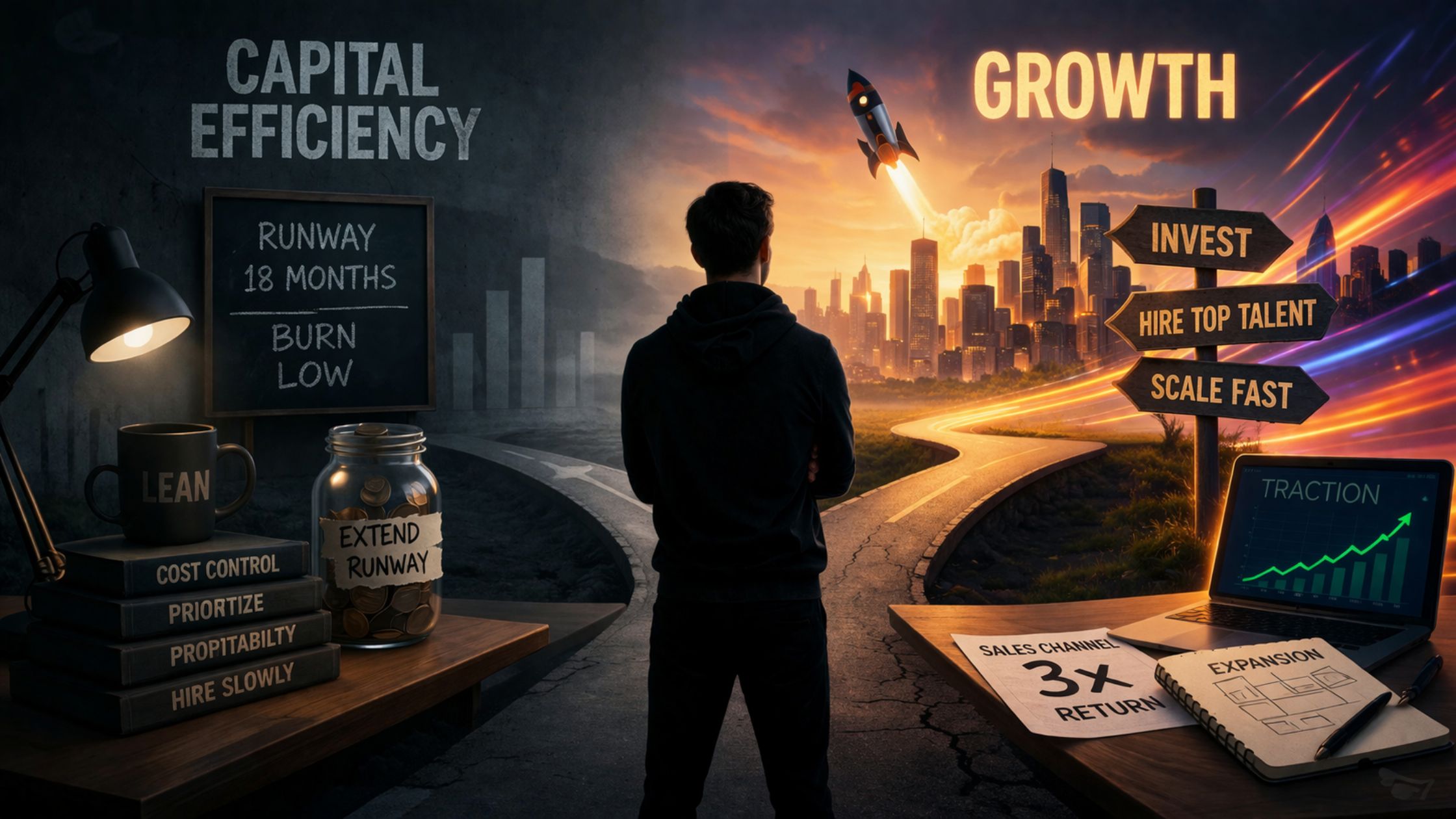
The Discipline Trap: When Capital Efficiency Starts Limiting Startup Growth
 by
by

As startups embrace lean operations, a new risk is emerging—mistaking caution for strategy at the very moment growth demands conviction.
Over the past few years, “capital efficiency” has become one of the most celebrated principles in the startup ecosystem. Founders have been urged to extend runway, reduce burn, and build sustainable businesses rather than chase growth at all costs.
This shift was necessary. The funding boom of 2020–2021 gave way to a more selective, disciplined investment environment, forcing startups to rethink how they operate. In many ways, the correction has been healthy—companies today are more focused, metrics-driven, and resilient. But as the ecosystem stabilizes, a more subtle problem is beginning to surface. Some startups are holding on to discipline even when their business—and the market—calls for acceleration. What was once a survival strategy is, in certain cases, becoming a growth constraint.
The post-funding slowdown created a deep psychological shift among founders. The priority moved from aggressive expansion to capital preservation. Hiring slowed, experimentation narrowed, and spending decisions became increasingly conservative.
Even as capital begins to flow back—albeit selectively—this mindset has persisted. The result is a generation of startups that are operationally efficient but strategically cautious. Founders are no longer asking, “How fast can we grow?” but rather, “How long can we last?” That question is important. But beyond a certain point, it becomes the wrong one. Because startups don’t scale in a vacuum. Markets move, competitors execute, and opportunities emerge—and disappear—faster than internal caution cycles.
The Inflection Point Most Startups Misread
There is a critical stage in a startup’s journey—often around early product-market fit or roughly $1M in ARR—where the nature of risk fundamentally changes. Before this stage, restraint is rational. The business is still proving itself, and capital must be deployed carefully. After this stage, however, the risk shifts. The question is no longer whether the model works, but whether the company can scale it fast enough. This is where many startups hesitate.
Tommy Khương, an Investment Associate at Capital JDI commented on the issue while speaking to AsiaTechDaily,
“Bootstrap discipline becomes a growth-killer at the moment of market inflection. If you are doing $1M in ARR and you know that spending $100k on a proven sales channel will return $300k, but you refuse to spend it to ‘stay lean,’ you aren’t being disciplined—you’re being timid.”
The distinction here is subtle but critical. Discipline, in its ideal form, is about efficient allocation of capital. But when it prevents founders from acting on validated opportunities, it shifts from strategy to hesitation. In practical terms, this often means delaying investments that have already demonstrated clear returns—whether in marketing, sales, or expansion.
The Talent Ceiling: When Lean Teams Stop Scaling
One of the clearest manifestations of underinvestment appears in hiring decisions. In an effort to control burn, many founders delay bringing in senior leadership—particularly in functions like sales, growth, and operations. Instead, they stretch existing teams or take on responsibilities themselves. This works—up to a point. But scaling a company requires a different kind of execution than building one. Without experienced operators, startups often struggle to convert early traction into repeatable growth.
Tommy captured this dynamic saying,
“Underinvestment typically manifests as a talent plateau; when a founder refuses to hire a ‘VP of Sales’ because they want to keep the burn low, they often accidentally cap their own ceiling.”
The rise of AI tools and lean operating models has reinforced the belief that smaller teams can achieve more. And to some extent, that’s true—efficiency gains are real. But tools can optimize execution; they cannot replace leadership, strategy, or market navigation. At scale, those become the defining factors.
When Markets Reward Speed, Not Just Efficiency
A key tension in today’s ecosystem lies between how founders manage risk and how markets reward performance. Founders, shaped by recent funding constraints, are optimizing for downside protection—longer runway, controlled hiring, and measured growth. Markets, however, reward something else: momentum. Investors continue to back companies that demonstrate clear execution, rapid scaling in proven channels, and the ability to capture market share decisively. In many sectors, capital is concentrating around perceived winners rather than being distributed evenly.
This creates a gap. Startups that move too cautiously may survive—but they risk being outpaced by competitors who are willing to invest at the right moment. And in fast-moving markets, second place often captures significantly less value. Timing, in this sense, becomes more important than absolute efficiency.
The New Capital Paradox
The ecosystem today presents an interesting paradox. On one hand, capital is more disciplined than before. Investors expect stronger fundamentals, clearer paths to profitability, and more thoughtful deployment of funds.
On the other hand, breakout companies still require bold execution—strategic hiring, aggressive channel expansion, and early market capture. The challenge for founders is navigating both realities simultaneously. Too much aggression leads to unsustainable burn. Too much caution leads to missed opportunities. In this environment, the winners are not necessarily the most conservative companies—but those that understand when to shift gears.
Redefining Discipline for the Next Phase
The core issue is not discipline itself, but how it is defined. For much of the past few years, discipline has been equated with cost control—spending less, hiring slower, and extending runway. But as startups move into growth phases, that definition needs to evolve. True discipline is not about minimizing spend. It is about deploying capital with conviction where returns are visible.
That could mean:
- Doubling down on a sales channel that consistently converts
- Hiring senior talent to unlock the next stage of growth
- Expanding into a market where demand signals are already clear
The underlying principle remains the same: reduce waste. But reducing waste is not the same as avoiding investment. The startup ecosystem has already corrected one extreme. The era of unchecked spending has given way to a more measured, thoughtful approach to building companies. Now, it faces a more nuanced challenge. If founders remain overly anchored to capital preservation, they risk solving the wrong problem. Running out of money is a visible failure. Running out of momentum is quieter—but often just as consequential.
The companies that define the next phase of the ecosystem will not be those that simply survive the longest. They will be the ones that recognize when survival is no longer the goal—and act accordingly. Because in the end, discipline is not about holding back. It is about knowing exactly when not to.
Quick Takeaways
- Capital efficiency has become a default mindset—but it’s not always the right strategy at every stage. What works in survival mode can hinder growth at scale.
- The real risk shifts after product-market fit. Early on, overspending is dangerous; later, underinvestment becomes the bigger threat.
- Many startups are misreading the inflection point. Proven growth channels and clear ROI signals often go underutilized due to excessive caution.
- “Staying lean” can quietly turn into strategic hesitation. As the investor insight highlights, refusing to invest in known opportunities is not discipline—it’s timidity.
- Underinvestment often shows up as a talent gap. Delaying key hires—especially in sales and growth—creates a ceiling that limits scaling potential.
- Markets reward momentum, not just efficiency. Investors are backing companies that execute and scale, not just those that conserve capital.
- The ecosystem has overcorrected from excess to caution. The next challenge is finding balance—not swinging between extremes.
- Discipline needs to be redefined. It’s no longer about spending less, but about allocating capital where returns are predictable and timely.
- The biggest risk isn’t just running out of money—it’s losing momentum when the opportunity window is open.
Similar Articles