AsiaTechDaily – Asia's Leading Tech and Startup Media Platform

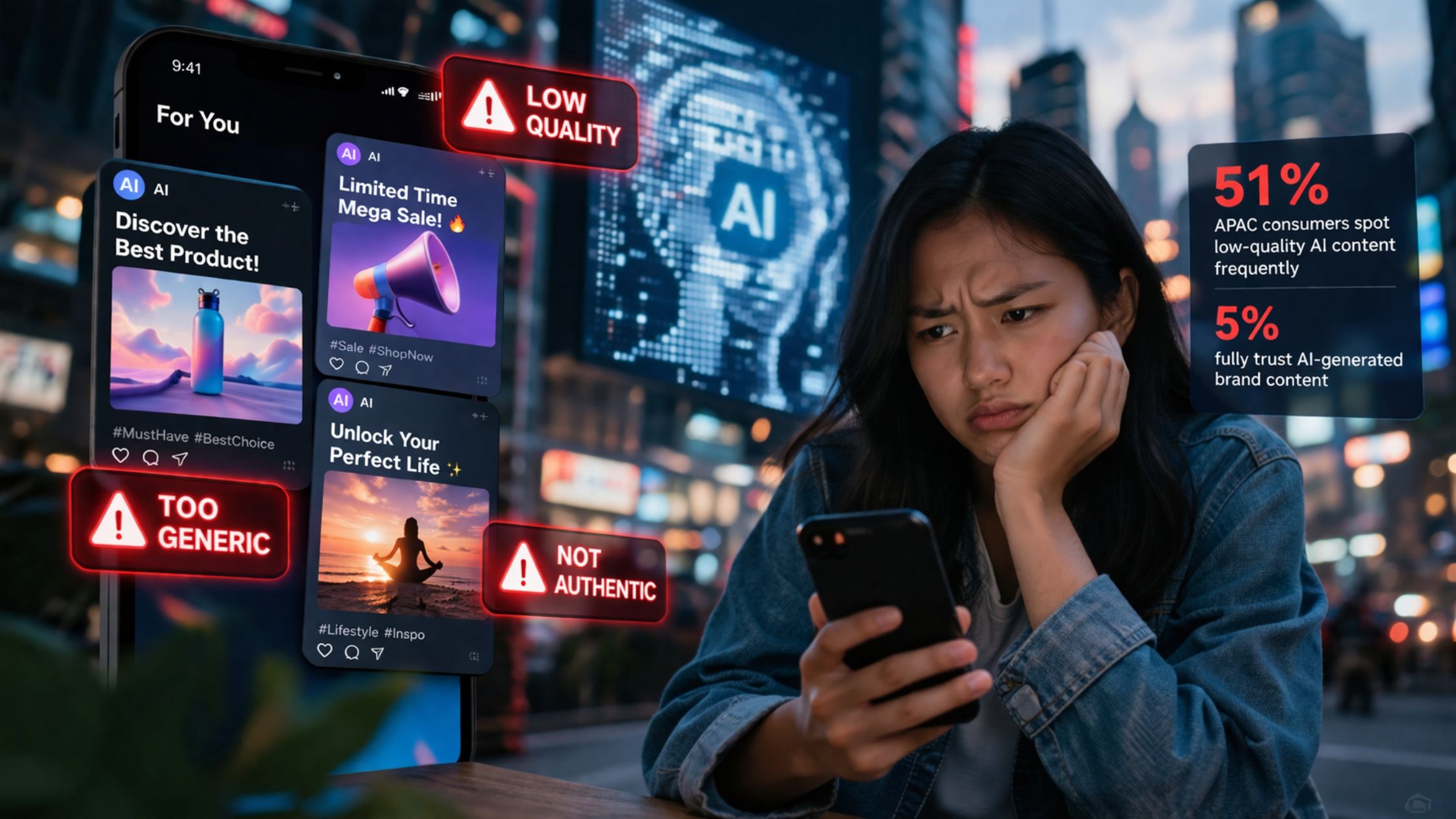
AI Content Is Everywhere—But Trust Is Breaking Down in APAC
 by
Byungho Lim
by
Byungho Lim

As consumers adopt AI faster than ever, a backlash against low-quality automation is forcing brands to rethink how they use it
Artificial intelligence has quickly moved from novelty to necessity in how consumers interact with brands. Across Asia-Pacific, it is now embedded in everyday decisions, from discovering products to comparing options and making purchases. But as its presence grows, so does a quieter, more complex shift: trust is beginning to erode.
A new report by Klaviyo captures this emerging contradiction. While consumers are using AI more frequently than ever, they are also becoming more critical of how it is used—particularly when it comes to brand communication. The result is not a rejection of AI itself, but a growing rejection of low-quality, automated content that feels impersonal and repetitive. This marks an important turning point. AI is no longer judged by its capability alone, but by the quality and intent behind its application.
The Rise of ‘AI Slop’
The term “AI slop” may sound informal, but it captures a serious issue. It refers to the growing volume of content generated quickly and cheaply using AI, often with minimal oversight or refinement.
In APAC, more than half of consumers say they frequently encounter such content. Over time, this exposure is changing how people interpret brand communication. It is not just that the content is low quality—it is that it signals low effort. When consumers repeatedly see generic captions, templated replies, or content that lacks nuance, they begin to associate it with a lack of care. The message may still be technically correct, but it feels detached. And in a digital environment where attention is already scarce, that perceived lack of effort becomes a liability.
This is where the real damage happens. Trust does not collapse suddenly—it erodes gradually. Each interaction that feels automated or generic reinforces the idea that the brand is not genuinely engaging, but simply operating at scale.
Why High Usage Is Leading to Higher Skepticism
What makes APAC particularly interesting is that skepticism is rising alongside adoption, not in opposition to it. Consumers in the region are among the most active users of AI globally. They rely on it to simplify decisions, explore options, and navigate increasingly complex digital environments. But this frequent exposure also makes them more aware of its limitations.
As people interact with AI tools more often, they develop a sharper sense of what feels authentic and what does not. They begin to notice patterns—repetitive phrasing, generic tone, lack of specificity. Over time, this familiarity leads to a more critical lens. This explains why trust in AI-generated brand content remains extremely low, even as usage continues to grow. Consumers are not rejecting AI—they are becoming more discerning users of it.
There is also a psychological shift at play. When AI is used as a tool to assist decision-making, it is perceived as helpful. But when it becomes the voice of a brand, expectations change. Communication is no longer just about information—it is about intent, personality, and connection. And this is where AI often falls short.
The ‘Sameness’ Problem and the Loss of Brand Identity
One of the more subtle but significant findings in the report is that a majority of consumers have mistaken human-written content for AI. This is not just a technical observation—it reflects a deeper structural issue in how content is being created. As more brands adopt similar AI tools and workflows, their outputs begin to converge. The same prompts, the same optimization techniques, and the same content strategies lead to a kind of uniformity. Over time, this creates a landscape where content feels interchangeable.
This “sameness” has two consequences. First, it weakens differentiation. If every brand sounds similar, it becomes harder for consumers to form a distinct impression of any one of them. Second, it blurs the line between human and machine-generated content. When even human-written content starts to follow predictable, AI-influenced patterns, authenticity becomes harder to signal—and even harder to recognize.
Marcus Rossato, Head of Marketing APJ at Klaviyo, highlights this shift:
“The honeymoon phase with AI is officially over for shoppers across Asia Pacific. Although consumers in the region lead the world in AI adoption, they have one of the highest bars for authenticity.”
He adds:
“For younger audiences and daily users, generic AI content isn’t just ineffective — it actively damages brand equity.”
This is a crucial point. The issue is no longer just about engagement metrics. It is about long-term brand perception.
AI Acceleration Meets Consumer Pushback
This growing skepticism is unfolding at a time when governments across the region are actively accelerating AI adoption.
Singapore, for example, has committed over S$1 billion to AI infrastructure, talent development, and deployment through its latest budget, alongside the creation of a National AI Council. Similar initiatives are being seen across other APAC markets.
On the surface, this suggests strong alignment between policy direction and technological progress. But at the consumer level, the picture is more complex.
As concerns around deepfakes, misinformation, and content farms increase, trust is becoming a central issue. The faster AI scales, the more visible its weaknesses become—not just technically, but socially.
This creates a tension that is likely to define the next phase of AI adoption in the region: how to balance rapid innovation with the need to maintain credibility and trust.
What Startups Need to Rethink About AI
For startups and growth-stage companies, the implications are immediate and practical. AI has become a powerful tool for scaling operations, particularly in marketing and customer engagement. It allows small teams to produce large volumes of content and respond quickly to user needs.
But the report suggests that this approach is reaching its limits.
The challenge is no longer access to AI—it is differentiation in how it is used. Startups that rely too heavily on automation risk blending into the background, producing content that is efficient but forgettable.
To adapt, companies need to rethink how they integrate AI into their workflows:
- Use AI to enhance thinking, not replace it
- Focus on context, specificity, and relevance in communication
- Maintain a clear and consistent brand voice, even when using automation
As Rossato puts it:
“The opportunity for brands in 2026 is not to scale content faster, but to scale usefulness.”
This shift from speed to substance may be uncomfortable, especially in environments that prioritize rapid growth. But it is becoming increasingly necessary. The APAC region is entering a more mature phase of AI adoption—one where enthusiasm is being replaced by evaluation. Consumers are no longer impressed by the presence of AI alone. They are asking whether it adds value, whether it feels authentic, and whether it reflects genuine intent.
For brands, this represents a deeper shift. AI is no longer just a tool for efficiency—it is a reflection of how a company chooses to communicate. In a digital environment saturated with automated content, the differentiator will not be how much a brand can produce, but how much it can resonate. Because in the end, trust is not built by technology. It is built by how that technology is used.
Quick Takeaways
- APAC consumers are using AI more—but trusting it less
High adoption is making users more aware of AI’s limitations, especially in brand communication. - “AI slop” is eroding brand trust
Low-quality, mass-produced content signals low effort, gradually weakening credibility. - The real problem is not AI—but how brands are using it
Consumers accept AI as a tool, but reject it when it replaces authentic brand voice. - Content is becoming indistinguishable—and that’s a risk
As outputs become more uniform, brands are losing differentiation and identity. - Trust is now the biggest challenge in AI-driven marketing
Scaling content without maintaining quality and intent is starting to backfire. - Startups must shift from volume to value
The next phase of AI adoption will reward relevance, context, and usefulness—not just speed. - APAC is entering a more mature phase of AI adoption
Consumers are no longer impressed by AI—they are evaluating it critically