AsiaTechDaily – Asia's Leading Tech and Startup Media Platform

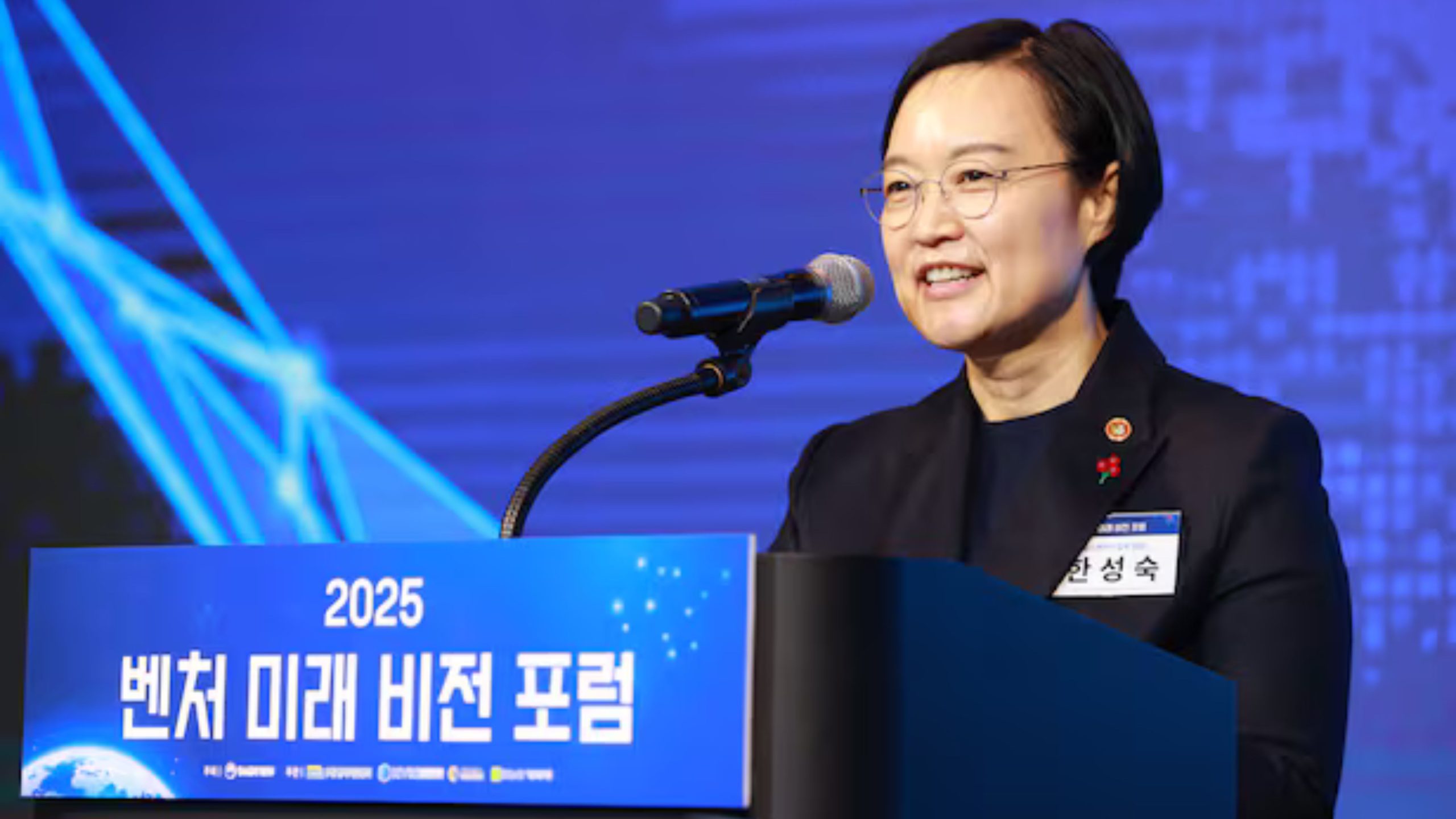
Korean Government Lays Out Startup Strategy as Venture Sector Marks Key Milestones
 by
by

The Ministry of SMEs and Startups mapped a policy agenda — GPUs, regional hubs, pay and venture-capital reform — to push Korea from strong startups to global tech champions. The challenge: execution, funding depth and talent retention.
On December 11 the Ministry of SMEs and Startups (MSS), led by Minister Han Seong-sook, convened the Venture Future Vision Forum at COEX to mark the 30th anniversary of Korea’s venture ecosystem and the 20th anniversary of the Mother Fund.
Speakers included domestic founders and overseas entrepreneurs — notably Jeong Se-ju of Noom — who described how startups actually scale and internationalise. The forum closed with a declaration committing participants to a 30-year vision for Korea as a venture nation, and the MSS signalled that near-term policy measures will follow.
The policy blueprint: four priority pillars
Minister Han’s roadmap — summarised under the label K-Big Tech — focused on four pillars:
- Expand AI infrastructure, especially access to high-performance GPUs.
- Build regional deep-tech hubs to decentralise innovation beyond Seoul.
- Create global-level compensation systems to retain and attract top engineers and founders.
- Strengthen the venture capital cycle so risk capital can flow reliably from seed to scale.
These pillars are a recognition that software or product ideas alone are not enough: hardware access, local ecosystems and incentives matter if Korea wants homegrown firms that can challenge global incumbents.
Why GPUs and infrastructure show up first
AI development is increasingly gated by compute. If governments want national champions in AI or other compute-heavy fields, easy access to high-performance GPUs — and the networks, data and facilities that surround them — becomes a public competitive asset. The ministry’s focus on GPUs is pragmatic: without large-scale compute, many promising projects stall or move overseas, taking talent and IP with them.
Regional hubs: decentralisation as strategy
The push for regional hubs aims to spread economic benefits and lower the concentration risk inherent in a single city ecosystem. If implemented well, regional hubs can tap local universities, manufacturing capabilities and cost advantages to nurture deep-tech startups that require labs, pilot facilities and longer development cycles — the very things Seoul’s service-centric ecosystem sometimes lacks.
Pay, mobility and the talent battle
Minister Han’s emphasis on global-level pay recognises a blunt market truth: top AI, semiconductor and systems engineers can choose employers globally. Korea competes not only with US and Chinese firms but also with other Asian tech clusters. Compensation is part of a package that includes career paths, ownership (equity), and easier cross-border mobility — all necessary to keep people and ideas in country.
Venture capital reform: what “virtuous cycle” means in practice
The MSS framed venture finance as a national growth engine. A “virtuous cycle” implies more than subsidies: it means clearer exit routes (IPOs, trade sales), diverse fund structures for different stages, and incentives for long-horizon capital that supports deep tech, not just fast consumer plays. The Mother Fund’s anniversary is symbolic — but real impact requires deeper private participation and ecosystem density.
The good signals — and the big unknowns
Positives: the forum’s format, explicit technology priorities, and visible buy-in from entrepreneurs create momentum. A policy program that listens to practitioners makes better sense than top-down declarations alone.
Open questions: How will MSS deliver GPU access at scale (procurement, cloud credits, shared facilities)? Will public-private investment reach the size and patient horizon deep tech needs? Can regional hubs avoid becoming underfunded poster projects? And crucially, how will compensation reform be implemented without destabilising existing firms or creating sudden wage inflation?
A pragmatic checklist for policymakers (brief)
- Create shared GPU pools (public-private compute centres) with subsidised access for strategic projects.
- Seed a small number of deep-tech manufacturing and lab hubs with clear KPIs and private co-investment.
- Reform tax/stock-option rules to enable founder and engineer equity that competes internationally.
- Encourage long-duration funds (venture and private credit) and clearer exit pathways to attract institutional LPs.
Conclusion — a necessary pivot, not a guarantee
The Venture Future Vision Forum was a useful inflection point: it turns conversation into a policy agenda and places hardware, talent and capital at the centre of Korea’s next-phase strategy. That clarity matters — but vision alone won’t create K-Big Tech. Execution will require coherent public investment, far deeper private capital, improved talent economics and fast, measurable pilots that prove the model. If Seoul can move from statements to concrete infrastructure projects, a few focused regional hubs, and finance reforms that actually channel long-term capital into deep tech, Korea’s startups will have a fighting chance to scale globally.
Quick takeaways
- The MSS framed a forward plan called “From Ventures and Startups to Unicorns: K-Big Tech” focused on four priorities: GPU access, regional deep-tech hubs, competitive compensation, and a healthier VC cycle.
- The forum adopted a “collective intelligence” format, pulling direct input from founders and international investors rather than a ceremony-style program.
- Key risks: delivering on infrastructure (GPUs), building manufacturing/scale pathways, attracting global talent, and aligning private capital for long-horizon deep tech bets.