AsiaTechDaily – Asia's Leading Tech and Startup Media Platform

Korea’s Big Startup Push: What the 40 KSGC Finalists Reveal About Asia’s Innovation Future
 by
by

From 2,626 applicants to 40 finalists, Korea’s flagship startup program is shaping a new entry path into the Asian market.
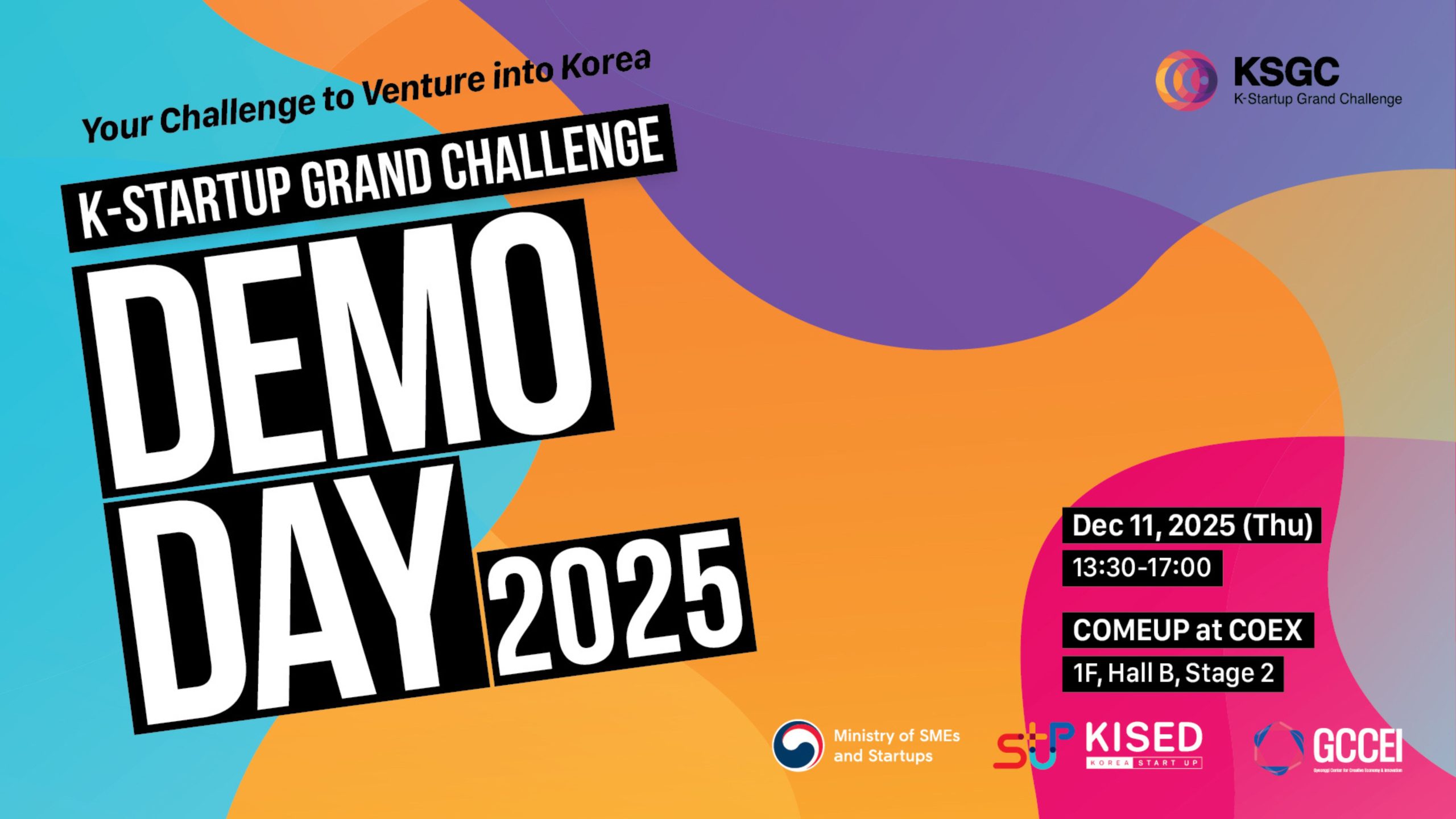
The K-Startup Grand Challenge (KSGC) 2025 is approaching its most significant milestone. On December 11, 40 global startups will take the stage at COEX Convention & Exhibition Center in Seoul for the program’s Demo Day—an event that will determine the 20 teams entering Phase 3 and the Top 8 that will be recognized through live pitching sessions. This moment marks the peak of a year-long selection process that began with global recruitment in April.
Unlike many accelerator demo days that focus solely on pitches, KSGC Demo Day sits at the intersection of public policy, international entrepreneurship, and Korea’s broader ambition to position itself as Asia’s next major innovation hub. This year, more than 2,626 applications from 97 countries flowed into the program, demonstrating intense global interest in Korea as a launchpad into the region.
A Funnel Designed for Serious Founders
KSGC’s structure reveals Korea’s shift from a welcoming ecosystem to a selective gateway. From the massive global pool, 80 teams moved into Phase 1 for online market exploration, which acted as a first filter for commitment and relevance. Later, 40 teams progressed to Phase 2, engaging directly in Korea-focused acceleration, market entry preparation, and business validation.
The Demo Day is where this process becomes decisive. The 20 teams advancing to Phase 3 will receive deep, full-scale support to strengthen operations and establish a market presence in Korea.
As Paul Kwon, Global Business Team Lead at GCCEI, explains:
“The teams reaching Demo Day have undergone months of preparation and validation. They’ve proven not only technological innovation but also a strong understanding of the Korean market.”
His comment highlights that this program is no longer only about innovative ideas—it is about founders who demonstrate real market fit and readiness to enter Asia through Korea.
What This Year’s Cohort Reveals About Korea’s Priorities
The 40 finalists span deep tech, AI, healthcare, sustainability, and advanced manufacturing. Together, they form a signal about where Korea believes future value will be created.
AI as Infrastructure, Not Hype
A significant share of startups integrate AI into core operational challenges—from predicting industrial equipment failures to automating sales workflows and enabling natural-language enterprise automation. Startups like Groundup.AI, Workist, Markopolo AI, PIX FORCE, and Metroo reflect a new trend: AI used not as a standalone product, but as a foundation for solving real business problems.
Deep Tech and Materials for the Next Industrial Shift
Companies such as CMMC, Hanjing Semi, and nanoCaps show Korea’s continued alignment with advanced manufacturing and semiconductor development. These areas remain central to the nation’s industrial strategy, and the presence of such startups in KSGC signals that deep tech still matters in a world dominated by software narratives.
Healthcare and Aging—A Natural Match for Korea
With Korea aging rapidly, it is no surprise that medtech and healthcare startups form a strong group this year. Solutions include AI-driven cancer diagnostics, elderly support systems, affordable rehabilitation devices, modular diagnostics labs for rural areas, and tools for managing food allergies. These innovations directly address pressing demographic and public-health challenges.
Climate and Sustainability as Rising Themes
Another notable trend is the strong representation of sustainability-focused startups. Teams working on circular materials, carbon-negative pallets, bio-fertilizer from waste, and environmental sensing technologies highlight Asia’s shifting policy and market priorities around climate resilience.
Cybersecurity, Identity, and Web3 Infrastructure
Startups like CyStack, Peris.ai, Trust Stamp, and RedMimicry reflect the region’s growing need for secure digital infrastructure. Their presence reinforces the idea that innovation requires trust, resilience, and modern identity frameworks.
Finalist Startups (Alphabetical List)
Here are the 40 companies presenting at KSGC Demo Day:
| Startup | Description |
|---|---|
| Acurion | AI detecting genomic markers for precise, efficient cancer diagnosis |
| ArbaLabs | Securing AI at the edge for aerospace & critical infrastructure with sovereign trusted tech |
| AvoLabs | AI-driven B2B EdTech tools delivering personalized learning and automation |
| BION | LEO™ Gluten Sensor helping manage gluten intolerance with simple food-allergy detection |
| CyStack | Cybersecurity firm offering innovative, research-driven security solutions |
| CMMC | Lightweight structural material combining aluminum and ceramic performance |
| Digital Human Corporation | Human-centric AI with KAi, an empathetic digital companion for elderly support |
| Edsy | AI English coach enhancing classrooms with personalized practice and tailored scaffolding |
| Exoheal | Accessible, affordable hand-paralysis rehabilitation device |
| Groundup.AI | AI asset management using sensors and agents to predict equipment failures early |
| Hanjing Semi | Quartz and SiC semiconductor components with high-quality, reliable manufacturing |
| IDOLL Robotics | Emotionally intelligent robot that sees, feels, and grows with users |
| InsightMatches | AI SaaS platform automating and accelerating global research and innovation matching |
| Konnect | Super-app for foreigners integrating search, bookings, payments, and verification |
| Lasarkaali Life Sciences | Clinically proven dental nutrition products reducing pain and recovery time |
| MaimHaim | AI geofencing that auto-activates location-based services at venues and facilities |
| Markopolo AI | AI automation platform personalizing engagement via SMS, email, push, WhatsApp, and more |
| Metroo | AI-powered cloud development studio with integrated hosting and deployment |
| nanoCaps | CNT-based energy storage delivering extreme power, high density, and rapid response |
| Niio | Platform turning any screen into a digital art canvas streaming curated global art |
| Oreyeon LDA | AI digital tools improving airport safety inspections and operational processes |
| Parongpong RAW Lab | Converts residual waste into durable, lightweight sustainable building materials |
| Patientory | Web3 health platform enabling secure management and sharing of personal medical data |
| Peris.ai | AI orchestration platform detecting and responding to cyber threats in real time |
| Pierrot Company | IT device subscription and IT recovery service |
| PIX FORCE | Computer vision transforming images into actionable insights for safer operations |
| Predulive Labs | AI infrastructure analytics detecting defects and compliance issues in real time |
| Prometheus MedTech.AI / UES | AI-powered UES tech enabling early diagnosis of congenital heart defects |
| Protein Kapital | Sustainable alternative protein & bio-fertilizer produced using insects and food waste |
| RedMimicry | Safe malware simulation platform for enterprise cybersecurity training |
| RIFFAI | AI sensing technology monitoring environmental changes and pollution |
| Shanghai Yixiao Information Technology | AI agent enabling enterprise apps to execute via natural language |
| Smart Contract | Automated smart contract workflows simplifying document and identity processes |
| TaggIoT | Smart Tag IoT sensors and analytics improving safety and efficiency in shipping |
| 3TGDS | Travel Trust Tickets enabling instant redemption across global travel & lifestyle services |
| Trust Stamp | AI identity technologies reducing fraud while protecting privacy |
| Umami Bioworks | AI-powered biotech platform creating next-generation marine ingredients and seafood |
| Vyuhaa Med Data | AI-native modular diagnostics lab enabling early cancer detection in rural communities |
| Veritas Vietnam | Turns agricultural waste into carbon-negative pallets replacing wood and plastic |
| Workist | AI agent automating sales documents from inbox to ERP across formats and languages |
COMEUP 2025: The Event That Multiples Every Opportunity
This year, Demo Day is embedded inside COMEUP 2025, Korea’s largest global startup festival taking place from December 10–12. The festival’s theme—“Recode the Future”—reflects the innovative focus of this year’s KSGC cohort.
Beyond the stage, COMEUP acts as a deal-flow engine. It converts startup pitches into real-world partnerships, funding discussions, and collaborations with Korea’s corporate giants.
A Bigger, Equity-Free Package Signals a Strategic Commitment
The 2025 edition marks the 10th anniversary of the K-Startup Grand Challenge, and Korea is celebrating it with a major upgrade. The program now offers an expanded equity-free support package of up to ₩950 million (US$633,000)—one of the most generous funding structures offered by any government-backed startup program worldwide.
Unlike many accelerators that require startups to give up equity in exchange for funding or support, KSGC allows founders to maintain full ownership. This is a strong signal of trust: Korea wants startups to grow locally, without forcing them to dilute their companies at an early stage.
The upgraded support is not just financial. The 20 Phase 3 teams will gain access to deeper, hands-on assistance that goes far beyond typical acceleration. This includes:
- Customized market-entry guidance based on their industry
- Support with regulatory navigation, which is often the biggest barrier for foreign founders
- Introductions to local corporate partners for pilots, procurement, and co-development
- Connections to investors looking specifically for foreign startups with Korean market potential
- Resources to help secure early customers in Korea
Together, this package shows that Korea is not aiming to host global startups temporarily. Instead, it is building the conditions for them to set up, grow, and expand into the broader Asian market. The message is clear: Korea wants to be a long-term partner, not just a stop on a demo day circuit.
Backed by Korea’s Strongest Innovation Institutions
Behind the K-Startup Grand Challenge is a coordinated network of national and regional institutions that have shaped the program into Korea’s leading global startup gateway. The initiative is hosted by the Ministry of SMEs and Startups (MSS), the country’s primary government body responsible for nurturing innovation and entrepreneurship. It is organized by the Korea Institute of Startup & Entrepreneurship Development (KISED), which oversees policy implementation and founder support programs across the nation. On the ground, the program is operated by the Gyeonggi Center for Creative Economy & Innovation (GCCEI), a key regional innovation hub that works directly with founders, mentors, and corporate partners.
This combined structure—national policy leadership, centralized program management, and regional execution—gives KSGC both scale and depth. Since its launch, the program has supported more than 1,000 global startups, helping many of them build partnerships, enter the Korean market, and expand across Asia. Over the past decade, this multi-institutional support system has cemented KSGC’s reputation as Korea’s premier landing program for international founders looking to grow in the region.
What Demo Day Really Represents
KSGC 2025 Demo Day represents more than a showcase—it marks a turning point in how Korea engages with the global startup community. The 40 finalists demonstrate that Korea is no longer positioning itself as a supporting ecosystem, but as a strategic launchpad for founders who want to serve markets across Asia. With strong government backing, equity-free funding, deep-tech investment, and exposure through COMEUP, Korea is building one of the most structured pathways for international founders looking for fast, credible market entry. Whether Korea becomes the region’s preferred base will depend on how these startups grow after Demo Day—but the momentum and intent are unmistakably in Korea’s favor.
Quick Takeaways
- 40 global startups selected from 2,626 applicants across 97 countries will pitch at KSGC 2025 Demo Day.
- 20 teams will advance to Phase 3, with Top 8 finalists chosen through live pitching sessions.
- Finalists cover key sectors including AI, deep tech, healthcare, sustainability, cybersecurity, and advanced manufacturing.
- Demo Day is embedded within COMEUP 2025, giving startups exposure to investors, corporates, and global media.
- The program marks its 10th anniversary with a redesigned hybrid model and ₩950 million (US$633k) equity-free support.
- Hosted by MSS, organized by KISED, and operated by GCCEI, KSGC has supported over 1,000 global startups to date.
- Korea is positioning itself as a strategic entry point for global founders expanding into the Asian market.
Similar Articles